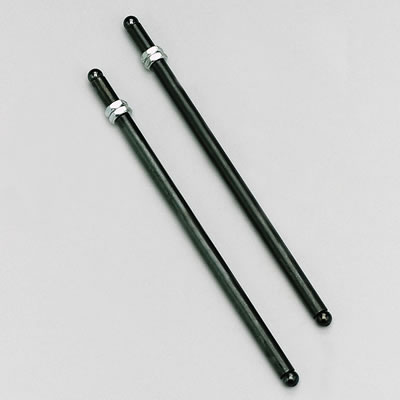
valvetrain loose? what could it be...

thanks for the reply as it clarified that alot for me. and as of right now i can not even load the pushrod. the rocker even at 20 lbs torque is not touching the pushrod. there is still slack in between them as shown in the video i posted.

and i am sorry for making assumptions or jumping the gun on this im just confused as what it could be.
 
Ok, let's fix your problem. I think based on the information from you so far, that this is not likely a lifter or cam damage problem, but an improper valvetrain adjustment problem.

If I were in your shoes right now, this is what I would do, step-by-step:

1. Remove all of your rocker arms. If you don't have a valvetrain organizer tray to place your rockers in
s107.jpg
, than lay them out on something clean, in an ordered way so put them back on the same valve stem tips later. If you don't want to remove your rocker arms, you don't have to, it isn't totally necessary. You can loosen them up enough to turn them to the side so you can slide the pushrods out. It may not hurt to remove the rocker arms however, to inspect them for damage.

2. Remove all of your pushrods. Based off of what you've said, I'm confident that you have incorrect length pushrods. You will most likely not reuse these.

3. Purchase a pushrod length checker tool
crn-99726-2.jpg
, if you don't already have one

4. Turn the motor over by hand (a 1/2" wrench and 15/16" socket work fine for this). Pick a cylinder (for simplicity, start with Cylinder #1, aka. passenger side front) and while turning the motor over, watch the intake and exhaust lifters for that cylinder. Continue turning the motor over until both lifters bottom out in the lifter bores, and are as low as they can go.

5. With the adjustable pushrod length checker installed between one of those lifters and the pushrod seat in the rocker arm body, twist the pushrod length checker until you have contact between both the lifter's pushrod seat and the rocker arm's pushrod seat. Then remove the checking pushrod and measure it's length, preferably with a set of calipers that can make that long of a reading.

5 Special Note: In an ideal world, you would also check valvetrain geometry at the same time, with the adjustable pushrod length checker. However, this would require that you remove a valve spring and replace it with a checking spring designed for this. Remember in my last post how I described checking valvetrain geometry with a sharpie marker and looking at the witness mark? The most correct way to do this when using an adjustable pushrod length checker to check for correct pushrod length is to install a checking spring (notice that it is a very thing single spring, which puts very little pressure on the seat) and turn the motor over with the checking pushrod.
adj22.jpg
You MUST NOT attempt to turn the motor over using the checking pushrod on a REAL VALVE SPRING. This will surely damage or break the checking pushrod. Knowing that your cylinder head is on the motor, and it would probably be a major PITA for you to do this, what you may want to do instead is order a few pushrods around the length that you determined with your checking pushrod in step 5. For example, you could order a pushrod as close to the height you measured as possible, and another pushrod of that height +.050", and another one of that height -.050". The purpose of that would be to allow you to use those pushrods to turn the motor over with your REAL valve springs, checking the size and location of the witness mark on the valve stem tip. The pushrod length that got you the narrowest witness mark on the center of the tip would be the one you ordered the complete set of pushrods for.

6. Once you have the correct pushrod length and verified correct valvetrain geometry, follow the instructions at the following link. Remember, when you install pushrods and pedestal mount rocker arms, you need to do it ONE CYLINDER AT A TIME. Both lifters need to be in the bottom of their bores for that cylinder before you torque the rocker arms to spec. There are a TON of people on these boards that make the huge mistake of torquing all of the rockers to "spec" at the same time, without turning the motor over ensuring the lifters for each cylinder are in the bottom of their bores one cylinder at a time. That is a guaranteed recipe for noise and wear and lost power.

Link for instructions to installing rocker arms once you have correct length pushrods:

http://www.cranecams.com/pdf/453e.pdf
 
thank you all for the help. i could not have asked for a more detailed and simplified method.

i guess while we are on the subject do you recomened any particular brand of adjustable pushrods? or the correct length rods after i get all the proper lengths?
 
No, I have no particular recommendation on the tool brand. Adjustable length pushrods are available from Comp, Crane, Jesel, etc. Almost any cam or valvetrain company sells them. They are a simple tool, so quality or brand is not too much of an issue.

Similarly, on the actual pushrod, you can order custom length sets from Comp, Crane, Jesel, etc, etc. Comp Magnum and Comp Hi-Tech pushrods are nice, I believe all of those are one piece (as opposed to the multi-piece, ball ends). Stick with the 5/16" diameter for your build.
 
should all of my rods be the same length?

what i gathered from this they should be and the ones that are to long i should shim the rocker up to accomidate for them. am i close on my "assumption":D or should i get adjustable ones to cater to each rocker?
 
they make rockers that have adjustable pushrod cups they are really no easier to use just get a checker check length and get a good set of pushrods shim em' if necessary. how much noise u got!!!

its horrindous. its extremly noticable. i just figured i could get some shaft mount rockers and they would do the same thing anyways. i want to get a set of roller rockers anyways.
 
should all of my rods be the same length?

what i gathered from this they should be and the ones that are to long i should shim the rocker up to accomidate for them. am i close on my "assumption":D or should i get adjustable ones to cater to each rocker?

It is possible for pushrods to vary in length from cylinder to cylinder, depending on factors such as the flatness of the head deck, etc. However, that would be a very minute difference from cylinder to cylinder.

But, that is opening up a huge can of worms that you DON'T need to deal with right now. Your problem is that you have a gross/excessive incorrect pushrod size, worry about fixing that.

Why are you thinking about shaft rockers? Do you really want to spend between $400-$900 on a shaft rocker setup when you're problem could most likely be solved for less than $100 with new pushrods and a length checker?

Some more food for thought. Shaft rockers have lash adjusters, but even last adjusters can't compensate for pushrods that are too short or too long. You will still run into the problem of needing proper pushrods.

Also, your stock valve covers will NOT fit over a shaft rocker setup, no matter how thick of a gasket you use or even if you remove the oil baffle from the driver side cover under the oil fill neck. Shaft rockers on your 5.0 would require tall valve covers, which would require at the least a spacer for your upper to lower intake, which in extreme cases could cause hood to upper intake interference and require something like a cowl hood to clear.

How much money do you want to spend here?
 
i just reamoved my rockers and rods and all of my pushrods are the exact same length. i only had one that was a littel different and it wasnt one of the rods/ rockers that was giving me a problem.

does this affect anything?
 
i just reamoved my rockers and rods and all of my pushrods are the exact same length. i only had one that was a littel different and it wasnt one of the rods/ rockers that was giving me a problem.

does this affect anything?

Of course all of your old pushrods will be the same length, the same incorrect length. This doesn't change anything.

I so terribly wish you lived within a hundred miles of me, I would have fixed this myself for you in the time it takes me to type one of these responses.

P.S.

One last thought. It is possible that these pushrods COULD be close to the correct length, read on. All of the slop in your valvetrain COULD be accounted for if they were not installed properly. Can you confirm that you followed the same type of procedure specifically outlined in that Crane .pdf link I provided a couple posts ago? If you in fact are sure that you torqued the rockers to spec one cylinder at a time, with each set of lifters bottomed out in their lifter bores, than you can ignore this whole P.S......your pushrods would be the wrong length.
 
then why are some of the rockers snuggin up fine? if they are all the same length would all the rockers have slack in them? what would cause them to wiggle around like they do when the others are secure.

i even tried to swap some of the rockers around to see if it was rocker specific related.

i guess what im trying to say is why do those select rockers have play in them and not the others? what singles them out?
 
then why are some of the rockers snuggin up fine? if they are all the same length would all the rockers have slack in them? what would cause them to wiggle around like they do when the others are secure.

i even tried to swap some of the rockers around to see if it was rocker specific related.

i guess what im trying to say is why do those select rockers have play in them and not the others? what singles them out?

At this point I don't know. That's why I really think the best thing you can do is start from scratch, that way there are no unkowns. Right now there are way too many unkown factors. Too much maybe, not enough facts.

The bare simple solution equation to your valvetrain problems are:

1. Verify correct pushrod length
2. Verify proper valvetrain geometry
3. Verify correct hydraulic lifter preload

If you can do those three things, all of your valvetrain problems should disappear. You've got the knowledge and the resources, now you just need a tool or two...
 
then why are some of the rockers snuggin up fine? if they are all the same length would all the rockers have slack in them? what would cause them to wiggle around like they do when the others are secure.

i even tried to swap some of the rockers around to see if it was rocker specific related.

i guess what im trying to say is why do those select rockers have play in them and not the others? what singles them out?

I just realized, you still didn't answer a very important question.

I need to know if you did or didn't do this:

Did you turn the motor over by hand so that one cylinder's lifters were both in the bottom of their bores, and then torqued down those cylinder's rockers only. Then, turn the motor over by hand again until the next cylinder's lifters were both in the bottom of their bores, and then torqued those cylinder's rockers only.


YES or NO
 
I just realized, you still didn't answer a very important question.

I need to know if you did or didn't do this:

Did you turn the motor over by hand so that one cylinder's lifters were both in the bottom of their bores, and then torqued down those cylinder's rockers only. Then, turn the motor over by hand again until the next cylinder's lifters were both in the bottom of their bores, and then torqued those cylinder's rockers only.


YES or NO

YES
 
Ok, well, than there is no apparent/easy explanation for why some rockers are loose and others are not.

The reason why I went all big and bold asking that last question, was I was actually hoping you just torqued all the rockers down without ensuring the cam lobes were on their base circle. It would explain why some rockers are tight and others loose, because some rockers would have been torqued at mid lift, some at full lift, some on the base circle, and so on. It would have been a total crapshoot.

Oh well, after you're through with this you'll be a valvetrain guru :nice:
 
Ok, well, than there is no apparent/easy explanation for why some rockers are loose and others are not.

The reason why I went all big and bold asking that last question, was I was actually hoping you just torqued all the rockers down without ensuring the cam lobes were on their base circle. It would explain why some rockers are tight and others loose, because some rockers would have been torqued at mid lift, some at full lift, some on the base circle, and so on. It would have been a total crapshoot.

Oh well, after you're through with this you'll be a valvetrain guru :nice:

thats what is confussing me. if the rods are on the base circle they should still make contact right?