Ok, let's fix your problem. I think based on the information from you so far, that this is not likely a lifter or cam damage problem, but an improper valvetrain adjustment problem.
If I were in your shoes right now, this is what I would do, step-by-step:
1. Remove all of your rocker arms. If you don't have a valvetrain organizer tray to place your rockers in
, than lay them out on something clean, in an ordered way so put them back on the same valve stem tips later. If you don't want to remove your rocker arms, you don't have to, it isn't totally necessary. You can loosen them up enough to turn them to the side so you can slide the pushrods out. It may not hurt to remove the rocker arms however, to inspect them for damage.
2. Remove all of your pushrods. Based off of what you've said, I'm confident that you have incorrect length pushrods. You will most likely not reuse these.
3. Purchase a pushrod length checker tool
, if you don't already have one
4. Turn the motor over by hand (a 1/2" wrench and 15/16" socket work fine for this). Pick a cylinder (for simplicity, start with Cylinder #1, aka. passenger side front) and while turning the motor over, watch the intake and exhaust lifters for that cylinder. Continue turning the motor over until both lifters bottom out in the lifter bores, and are as low as they can go.
5. With the adjustable pushrod length checker installed between one of those lifters and the pushrod seat in the rocker arm body, twist the pushrod length checker until you have contact between both the lifter's pushrod seat and the rocker arm's pushrod seat. Then remove the checking pushrod and measure it's length, preferably with a set of calipers that can make that long of a reading.
5 Special Note: In an ideal world, you would also check valvetrain geometry at the same time, with the adjustable pushrod length checker. However, this would require that you remove a valve spring and replace it with a checking spring designed for this. Remember in my last post how I described checking valvetrain geometry with a sharpie marker and looking at the witness mark? The most correct way to do this when using an adjustable pushrod length checker to check for correct pushrod length is to install a checking spring (notice that it is a very thing single spring, which puts very little pressure on the seat) and turn the motor over with the checking pushrod.

You MUST NOT attempt to turn the motor over using the checking pushrod on a REAL VALVE SPRING. This will surely damage or break the checking pushrod. Knowing that your cylinder head is on the motor, and it would probably be a major PITA for you to do this, what you may want to do instead is order a few pushrods around the length that you determined with your checking pushrod in step 5. For example, you could order a pushrod as close to the height you measured as possible, and another pushrod of that height +.050", and another one of that height -.050". The purpose of that would be to allow you to use those pushrods to turn the motor over with your REAL valve springs, checking the size and location of the witness mark on the valve stem tip. The pushrod length that got you the narrowest witness mark on the center of the tip would be the one you ordered the complete set of pushrods for.
6. Once you have the correct pushrod length and verified correct valvetrain geometry, follow the instructions at the following link.
Remember, when you install pushrods and pedestal mount rocker arms, you need to do it ONE CYLINDER AT A TIME. Both lifters need to be in the bottom of their bores for that cylinder before you torque the rocker arms to spec. There are a TON of people on these boards that make the huge mistake of torquing all of the rockers to "spec" at the same time, without turning the motor over ensuring the lifters for each cylinder are in the bottom of their bores one cylinder at a time. That is a guaranteed recipe for noise and wear and lost power.
Link for instructions to installing rocker arms once you have correct length pushrods:
http://www.cranecams.com/pdf/453e.pdf


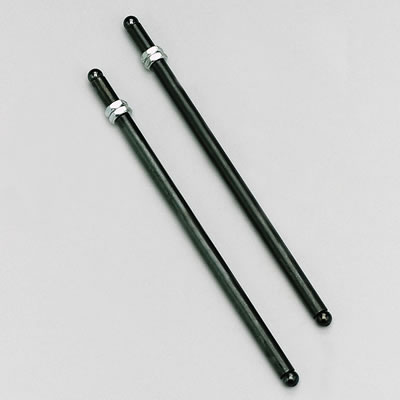
 or should i get adjustable ones to cater to each rocker?


