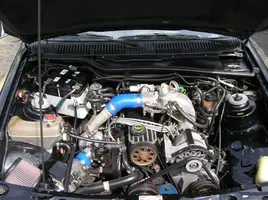
Turbo 4 cylinder vs a stock 5.0

Most well tuned H/C/I 5.0’s should actually get better mileage than a stock 5.0, assuming the cam isn’t overly aggressive. With the better flowing combo comes a higher VE of the engine itself. One thing to keep in mind is that many running a n/a h/c/I package are also running a numerically higher gear ratio (often 3.73’s or higher). The gears can have a huge impact on fuel economy.

My 5.0 gets an average of 24mpg on the freeway….and can get upwards of 28mpg if I really baby it. :nice:

Well V.E. is actually more of a measurement in making power although I do know it can be applied loosely to an engines overall perfromance to some degree. The bottom line is you will always have more overlap in a decent n/a performance cam and this will always yield worse mileage overall.
For instance listening to a performance cam at idle. Im sure you know that rough bumpity bump is actually slight misfires and you will generally have a good amount of fuel smell with a decent cam which is wasted fuel. So theres a huge loss of efficiency right there. And if you make an engine able to make more power higher in the rpm range (which is how you get the extra power from the increased flow of the new parts) its efficiency will always suffer down low. This is just common sense.
But anyway im not going to shoot ducks with you here. I have done many HCI set-ups in my years working at perfromance shops and have yet to have a customer come in and say "hey I actually have better mileage than before". It just rarely works out that way.
And your point of gears is a valid one. Although most people do gears before they do anything else. I do have to say Im having a hard time with 28 mpg with a hci 5.0 especially considering you probably also have gears. But I cant prove you wrong so thats all Ill say on that.
I will say this. If someone wants to do a 2.3 turbo car for mileage and they think it will get a ton better than a comparable 5.0 then your kind of wasting your time. Will a stock 2.3 turbo car with the boost turned up, a front mount, and exhaust get better mileage than a 5.0 that can keep up with you? Without a doubt. Will the difference be life changing? Not at all.
 
Well V.E. is actually more of a measurement in making power although I do know it can be applied loosely to an engines overall perfromance to some degree. The bottom line is you will always have more overlap in a decent n/a performance cam and this will always yield worse mileage overall.
For instance listening to a performance cam at idle. Im sure you know that rough bumpity bump is actually slight misfires and you will generally have a good amount of fuel smell with a decent cam which is wasted fuel. So theres a huge loss of efficiency right there. And if you make an engine able to make more power higher in the rpm range (which is how you get the extra power from the increased flow of the new parts) its efficiency will always suffer down low. This is just common sense.
But anyway im not going to shoot ducks with you here. I have done many HCI set-ups in my years working at perfromance shops and have yet to have a customer come in and say "hey I actually have better mileage than before". It just rarely works out that way.
And your point of gears is a valid one. Although most people do gears before they do anything else. I do have to say Im having a hard time with 28 mpg with a hci 5.0 especially considering you probably also have gears. But I cant prove you wrong so thats all Ill say on that.
I will say this. If someone wants to do a 2.3 turbo car for mileage and they think it will get a ton better than a comparable 5.0 then your kind of wasting your time. Will a stock 2.3 turbo car with the boost turned up, a front mount, and exhaust get better mileage than a 5.0 that can keep up with you? Without a doubt. Will the difference be life changing? Not at all.

An engines "VE" is typically in reference to the overall efficiency of the engine itself. Of course, typically with more efficiency comes more power.

Again, the assumption was...without an overly aggressive cam. Regardless, even with a tad more overlap...it's not going to be detrimental to fuel economy during load. Sure....at idle it may not be quite as efficient,but at a steady state under load it certainly can be.

As for my setup...it's not an uncommon one. 3.27 gears and a decent tune go a long way in regards to freeway fuel economy.
 
With the research sunk into the crop of today’s modern dual pattern grinds that are now available, the days of "lumpity-lump" and terms like "3/4 lift cam" have gone the way of the dinosaur. It actually really easy to build an engine with smooth idle, clean emissions and a nice dose in horsepower without a bumpy idle and raw fuel pouring out the tail pipes now a days.

Of course with more air, comes the need for more fuel....but as millhouse stated, moderate power levels (into the 300rwhp + range) for a 302W are not uncommon while still maintaining stock like drivability, efficiency and fuel economy.

While I also agree that power adder cars have the distinct advantage of maintaining stock like emissions and fuel economy levels under vacuum, running around in a small displacement turbo I-4, with enough turbo to run efficiently into the 20psi+ range is going to have a detrimental effect on drivability. In which case you can either suffer through the “lag” and diminished low end characteristics experience during normal driving and live with it, or start becoming a lot more aggressive with the throttle, anticipating boost levels and suffering the drastic loss in fuel economy because of it.

The ONLY way IMO to salvage off idle and low end response....and therefore drivability in a small displacement turbo charged engine when drastically its breathing capabilities is to either A) increase displacement, or B) incorporate some form of positive displacement style supercharger into the mix.

This is one of the many reasons I am a fan of compound boost applications (dual power adder). You get the best of both worlds while still maintaining great drivability, emission levels and economy under normal and even spirited driving circumstances, yet are still able to pull the trigger and rip your ears off at will!
 
Here's a coupe pics of mine:
P4260037-1.webp


Before the ghetto intercooler:
enginebayafter.webp
.

very cool, ide love to have one
 

Attachments

  • P4260037-1.webp
    P4260037-1.webp
    115.4 KB · Views: 184
  • enginebayafter.webp
    enginebayafter.webp
    107.2 KB · Views: 166
With the research sunk into the crop of today’s modern dual pattern grinds that are now available, the days of "lumpity-lump" and terms like "3/4 lift cam" have gone the way of the dinosaur. It actually really easy to build an engine with smooth idle, clean emissions and a nice dose in horsepower without a bumpy idle and raw fuel pouring out the tail pipes now a days.

Of course with more air, comes the need for more fuel....but as millhouse stated, moderate power levels (into the 300rwhp + range) for a 302W are not uncommon while still maintaining stock like drivability, efficiency and fuel economy.

While I also agree that power adder cars have the distinct advantage of maintaining stock like emissions and fuel economy levels under vacuum, running around in a small displacement turbo I-4, with enough turbo to run efficiently into the 20psi+ range is going to have a detrimental effect on drivability. In which case you can either suffer through the “lag” and diminished low end characteristics experience during normal driving and live with it, or start becoming a lot more aggressive with the throttle, anticipating boost levels and suffering the drastic loss in fuel economy because of it.

The ONLY way IMO to salvage off idle and low end response....and therefore drivability in a small displacement turbo charged engine when drastically its breathing capabilities is to either A) increase displacement, or B) incorporate some form of positive displacement style supercharger into the mix.

This is one of the many reasons I am a fan of compound boost applications (dual power adder). You get the best of both worlds while still maintaining great drivability, emission levels and economy under normal and even spirited driving circumstances, yet are still able to pull the trigger and rip your ears off at will!

Havent put a cam into many 302s have you? It also doesnt sound like you have a whole lot of experience with turbos either. Its not hard to have little to no lag if you size your turbo correctly and have a good overall designed system. You can actually have no lag at all if you want to run an auto with a converter.


Millhouse:
Volumetric efficiency in internal combustion engine design refers to the efficiency with which the engine can move the charge into and out of the cylinders. More correctly, volumetric efficiency is a ratio (or percentage) of what volume of fuel and air actually enters the cylinder during induction to the actual capacity of the cylinder under static conditions. Therefore, those engines that can create higher induction manifold pressures - above ambient - will have efficiencies greater than 100%. Volumetric efficiencies can be improved in a number of ways, but most notably the size of the valve openings compared to the volume of the cylinder and streamlining the ports. Engines with higher volumetric efficiency will generally be able to run at higher speeds (commonly measured in RPM) and produce more overall power due to less parasitic power loss moving air in and out of the engine.
 
Gearbanger not for nothing,if you properly size a turbo, the horrendous lag that you speak of should be minimal,especially how turbo technology is coming around.Back in the 80s and 90s ,yep people where throwing on tractor trailer turbos and wondering why they werent spooled up until 6000 rpm.Dont get all crazy now ,i am not attacking you,just like the 3/4 race cams,turbos have really come along in drivabilty .Heck guys are driving around with blo-thru carbd cars that drive almost as good as a fuel injected car.AGAIN I AM NOT FLAMING YOU.LOL
 
Millhouse:
Volumetric efficiency in internal combustion engine design refers to the efficiency with which the engine can move the charge into and out of the cylinders. More correctly, volumetric efficiency is a ratio (or percentage) of what volume of fuel and air actually enters the cylinder during induction to the actual capacity of the cylinder under static conditions. Therefore, those engines that can create higher induction manifold pressures - above ambient - will have efficiencies greater than 100%. Volumetric efficiencies can be improved in a number of ways, but most notably the size of the valve openings compared to the volume of the cylinder and streamlining the ports. Engines with higher volumetric efficiency will generally be able to run at higher speeds (commonly measured in RPM) and produce more overall power due to less parasitic power loss moving air in and out of the engine.

No argument from me....although you more or less just expanded on the point I was making. :nice:
 
Havent put a cam into many 302s have you? It also doesnt sound like you have a whole lot of experience with turbos either. Its not hard to have little to no lag if you size your turbo correctly and have a good overall designed system. You can actually have no lag at all if you want to run an auto with a converter.
Why is that....because I don't believe you need to have a lumpy idle or a pile of overlap in order to make decent power? If you think the only cars that make power are the ones with rough idle, I think it’s your credibility that needs to be held in question, not mine? :shrug:

As far as the turbo lag issue goes....yeah, yeah....I've heard it all before. But I have yet to see turbo lag eliminated altogether. Not to mention the same "properly sized" tubo's that many generally utilize in order to spool quickly and reduce lag aren't the same ones that churn out big horsepower numbers. I have yet to see a single turbo set up that does both.....especially on a 2.3L I4. And running an auto with a converter is fine if going from a dead punch stop is all you're doing, but low speed merges and on and off the throttle driving still results in the dreaded "dead spot". And lets be honest....your fuel economy is going to suffer as a result. You want to prove me wrong....lets see some dyno figures of turbo 2.3L power curves. Even when run on the conservative side most set ups I’ve seen don't start making any real boost until 2,400-2,800RPM. Better than stock, but not exactly lag free IMO....and its certainly not coming from any 11-second, full weight ride :shrug:

Gearbanger not for nothing,if you properly size a turbo, the horrendous lag that you speak of should be minimal,especially how turbo technology is coming around.Back in the 80s and 90s ,yep people where throwing on tractor trailer turbos and wondering why they werent spooled up until 6000 rpm.Dont get all crazy now ,i am not attacking you,just like the 3/4 race cams,turbos have really come along in drivabilty .Heck guys are driving around with blo-thru carbd cars that drive almost as good as a fuel injected car.AGAIN I AM NOT FLAMING YOU.LOL
I'm not taking it as a flame, but I don't think we're talking about the same thing here either.

The original context of the thread was how Turbo 2.3L I4's could easily be made to run down bolt on 5.0L's. Well a good bolt on 5.0L will run into the low-12's from what I gather. You're not going to see that kind of ET's out of the stock SVO turbo at full street weight (at least from what I've seen). Most guys running quicker than mid-13s/high-12's are swapping out to larger units to support airflow levels. The bigger the turbo, the greater the power potential, but the higher and more violent the power band tends to be. Yes, I've heard the arguments of different cold side sizing and down tubes, up tubes, toothpaste tubes...whatever. But in real world applications all that I have seen have displayed drastically reduced drivability characteristics at these power levels.

I'm not saying they aren't something their owners haven't learned to live with, but I personally like my torque being made right off idle...and that's not something you're doing with any turbo set up I don't care how well you size it.

My car puts out over 300lbs/ft at the wheels just about off idle and is seeing over 360lbs/ft by 2,000RPM and remains above 350lbs/ft all the way to red line. My torque is instant, my idle is smooth, my power band doesn't need to be anticipated and is completely dependant on the angle of my right foot and my mileage has actually increase under light to moderate driving conditions. When you can show me an engine under 4.6L of displacement that can do that with a turbo set up, then I'll be convinced.

I don't claim that my system make great horsepower, or ultra high torque figures, but I do know it displays better drivability characteristics and street manners and more usable power under the curve than any turbo set up I've seen to date.
 
Why is that....because I don't believe you need to have a lumpy idle or a pile of overlap in order to make decent power? If you think the only cars that make power are the ones with rough idle, I think it’s your credibility that needs to be held in question, not mine? :shrug:

I guess it depends on your idea of a decent amount of power. The 302 isnt exactly a large engine and any cam that makes a good amount of power is going to be a little bit lumpy. Im not going to sit here and school you on why.


And running an auto with a converter is fine if going from a dead punch stop is all you're doing, but low speed merges and on and off the throttle driving still results in the dreaded "dead spot".


:lol: Yea because converters only flash right off idle.
 
No I didnt, but I suppose I can see how you might think that. Why dont you go look up how VE is calculated. Ill give you a hint, it isnt at cruising speed. :D

I already knew how VE was calculated when I posted this:

An engines "VE" is typically in reference to the overall efficiency of the engine itself. Of course, typically with more efficiency comes more power.

Now correct me if I'm wrong, but no-where do I mention VE in relation to cruising speed. :nice:

My post was in response to yours shown below....where you made a statement in which the term "V.E." is "more a measurement of making power" when in fact the power that is a result of an engine with a higher "V.E.". :nice:

Well V.E. is actually more of a measurement in making power although I do know it can be applied loosely to an engines overall perfromance to some degree.
 
With my 2.3, I was running high 12s with: C4, stock converter, home ported intake, home ported head, 20psi, K&N filter and a small front mount intercooler. I was running E85 and bigger injectors to compensate at the time, but it could be and has been done many times with premium gas. In fact, I wasn't taking advantage of the E85 with more boost because my turbo was already going bad.

I added a 40 shot and ran the times in my signature. Again, mostly junk yard parts.

What would it take for a 3200 lb SVO or turbo 4 cyl to run 12.9 on 18" street tires, and mid 12s on an ET Street? I see about 26-27 mpg on the highway with no bumpity cam! :D
 
Awesome, you need premium fuel, as with most forced induction cars? Also what kind of gas mileage did it see? I have seen some 12 second 4cyls but the couple I noticed sounded like they were cammed, and built.

Not knocking, just wondering, badass set up BTW! Any pics?
 
Like I said above, I'm running E85, though I've seen many people with similar combinations run similar times on premium. I wasn't taking full advantage of the extra octane.

My fuel milage is terrible, 11-12mpg. However, the tune is terrible too. I'm running larger injectors without changing the computer, so it runs rich all the time. I also don't have an overdrive gear, 3.73s and when I drive the car, I drive it HARD. Ohh, and of course it is lower because of the E85 too. Given a proper tune and reasonable driving, I'm sure it would be around 20mpg. I just haven't gotten that far yet.

My 2.3 isn't cammed at all. It has a very smooth idle, drawing 18-20" hg at idle. It makes peak torque a bit after 3000rpm, which is just fine because the torque converter stalls to about 2600. Doesn't take long at all to get into boost. At the track, it doesn't rev a lot too, I'm ussually shift around 5500, which is lower than most of the V8s around here. ;)

I posted some pics below. The car is a huge POS, but that adds to the sleeper effect. It is so very cheap and I don't have much money in it. In fact, the most expensive single part were the nitto drag radials at 150$ each.

Awesome, you need premium fuel, as with most forced induction cars? Also what kind of gas mileage did it see? I have seen some 12 second 4cyls but the couple I noticed sounded like they were cammed, and built.

Not knocking, just wondering, badass set up BTW! Any pics?

Now, I'd like to address some of Gearbangers comments:

About gas mileage, most of the modified 2.3s get terrible gas mileage because they aren't given a proper tune. Most of us try to get the most from the factory computer and injectors by running bigger injectors or more fuel pressure, at the expense of gas mileage. Add a proper tune and a 5sp 2.3 will get 28-32mpg on the highway. Big turbos get better gas mileage too, because it isn't constantly trying to get into boost on the highway.

I have to agree, the power band isn't as controllable as a roots blower or NA engine. This is the nature of any turbo setup. That is why I have a V8 for a daily driver and a the 2.3 is the toy. But at the same time, the violence of the power band is what makes it soooo very fun to drive. I absolutely love the violence as boost comes in hard, it just throws you hard into the seat. As for spool up while merging on the highway? What wait time? If you are cruising or accelerating on the highway, the response is pretty much immidiate. I have no trouble keeping it at part throttle too, for example if I only want 10psi. A small shot of nitrous does amazing things for elimiating turbo lag too. I've got a WOT switch on my nitrous, so I just floored the gas on the last yellow and it sat down and went with a 1.7xx 60' and 12.26 quarter mile.

To me, it's the fun factor and cheapness of the 2.3. I've driven a lightly modded 04 cobra and ridden in a 4v 4.6 with a centrifigual blower, but niether had the rediculous mid range torque that my 2.3 does. Hitting full boost in the 2.3 is just wicked.

A terrible 2.0 60': P1010075.flv video by bhuff66062 - Photobucket

Video of the speedo from last year, before the nittos, no nitrous: YouTube - bhuff's 2.3 turbo, Speedo/Tach Acel

A picture of the pile: http://img504.imageshack.us/img504/5770/p1010165xg6.jpg
 
I'm a fan of sleepers, looks good to me!

I'm sure when your tuning for power, your killing your gas mileage, whether 4cyl or 5.0. Is your motor from an NA 2.3 or a turbo coupe (I think you mentioned this before). I had dreams of turboing my 93 5-speed car, but never ended up doing it!
 
The engine was origionally from a NA car. Of course, I put stronger rods and pistons in. The stock turbo engines are pretty stout from the factory though, cabable of 400+ rwhp without touching the internals. I went with slightly stronger rods and pistons because I was planning to push to around the limits of the stock turbo internals... I was running a 40 shot last fall and plan to try out the 85 shot this spring. 11s? :D