Progress Thread Progress Thread- From6to8's 1994 Cobra Supercharger install

Here is the whole f..ucking point of the upgraded wiring (Noobz jump in here if needed). When you are tuning a motor consistent fuel delivery is a must so the fuel tables actually work and the AFR can be maintained in the desired range. That’s it no more no less.


That right there.


@Noobz347 I remember you saying you had voltage drop issues. So you first diagnosed it when you were not getting 12 volts at the fuel pump? If that's the case that's why you added the booster pump correct?

Or when did you notice voltage drop was it under boost? Enlighten me on that whole thing again when you diagnosed and found voltage drop at whatever interval and decided to add the BAP...


I started noticing my issue the [most] because I was on mid-shift and drove back and forth to work with headlights and A/C. I was getting little stumbles here and there that were inconsistent and just making me scratch my head.

So... I was magnifying the issue by driving at night. After some tests and discussion, I ordered a BAP and BAS and installed them both to keep the peasants in-line. On the dyno, it was easy to see where the [sweet spot] voltage was for the pump because everything just smoothed out.
 
That right there.


I started noticing my issue the [most] because I was on mid-shift and drove back and forth to work with headlights and A/C. I was getting little stumbles here and there that were inconsistent and just making me scratch my head.

So... I was magnifying the issue by driving at night. After some tests and discussion, I ordered a BAP and BAS and installed them both to keep the peasants in-line. On the dyno, it was easy to see where the [sweet spot] voltage was for the pump because everything just smoothed out.
gotcha.

did you go with a kenny bell BAP? Not sure if there are a lot of other options as I glanced at some earlier
 
  • PlusOne
Reactions: Noobz347
Kenny Bell is the only one I would trust. Ran a BAP on my dad’s 95 F150 for years. Sold it to a friend and it failed in the early 2000’s. He called me and then called KB as it did not run as good without it. Put a new one in and ran good again. Firm believer in them is you cannot maintain a constant voltage.
 
I've owned multiple 94-95 cars and the factory wiring is not sufficient for a 255lph pump. Ignore those other posts. It was suggested on the Corral and here that you change the pump wiring. Those who suggested it have BTDT. In this thread you received excellent advice in this post :
https://stangnet.com/mustang-forums...ercharger-install.930799/page-17#post-9456192

I had issues like yours and even hurt a fuel pump by not doing what is suggested in that post. I documented in in a thread on the Corral.
I also installed a heavy duty pump plug and pigtail that attaches to the plug on the top of the tank. Notice what Quantum states about pump wiring in this add.
https://www.walmart.com/ip/Quantum-...251866?wmlspartner=wlpa&selectedSellerId=5462

I also installed a SVE fuel pump hanger from LMR. It has larger gauge wiring going directly to the pump. Notice that it uses 12ga wire. You can buy AN fittings that will adapt the -6an fittings to the steel fuel supply and return lines.
https://lmr.com/item/SVE-9407AHP-K/86-97-mustang-sve-6an--high-performance-fuel-hanger

Wiring is one thing that can't be done on the cheap. The above parts allowed my turbo'd engine to get steady fuel pressure without hurting the pump with inadequate wiring. The fuel pump hanger isn't a must but I like that it has the larger gauge wires.
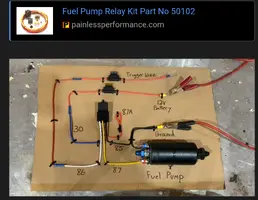
did you mean " Can" be done on the cheap, as in this relay kit for $31, or make my own like in the below video which seems to be like about $10-20 bucks. I have access to wiring at work? I believe that's what Aerocoupe was describing to do.
Looks like I'd just need to buy the 30 amp relay and if I make my own just get a fuse tap? Any particular brand of relay or just look for good reviews on ebay/amazon. I always like to get a decent name at least that has good reviews for anything I buy btw....


View: https://www.youtube.com/watch?v=8GjvRdssvFI
 
Last edited:
Again, I am not a supercharger guru but wouldn't the vacuum source for the FPR need to be after the throttle body?

The other thing you did not look at or at least failed to mention is what was the voltage at the battery when testing the voltage at the inertia switch connection? If there is a wiring harness connector for the fuel pump and sending unit just above the tank and behind the bumper you should be testing the voltage on the pump side of that connector. Closer to the pump is better. If the voltage continues to be sketchy then just run a dedicated 14 ga wire from the battery (with a fuse) to a relay in the trunk. Cut the wire on the pump side of the inertia switch and use that to trigger the relay and wire the pump output from the relay back to the pump side of the wire you cut on the inertia switch. Ground the coil side of the relay in the trunk to a good ground.

Bosch relay wiring:

87 - Battery 12V+
30 - 12V+ to pump
85 - ground
86 - 12V+ from inertia switch
by the way I am now getting over 12 volts at the inertia and at the pump and at the battery 12.80 with car off and 13 plus to 14 plus with it running.

in the previous post I guess if I had to do anything I'd do that but right now the voltage appears to be fine....

YOu said 14 gauge, I guess when I do it I might as well do 10 for potential future upgrades but you're saying 14 will suffice for me currently? If so, curious as to how safe 14 is as to what level of hp for that 255? Or will 14 support whatever the 255 can flow?
 
Last edited:
Kenny Bell is the only one I would trust. Ran a BAP on my dad’s 95 F150 for years. Sold it to a friend and it failed in the early 2000’s. He called me and then called KB as it did not run as good without it. Put a new one in and ran good again. Firm believer in them is you cannot maintain a constant voltage.
Gotcha. Btw just commented earlier on voltages and asked about relays.....
 
did you mean " Can" be done on the cheap, as in this relay kit for $31, or make my own like in the below video which seems to be like about $10-20 bucks. I have access to wiring at work? I believe that's what Aerocoupe was describing to do.
Looks like I'd just need to buy the 30 amp relay and if I make my own just get a fuse tap? Any particular brand of relay or just look for good reviews on ebay/amazon. I always like to get a decent name at least that has good reviews for anything I buy btw....


View: https://www.youtube.com/watch?v=8GjvRdssvFI


It depends on your definition of cheap I guess. I used the Painless kit you linked to when my battery was under the hood. I relocated my battery to the trunk and changed things up. Then I noticed that the factory two pin plug that plugs into the pump hat was getting warm. The car started sputtering after a 1/2 hour to 45 minutes of driving. The fuel pressure dropped to 20psi at idle. I pulled the tank and pump and the pump wiring inside of the tank was melted. I then added the heavy duty fuel pump plug and pigtail along with the SVE pump hanger with included 10ga wiring. No more issues.

When the fuel pump struggles due to low voltage, the resistance rises. You can measure voltage at the pump when the car is first started and it may read fine. Now go drive it for a while and then measure it. Heat and resistance will pull that voltage down.

If your car is being tuned you have to do WOT pulls. There's no way around it. If that pump fails or slows down during that pull, you could easily lose your engine due to a lean condition.

You've received great advice here and on the Corral.

 
It depends on your definition of cheap I guess. I used the Painless kit you linked to when my battery was under the hood. I relocated my battery to the trunk and changed things up. Then I noticed that the factory two pin plug that plugs into the pump hat was getting warm. The car started sputtering after a 1/2 hour to 45 minutes of driving. The fuel pressure dropped to 20psi at idle. I pulled the tank and pump and the pump wiring inside of the tank was melted. I then added the heavy duty fuel pump plug and pigtail along with the SVE pump hanger with included 10ga wiring. No more issues.

When the fuel pump struggles due to low voltage, the resistance rises. You can measure voltage at the pump when the car is first started and it may read fine. Now go drive it for a while and then measure it. Heat and resistance will pull that voltage down.

If your car is being tuned you have to do WOT pulls. There's no way around it. If that pump fails or slows down during that pull, you could easily lose your engine due to a lean condition.

You've received great advice here and on the Corral.

After driving the car yesterday I had 12 plus volts at the pump. The next time I drive it which will likely be friday I will measure it and see what it is; it'll be a nice at minimum half hour drive round trip.
 
To answer your question about wire size I would need to know how many amps you are expecting to draw with the future pump.

Also, what are you wanting a fuse tap for? If it is to power the relay that is a hell no. You will want to come directly off the battery to the relay. The size power wire from the battery to the relay will again depend on amp draw.
 
Last edited:
To answer your question about wire size I would need to know how many amps you are expecting to draw with the future pump.

Also, what are you wanting a fuse tap for? If it is to power the relay that is a hell no. You will want to come directly off the battery to the relay. The size power wire from the battery to the relay will again depend on amp draw.
340 would be the biggest pump that I would ever need to go.

No as in the video I shared it mentioned you can run instead of putting a circuit breaker, you can put a fuse between the wire that's running from the battery to the relay.

Just looking at the picture he explains about four different ways it can be ran. So the way you described, everything that's in this photo is not necessary just so you don't think I'm talking about needing to run everything that's in this photo I was specifically asking about instead of a circuit breaker just to use a fuse. Maybe you mentioned putting a fuse on that wire.
 

Attachments

  • Screenshot_20260406-194830-870.webp
    Screenshot_20260406-194830-870.webp
    62.6 KB · Views: 32
So if we are talking a Walbro pump here is the chart that shows output pressure, flow rate, and amperage draw. The values are shown at 12V and 13.5V.

1775573331325.webp


Let’s just assume a 39 psi base fuel pressure and 15 psi of boost. The pump now needs to put up 54 psi of pressure to compensate for the additional manifold pressure from the boost. With that I would want to look at 60 psi and remember I’m an engineer by trade so I like safety factors and making things way more complicated than need be. I would also set the circuit up for a 13A maximum draw as the pump chart shows a maximum of a 11.66 amp draw at 60 psig at 13.5V.

Assuming a 15’ run of 10 gauge (ga) power wire from the battery to the relay with an inline fuse holder (inline fuse wiring should be 10 ga wire as well) with a 15 amp fuse. From the relay to the pump would be around 5’ so you would need 14 ga wire for that run. You should also ground the pump with a 14 ga wire.

I ran 14 ga on all of mine as I already had 4 ga wire in the trunk for the car audio and it is way oversized for what I have so there was plenty there to power the pump.

Insert crappy wiring diagram here:

1775591676808.webp
 
So if we are talking a Walbro pump here is the chart that shows output pressure, flow rate, and amperage draw. The values are shown at 12V and 13.5V.

1775573331325.webp


Let’s just assume a 39 psi base fuel pressure and 15 psi of boost. The pump now needs to put up 54 psi of pressure to compensate for the additional manifold pressure from the boost. With that I would want to look at 60 psi and remember I’m an engineer by trade so I like safety factors and making things way more complicated than need be. I would also set the circuit up for a 13A maximum draw as the pump chart shows a maximum of a 11.66 amp draw at 60 psig at 13.5V.

Assuming a 15’ run of 10 gauge (ga) power wire from the battery to the relay with an inline fuse holder (inline fuse wiring should be 10 ga wire as well) with a 15 amp fuse. From the relay to the pump would be around 5’ so you would need 14 ga wire for that run. You should also ground the pump with a 14 ga wire.

I ran 14 ga on all of mine as I already had 4 ga wire in the trunk for the car audio and it is way oversized for what I have so there was plenty there to power the pump.

Insert crappy wiring diagram here:

1775591676808.webp
Appreciate the insight and taking the time to make a drawing.

I guess those saying 10 gauge all the way to the pump was not taking into account the inertia switch and it was probably Fox guys. Unless they were talking about going 10 gauge to the relay and then out of the relay to the pump with 10 gauge.

With the OEM hanger and grounding the pump with 14 gauge I would simply have to splice in to the harness connectors ground and reground it?

Some also believed to just bypass all of the Ford harness connectors as well but that would be definitely complicated for me to have to rerun all of those 4 wires that's in the harness connector. Maybe it's not that serious and most people's eyes to bypass those connectors but just to upgrade the wiring?
 
I guess those saying 10 gauge all the way to the pump was not taking into account the inertia switch

No... You saw the [new] relay above? That relay closes the circuit to send power right from the battery to the pump. The 12 Volts at the inertia switch now has the sole duty of triggering that relay. It doesn't need to support anything more than a few mili-amps.
 
No... You saw the [new] relay above? That relay closes the circuit to send power right from the battery to the pump. The 12 Volts at the inertia switch now has the sole duty of triggering that relay. It doesn't need to support anything more than a few mili-amps.
Gotcha and it seems that short 5 ft run at most doesn't need 10 gauge anyway....

Should I run 14 for the ground and to the inertia as well? From the relay to the inertia if so I'd need a step down crimp connector and one for the connection to the pump's pigtail wire.
 
Last edited:
No... You saw the [new] relay above? That relay closes the circuit to send power right from the battery to the pump. The 12 Volts at the inertia switch now has the sole duty of triggering that relay. It doesn't need to support anything more than a few mili-amps.
Got some of this at work and looks like it's true copper too.

XHHW-2 600 10 gauge wire is true copper (bare annealed copper) with Cross-Linked Polyethylene (XLPE) insulation, not TXL, GXL, or SXL
 
I'm going to leave this here because he's doing the same kind of wiring upgrade for the pump:

 
I'm going to leave this here because he's doing the same kind of wiring upgrade for the pump:

I will take a look at that later tonight.

Did you say I can check volts at the inertia for WOT or does it have to be specifically a little bit lower down at the pump pigtail?

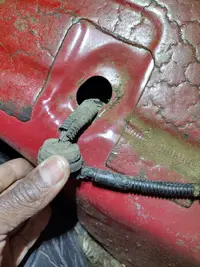
Up on further review taking a picture it looks like I have to go after that junction. Now upon a second review and I remember reading where the brown and purple connects to the black and purple wire. They connect at the pigtail connector of course and so do I need to go after the pigtail or does it matter?
 

Attachments

  • IMG_20260408_182751055_HDR.webp
    IMG_20260408_182751055_HDR.webp
    669 KB · Views: 22
Last edited:
i thought I posted here since last Wed. Let me see if I can post a quote from the late JRicher if I'm spelling it right.

Copied from the FORD RACING PERFORMANCE PARTS catalog:

PROPERLY SIZING FUEL SYSTEM COMPONENTS


Fuel Pumps
The following information is presented assuming the above information has been taken into consideration regarding BSFC, fuel pressure and specific gravity of the fuel being used. Most fuel pumps for electronic fuel injection are rated for flow at 12 volts @ 40 PSI. Most vehicle charging systems operate anywhere from 13.2v to 14.4v. The more voltage you feed a pump, the faster it spins which, obviously, will put out more fuel. Rating a fuel pump at 12 volts then, should offer a fairly conservative fuel flow rating allowing you to safely determine the pump’s ability to supply an adequate amount of fuel for a particular application.

As previously mentioned, engines actually require a certain WEIGHT of fuel, NOT a certain VOLUME of fuel per horsepower. This can offer a bit of confusion since most fuel pumps are rated by volume, and not by weight. To determine the proper fuel pump required, a few mathematical conversions will need to be performed using the following information. There are 3.785 liters in 1 US Gallon. 1 gallon of gasoline (.72 specific gravity @ 65° F) weighs 6.009 LBS.

To be certain that the fuel pump is not run to its very limit, which could potentially be dangerous to the engine, multiply the final output of the fuel pump by 0.9 to determine the capacity of the fuel pump at 90% output. This should offer plenty of ‘cushion’ as to the overall “horsepower capacity” of the fuel pump.

To determine the overall capacity of a fuel pump rated in liters, use the additional following conversions:
(Liters per Hour) / 3.785 = Gallons
Multiply by 6.009 = LBS/HR
Multiply by 0.9 = Capacity at 90%
Divide by BSFC = Horsepower Capacity
So for a 110 LPH fuel pump:
110 / 3.785 = 29.06 Gallons
29.06 x 6.009 = 174.62 LBS/HR
174.62 x 0.9 = 157 LBS/HR @ 90% Capacity
157 / 0.5 = 314 HP safe naturally aspirated “Horsepower Capacity”

Safe “Horsepower Capacity” @ 40 PSI with 12 Volts
60 Liter Pump = 95 LB/HR X .9 = 86 LB/HR, Safe for 170 naturally aspirated Horsepower
88 Liter Pump = 140 LB/HR X .9 = 126 LB/HR, Safe for 250 naturally aspirated Horsepower
110 Liter Pump = 175 LB/HR X .9 = 157 LB/HR, Safe for 315 naturally aspirated Horsepower
155 Liter Pump = 246 LB/HR X .9 = 221 LB/HR, Safe for 440 naturally aspirated Horsepower
190 Liter Pump = 302 LB/HR X .9 = 271 LB/HR, Safe for 540 naturally aspirated Horsepower
255 Liter Pump = 405 LB/HR X .9 = 364 LB/HR, Safe for 700 naturally aspirated Horsepower

Note: For forced induction engines, the above power levels will be reduced because as the pressure required by the pump increases, the flow decreases. In order to do proper fuel pump sizing, a fuel pump map is required, which shows flow rate versus delivery pressure.

That is, a 255 liter per hour pump at 40 PSI may only supply 200 liters per hour at 58 PSI (40 PSI plus 18 lbs of boost). Additionally, if you use a fuel line that is not large enough, this can result in decreased fuel volume due to the pressure drop across the fuel feed line: 255 LPH at the pump may only result in 225 LPH at the fuel rail.


My Comments:

A lot of people oversize the fuel pump by buying a 255LPH pump thinking that the fuel pump regulator will just pass the excess gas back to the tank. It does, but… Did you ever consider that circulating the fuel around as a 255 LPH pump does will cause the gas to pickup engine heat? What happens to hot gasoline? It boils off or pressurizes the fuel tank! With most of the 5.0 Mustangs having the carbon canister removed or disabled, the car stinks like gas, and the gas mileage drops since the hot fuel evaporates away into the air.


Some more on the subject of fuel pressure...

How the fuel pressure regulator works

Revised 5-Jan-2014 to add how to set fuel pressure,

Step 1.) Check fuel pressure:
The local auto parts store may rent or loan a fuel pressure test gauge if you don't have one.
Disconnect the vacuum line from the fuel pressure regulator. Check it for evidence of fuel present in the line by removing it and blowing air through it. If you find fuel, the fuel pressure regulator has failed. Reinstall the line; leave the fuel pressure regulator end of the vacuum line disconnected. Then cap or plug the open end of the vacuum line and stow it out of the way.
Connect the fuel pressure test gauge to the Schrader port located just behind the alternator.
Turn the ignition switch on & start the engine. Observe the pressure: you should see 37-41 PSI at idle.
Turn the ignition off; reconnect the vacuum line to the fuel pressure regulator. Then disconnect the fuel pressure test gauge. Watch out for squirting gas when you do this.

Step 2 .) How the fuel pressure regulator works
The fuel pressure regulator in 5.0 pushrod Mustangs is a shunt regulator that works in parallel with the fuel injection system. The regulator bypasses fuel back to the tank to maintain a constant 39 PSI to the injector tips. A constant pressure insures that the computer will always have the same flow rate to base its calculations on.

The 39 PSI pressure is measured at 29.92 inches of atmospheric pressure to get the proper flow rate. But the pressure inside the intake manifold may be higher or lower than the atmospheric pressure outside the intake manifold. These differences would cause the flow rate to change and mess up the computer’s air/fuel calculations.

As the vacuum inside the intake manifold increases, the effective pressure at the injector tips increases. Conversely, as vacuum inside the manifold decreases, the effective pressure at the injector tip decreases.

Some math to illustrate the effect:
39 PSI at 20” of vacuum inside the manifold works out to be 49 PSI,
since the 20 “ vacuum/2 = 10 PSI that you add to the base fuel pressure.
That gives you 49 PSI at the injector tip.

39 PSI at 5” of vacuum inside the manifold works out to be 41.5 PSI,
Since 5” vacuum/2 = 2.5 PSI that you add to the base fuel pressure
That gives you 41.5 PSI at the injector tip

39 PSI with 10 lbs of boost inside the manifold works out to be 29 PSI.
That gives you 29 PSI at the injector tip

That reduces the flow rate and explains the need for higher pressures on engines with pressurized induction.

Since intake manifold vacuum and pressure plays havoc with the pressure at the injector tips, what has to be done to get it back in the magic 39 PSI range? That’s where vacuum applied to the back side of the fuel pressure regulator comes in. Remember this: unless you have some really poorly designed or trick plumbing, vacuum is the same throughout the engine’s vacuum system.

Apply 20” of vacuum to the back of the regulator and the 49 PSI pump pressure with 20” of vacuum at the injector tips drops to 39 PSI.

Apply 5” of vacuum to the back of the regulator and the 41.5 PSI pump pressure with 5” of vacuum at the injector tips drops to 39 PSI.

Here’s another side effect: apply 10 PSI boost pressure to the back of the regulator and the normal 39 PSI at the injector tips increases to 49 PSI. That overcomes the 10 PSI in the intake manifold to give you 39 PSI at the injector tips. Pretty clever of these engineers to use intake manifold vacuum and pressure that way.

Simply stated, intake manifold vacuum adds to the effective fuel pressure at the injector tips. Apply the same vacuum to the back side of the fuel pressure regulator, and everything balances out. Add pressure to the intake manifold and the effective fuel pressure at the injector tip decreases. Apply the same pressure to the back side of the fuel pressure regulator, and everything balances out.

Now you know why to disconnect the vacuum when making fuel pressure measurements.


Go back and reread the Tech note. It seems that you saw the 29 PSI and the word boost in the same paragraph and quit reading. This is a lot more that you either didn’t read or understand. "The regulator bypasses fuel back to the tank to maintain a constant 39 PSI to the injector tips.... The 39 PSI pressure is measured at 29.92 inches {or 14.7 PSI} of atmospheric pressure to get the proper flow rate. "

The key thing to keep in mind is the term effective pressure

As the pressure inside the intake manifold changes so does the effective fuel pressure at the injector tips. Less than 14.7 PSI in the intake manifold increases the effective fuel pressure. Greater than 14.7 PSI the intake manifold decreases the effective fuel pressure. Now that we know that vacuum or pressure changes the effective pressure at the injector tips, let's proceed onward.

I'm going to introduce a new term PISD. That stands for Pounds per Square Inch Differential. The proper definition is:

"The difference in pressure between two points in a fluid-flow system, measured in pounds per square inch. Abbreviated PSID or psid" (McGraw-Hill Dictionary of Scientific & Technical Terms, 6E, Copyright © 2003 by The McGraw-Hill Companies, Inc.).

The term PSID perfectly describes the situation we have here. In order to preserve the injector flow characteristics, we need to maintain the 39 PSID at the injector tips. That is done by applying pressure or vacuum to the back of the fuel pressure regulator. Pressure applied to the fuel pressure regulator increases the fuel pressure. Vacuum applied to the fuel pressure regulator decreases the fuel pressure. Keep that in mind along with the idea of effective pressure or PSID and you will have a better understanding.

When you connect a pressure gauge to the fuel pressure regulator, you are seeing PSIG. That letter "G" needs some explanation, so I will borrow a very good explanation from https://www.quora.com/Air-Pressure/What-is-the-difference-between-the-units-psi-and-psig
Kim Aaron, Spacecraft Mechanical Engineer writes
When you stick a pressure gage on the valve stem of a tire on a car or a bicycle, the needle is reading the pressure difference between the air inside the tire and the air outside the tire. That's called gage pressure. The units of psig (pounds per square inch, gage) remind us that we are talking about this *difference* in pressure. The absolute air pressure at sea level is about 14.7 psi. Suppose the air pressure in your car tire is 30 psig. Then the absolute pressure inside is 30+14.7 = 44.7 psi. Sometimes, we write that as 44.7 psia (pounds per square inch, absolute) to remind us we are talking about an absolute pressure. In either case, we could just use psi. It just helps avoid confusion to use the psig or psia as appropriate to be clear which we are talking about.
By the way upon my test last week, I was able to confirm 12 volts at into and out of the Ccrm. It is very tricky to use the safety pin or something else that will fit in to back probe because you can't always get the probe of the meter in depending on angles and such of where you are probing. So it seems all of that stuff is functioning and the fuel pump is receiving 12 volts everywhere it is supposed to including at the pump.

I plan on dropping the tank this week to check and make sure I don't see anything glaring as to why the fp would be 8 psi lower after driving the car on a 20 minute trip. It's not like it is dropping suddenly all of a sudden either, there's no fuel leaking from the regulator, and the fp after the car is cut off is decreasing at a normal rate, not straight to zero. When the fuel pressure was at 22-23 ( At startup it's 30-32) I wanted to test WOT and see if the fp increased and it did by 10 psi and the A/F looked fine at 11 plus to 12. So I will see what I see at the pump when i remove it this week. I want to verify there is no issue inside the tank and eliminate that.

I've researched a lot on cavitation and fuel boiling and low voltage and such and it doesn't seem that the car is doing anything in a negative way reflective in what those things would cause or how the car would run as a result. The fuel filter was changed not long ago before the SC install and had to be less than 10k miles ago when I put the engine out of my other car in the '94. It seems if I had a filter issue it would be doing a whole lot worse than the little things it is doing which is initially when I take off for the first time it will hesitate and jerk a tad a few times before it levels out. It has a little miss in low mid and high rpms but it's not herky jerky the way it was prior to the most recent distributor swap. When I start it it starts fine but idles sort of like it wants to cut off sort of for about the first 30-45 seconds and as it warms up the tone increases and it sounds more like it should.

After I have verified the rest of the things on the list the last thing after I put new wires and dizzy cap and rotor, I will likely drive it to the tuner for him to check/change the cold start fuel tables/trim, ect as that might be all it is in that regard. The few new items just mentioned might be the slight missing, maybe. Overall the car is driving much better and I want to verify that the fuel pump and hose ect is fine. Get all of those things sorted and back to the tuner if need be after those things and it should be fine. I will do the wire upgrade at some point too but these things i must eliminate and make sure all these things are up to par.

Also from JRicher' quote, i remember the tuner saying somethign to the effect of that if the fuel pressure is showing a certain pressure on the gauge as long as it's not crazy crazy low and if it's increasing during WOT and the A/F is fine, I should be fine but I will ask him about all of that again a I update him after all of these things. He saif if he tuned the car and the fuel pressure was like that when he tuned it and which he had to back off fuel because it was getting plenty of fuel, that if it was tuned with those pressures then I should be fine.
 
Well it seems the brunt of my issues was the fuel pressure itself. I bought the fuel pressure up from about 26 to 31 and that's after I had already driven the car about 20 minutes. I knew the next day when I started it the fuel pressure would be higher and it was 43 44.

After the car warmed up and I took off driving it was about 39 and after about a 20 minute drive it was around 31 to 33. The lowest I've seen it was about 27 but the car drives a whole lot better and the missing is very minimal and tolerable as opposed to how it was when the fuel pressure was only around 34 to 36 at startup. I'd say the fuel pressure after the car is good and warm and driving it for a while seems to be on average around 31 32. Not sure I need to adjust it to where when it settles it will hold around 39 so that would mean that at startup it would probably be around 50.

I will call the tuner on Monday and see if he wants to tweak some things after all of the little changes that I have found and made and tested, etc. overall right now I'm just going to drive the car and enjoy it, button things back up and stuff put things away put tools away and just drive the car and enjoy it right now.