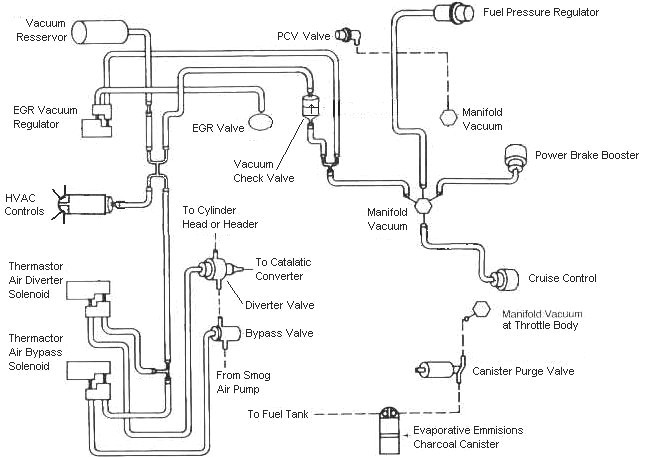
2 questions EGR and Vac.

OK guys firts question
1) Im about to start taking out the EGR on my car, what do i need to no before i do this?
2) I have a lot of vacume lines from when i took the A/C out and also other things what should i do with these? They look sloppy with just bolts sticking in the end of them. Is there any way I can cut and hide them or take them out in general?
 
Do not remove the EGR unless you also plan to spend some $$$ on a custom dyno tune & chip to eliminate it from the computer's firmware. A missing EGR may put the computer into limp mode (reduced performance)

Some basic theory to clarify how things work is in order…

The EGR shuts off at Wide Open Throttle (WOT), so it has minimal effect on performance. The addition of exhaust gas drops combustion temperature, increases gas mileage and reduces the tendency of the engine to ping. It can also reduce HC emissions by reducing fuel consumption.

The EGR system has a vacuum source (line from the intake manifold) that goes to the EVR, computer operated electronic vacuum regulator. The EVR is located on the back of the passenger side shock strut tower. The computer uses RPM, Load. and some other factors to tell the EVR to pass vacuum to open the EGR valve. The EGR valve and the passages in the heads and intake manifold route exhaust gas to the EGR spacer (throttle body spacer). The EGR sensor tells the computer how far the EGR valve is open. Then computer adjusts the signal sent to the EVR to hold, increase or decrease the vacuum. The computer adds spark advance to compensate for the recirculated gases and the slower rate they burn at.

Diagram courtesy of Tmoss & Stang&2birds.
mustangFoxFordVacuumDiagram.jpg


The EGR sensor is basically a variable resistor, like the volume control on a radio. One end is 5 volt VREF power from the computer (red/orange wire). One end is computer signal ground (black/white), and the middle wire (brown/lt green) is the signal output from the EGR sensor. It is designed to always have some small voltage output from it anytime the ignition switch is the Run position. That way the computer knows the sensor & the wiring is OK. No voltage on computer pin 27 (brown/lt green wire) and the computer thinks the sensor is bad or the wire is broken and sets code 31. The voltage output can range from approximately .6-.85 volt.

EGR test procedure courtesy of cjones

to check the EGR valve:
bring the engine to normal temp.
connect a vacuum pump to the EGR Valve
apply 5in vacuum to the valve.
if engine stumbled or died then EGR Valve and passage(there is a passageway through the heads and intake) are good.
if engine did NOT stumble or die then either the EGR Valve is bad and/or the passage is blocked.
if engine stumbled, connect vacuum gauge to the hose coming off of the EGR Valve
snap throttle to 2500 RPM (remember snap the throttle don't hold it there).
did the vacuum gauge show about 5in vacuum?

if not, check for manifold vacuum at the EGR vacuum valve.
if you have manifold vacuum then connect vacuum gauge to the EGR valve side of the vacuum valve and snap throttle to 2500 RPM.
should read about 5in vacuum.
 
Removing the carbon canister will set code 85 in the computer.

Charcoal canister plumbing - one 3/8" tube from the bottom of the upper manifold to the rubber hose. Rubber hose connects to one side of the canister solenoid valve. Other side of the solenoid valve connects to one side of the canister. The other side of the canister connects to a rubber hose that connects to a line that goes all the way back to the gas tank. There is an electrical connector coming from the passenger side injector harness near #1 injector that plugs into the canister solenoid valve. It's purpose is to vent the gas tank. The solenoid valve opens at cruse to provide some extra fuel.

It does not weigh but a pound or so and helps richen up the cruse mixture. It draws no HP & keeps the car from smelling like gasoline in a closed garage. So with all these good things and no bad ones, why not hook it up & use it?

Here's a book that will get you started with how the Ford electronic engine control or "computer" works.

Ford Fuel Injection & Electronic Engine Control 1988-1993 by Charles Probst :ISBN 0-8376-0301-3.

It's about $20 from Borders.com see http://www.amazon.com/ . Select boo...very good, and I found it to be very helpful.
 
Wait wait wait.... don't remove the EGR valve unless you want a custom tune?! What if I bought a "EGR Simlulator" that send s a signal saying it's there but tells the computer that it's closed/open ( whichever is better)? The peeps @ fordfuelinjection.com say it helps the engine run better.... nothing of a tune needed. Fill me in if this is wise!
 
iLkYsPoNy said:
Wait wait wait.... don't remove the EGR valve unless you want a custom tune?! What if I bought a "EGR Simlulator" that send s a signal saying it's there but tells the computer that it's closed/open ( whichever is better)? The peeps @ fordfuelinjection.com say it helps the engine run better.... nothing of a tune needed. Fill me in if this is wise!
The EGR simulator is nothing more than two 10 cent resistors wired up to fool the computer into not setting a code. It does not change the fact that the computer leans out the fuel mixture and advances the timing. Those two conditions can lead to a ping or spark knock in some engines.
 
iLkYsPoNy said:
I guess it's my fault for jumping in on a thread that wasn't mine... but if I'm getting a code for a bad EGR, my car "bucks" at low speeds, and my idle fluctuates.... will the "EGR Simulator" help me?

ps: I tried just putting a bolt in the vacuum line on the EGR but it only helped temporarily.
See "Help me create the Surging Idle Checklist" at http://forums.stangnet.com/showthread.php?t=534062
for help with your idle problems. The first post contains all the updates to the fixes. I continue to update it as more people post fixes or ask questions.

For your EGR problems, start your own post & I will try to help. You will need to post the exact code numbers you got.