alternator help please

87WhiteStang1

Member
Dec 19, 2007
182
0
16
about a week ago i noticed that my battery was not charging(new battery) so i got a new 95 amp PA performance alternator..it got here i put it on, i followed the directions and put it on like it said and it is still not charging. my voltmeter is down low and stay the same when the car is running...i have tried just running a staright 4g power wire from the power output stud on the alt to the battery. still nothing???need some help
 
Have you changed any of the stock wiring - removed any of the plugs or wires?
Does the Low Battery light on the dash glow when you start the engine?
What does the DVM read wehn you run the engine at 1200 RPM?
 
the wiring was what was on there hooked to the stock alt before and i just did whaat the directions with my new alt old me. the alt/bat light does glow on the dash when the engine is off, the voltmeter reads around 12.5-13 with engine off or with engine off.
 
You have to answer the questions asked specifically. There's a huge difference between 12.5 and 13.0 Volts, for instance. And since idle speeds vary, the 1200 RPM (or 2K RPM, or any other higher than idle RPM) notation is important. Use a DMM, as the stock gauge is not accurate enough to interpolate.

The battery light should illuminate KOEO, and KOER if there is an issue with the alternator's output.

Check the regulator wiring, and the rectifier plug wiring if applicable. The rectifier plug should be replaced with any alt replacement. If you have a 3G style alt, you dont have a rectifier plug.

Good luck.
 
ok the bat sits at 12.86volts with engine off and with engine running at 1100 RPM idle it is at 12.8 and when i rev it to about 3-4 K it will stay around 12.75-12.8volts. it is obviously not charging at all. i have power going all the way through the fusable link on the green wire at the solenoid to the black/orange power wires at the alt which are connected to the power stud on the back of the new alt. my ASI harness connections look very clean and not melted at all. the white wire is going straight from the S(stator) connection on the harness to the specified plug on the new alternator. something is not telling this thing when to turn on! also the battery light on dash is only on when the engine is not running. but i have been charging my battery on the charger so its not too low. PLEASE give me any advice guys i need to drive my car! Thanks!:(
 
Never, never disconnect an alternator from the battery with the engine running. The resulting voltage spike can
damage the car's electronics including the alternator.

Do all of these tests in sequence. Do not skip around. The results of each test depend on the results of the previous
tests for correct interpretation.

Changes in wiring for a 3G alternator are in red

Alternator troubleshooting for 86-95 5.0 Mustangs:
Engine off, ignition off, battery fully charged.
1.) Look for 12 volts at the alternator output. No 12 volts and the dark green fuse link between the orange/black
wires and the battery side of the starter solenoid has open circuited.
3G alternator: Look for 12 volts at the stud on the back of the alternator where the 4 gauge power feed wire is bolted.
No voltage and the fuse for the 4 gauge power feed wire is open or there are some loose connections.

2.) Look for 12 volts on the yellow/white wire that is the power feed to the regulator. No 12 volts, and the fuse link
for the yellow/white wire has open circuited.

Engine not running, ignition on, battery fully charged.
1.) Alternator warning light should glow. No glow, bulb has burned out or there is a break in the wiring between the
regulator plug and the dash. The warning light supplies an exciter voltage that tells the regulator to
turn on. There is a 500
ohm resistor in parallel with the warning light so that if the bulb burns out, the regulator still gets
the exciter voltage.
Disconnect the D connector with the 3 wires (yellow/white, white/black and green/red) from the voltage regulator.
Measure the voltage on the lt green/red wire. It should be 12 volts. No 12 volts and the wire is broken, or the 500 ohm
resistor and dash indicator lamp are bad. If the 12 volts is missing, replace the warning lamp. If after replacing the warning lamp,
the test fails again, the wiring between the warning lamp and the alternator is faulty. The warning lamp circuit is part of
the instrument panel and contains some connectors that may cause problems.

2.) Reconnect the D plug to the alternator
Probe the green/red wire from the rear of the connector and use the battery negative post as a ground. You should see
2.4-2.6 volts. No voltage and the previous tests passed, you have a failed regulator. This is an actual measurement taken
from a car with a working electrical system.

Engine running, Ignition on, battery fully charged:
Probe the green/red wire from the rear of the connector and use the battery negative post as a ground. You should see
battery voltage minus .25 to 1.0 volt. If the battery voltage measured across the battery is 15.25 volts, you should see 14.50 volts

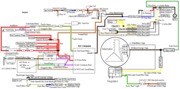
Diagram courtesy of Tmoss & Stang&2birds
fuel-alt-links-ign-ac.gif


See the following website for some help from Tmoss (diagram designer) & Stang&2Birds (website host) for help on 88-95 wiring Mustang FAQ - Engine Information Everyone should bookmark this site.

Ignition switch wiring
http://www.veryuseful.com/mustang/tech/engine/images/IgnitionSwitchWiring.gif

Fuel, alternator, A/C and ignition wiring
http://www.veryuseful.com/mustang/tech/engine/images/fuel-alt-links-ign-ac.gif

Complete computer, actuator & sensor wiring diagram for 88-91 Mass Air Mustangs
http://www.veryuseful.com/mustang/tech/engine/images/88-91_5.0_EEC_Wiring_Diagram.gif

Vacuum diagram 89-93 Mustangs
http://www.veryuseful.com/mustang/tech/engine/images/mustangFoxFordVacuumDiagram.jpg

HVAC vacuum diagram
http://www.veryuseful.com/mustang/tech/engine/images/Mustang_AC_heat_vacuum_controls.gif

TFI module differences & pinout
http://www.veryuseful.com/mustang/tech/engine/images/TFI_5.0_comparison.gif

Fuse box layout
http://www.veryuseful.com/mustang/tech/engine/images/MustangFuseBox.gif
 

Attachments

  • fuel-alt-links-ign-ac.gif
    fuel-alt-links-ign-ac.gif
    83.1 KB · Views: 171
Okay so i did all the tests listed above and my results are as follows:

engine off,ignition off bat charged:
-alternator output(black/orange wires) is at 12.95 volts
-yellow/white wire on D plug connector has 12.95 volts as well

engine not running,ignition on, bat charged:
-AMP light (right below parking brake light)on dash glows
D connector disconnected:
-green,red wire has 12.08 volts

D plug connected:
-green red wire(probed behind D plug) has 3.6 volts

engine running, ignition on, bat charged:
-bat voltage is 12.45
-green/red wire on Dplug has 12.28 volts


Everything seems to pass i still don't understand why it does not work!! getting angry...still open to advice and hope the results to those tests will help narrow down things. Thanks guys
 
If not done, I would disconnect both alt plugs. Do a continuity test between the two stator loops (the white/blk wiring). You should see about .5 ohms.
 
im new to this electrical stuff so i am going to need to know specifically how to do that. thanks again for the help

There is a white/blk wire going into the regulator plug and there's one going into the rectifier plug. It's the same wire - it just makes a big loop.

You disconnect each plug. Put one of your meter's leads into the terminal for one of the white/blk wires and put the other lead into the other white/blk lead. Set your meter to read ohms and note the reading. It should be 0.5 Ohms or so.
 
okay heres what i did...first i took the BRAND new alternator to get it tested at autozone...it passed of course..then i put it back in. connected the power but left the D plug and the other end of the stator loop unconnected. used my meter-put one end on the regulator where the white/blk wire would connect and the other end where the other end of the loop would connect. now my meter has 5 settings for Ohms: 2000K,200K,20K, 2000 and 200. didn't know which one to use so i tried them all and got nothing on all of them(with or without engine started) get back to me guys, need more advice
 
Nothing is not good. Using the 200 Ohm range should have given you .3 to 1.5 Ohms.

Since you seem to be having some problems understanding basic electrical circuits, here is some help.

Automotive circuits are mostly simple stuff: a power source, a connection path, a control device, a load, and a ground.
The battery/alternator is the positive power source.
The wire and fuses are the connection path.
Control devices are switches, relays and sensors.
A load is a light, motor, solenoid or heater element.
In automotive circuits, grounds are the return path so the electrical power can flow from the load to the negative side of the power source.
Electricity flows like water:
Voltage is like pressure,
Current in amps is like volume,
Resistance is like the kink you put in a garden hose to decrease the pressure or volume.
Power is pressure multiplied by volume or voltage multiplied by current (amps)

Digest that, and you just got the first 3 days of Electricity 101.

Use some jumper wires (connection path and ground) to hook up a switch (control device), a battery (power source), a light bulb (load). Now make the light turn on and off with the switch.
That's the electrical lab for the first week of Electricity 101. People pay hundreds of dollars and sit in hard chairs in a stuffy classroom to learn what I just told you for free. So smile, you just got an expensive lesson for free :D:

Step 1.) Find the instruction book that came with your Multimeter. Read it and familiarize yourself with how it works and how use it. If you lost the book or didn’t get one with it, do a Google search on the web to find the manufacturer’s web site & download a copy of the manual.

Step 2. ) Make sure that you know what test lead plugs into which jacks on the Multimeter. There are usually several different jacks on most Multimeters, and they have different functions. Make sure that your battery(s) in the Multimeter are good: if you have any doubts, replace the battery(s).

Step 3.) Once you are sure that the Multimeter is functional and you have the leads plugged into the jacks for Ohms ( the upside down “U” symbol), do some simple measurements to make sure that you know how to use it correctly. Set the switch to the lowest range and touch the leads together: you should not see “nothing” but you should see 1.0-0.3 ohms. On your meter, the 200 ranges is probably the lowest ohms reading. Measure a 60 watt light bulb: cold it will measure about 17.5 Ohms. It you measure it while it is hot, the reading will be greater.

Step 4.) Make several test measurements using the ohms function and the DC volts function. Remember all resistance measurements must be done with the power off the circuit. This avoids false readings and possible damage to the ohmmeter.. Repeat steps 3 & 4 until you are sure that you can do it without making any mistakes.

If you would like more instruction on automotive electrical systesm, try Automotive Online Instruction for a beginning course.

I recommend you follow the Google search trail - automotive electrical course online - Google Search
 
now that i know how to use my multimeter...i made sure i had the multimeter set right and it was on 200 Ohm measurement...i touch the leads together and get .3, i touch the leads to the plugs where both ends of the stator loop hook to and i get nothing! im not sure what that is supposed to mean but would really like to get this figured out soon. thanks
 
If you have a loss of continuity in that wire, start tracing it till you find the open.

You could also rewire that portion of the circuit if you like.
 
there was no wire on it when i tested it...i was told to unhook the D connector and the other end of the stator loop and touch the leads to where the white/black wire would connect. ???
 
there was no wire on it when i tested it...i was told to unhook the D connector and the other end of the stator loop and touch the leads to where the white/black wire would connect. ???

You disconnect both plugs on the alt. Now forget the alt is there - you are only testing at the wiring pigtail-connectors themselves (not anything on the body of the alternator).

Each plug has a white/blk wire. It is the same wire - it loops from one plug pigtail to the other. So in doing a continuity test, you are seeing if the loop of wire is intact. Redo the test if you need to.

If this is still confusing:

As a bench test, grab a spare piece of wire you have laying around (or a paperclip). Put a DMM lead on each end of the wire and note the reading. In an example like this, the reading will be VERY low (around 0.10 Ohms probably). This means the wire has very little resistance, or that each end is VERY connected to the other. Low resistance = electricity flows from one end of a wire to the other with very little impediment. This is good.
 
ok i was a little confused on that...i understand it now however i am sure that the wire is fine because it is brand new it came with my new alt and its only about 4 inches long from one plug to the other, however i will try that again tomorrow and let you know the read. until then any other suggestions and advice are welcomed...really need to get my car working:(. thanks
 
The alternator isn't powdercoated or painted is it? If so, you need to create a grounding point for the alternator (in stock form, the alt achieves ground through its mounting bracket).