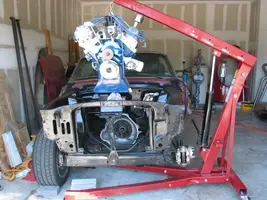
Carburetor mount hoist bracket - strong enough?

I need to position a 351W with AOD an attached into a 68 mustang in order to put in the engine mounts on a mustang ii cross member. The 351W has aluminum intake manifold and heads. I've been using a hoist bracket that mounts to the carburetor spot on the intake with the engine alone. I'm worried that the added weight of the AOD will strip the threads in the intake manifold.

Recommendations?

Added comments on successfully locating and welding the engine mounts are also welcome.

Thanks,
Kent
 
It'll work fine. I too had concerns, but my buddy had my leveler and I was forced to use the carb plate this last time (a couple months ago). I had my engine, steel scattershield, steel flywheel, clutch, and Richmond 6 speed all held by the carb plate. I will admit that I was nervous as hell, but all went well.
 
They work fine. I understand your concerns as I had them the first time I saw one of these things but after using them several times they will not present a problem as long as you use the longest grade 8 bolts you can while making sure they are good and tight. The aluminum is much stronger than you think.
 
I've changed out at least 50 engines and tranny combos, using a carb plate from Summit.... Never a problem and I always use aluminum intakes.

Just make sure ther'es no play in the bolts (I personally use studs in the intake and use nuts up top), but don't make them too tight...just good and snug is good enough.
 
Ronstang said:
...they will not present a problem as long as you use the longest grade 8 bolts you can...

Threading "Grade 8" bolts into an aluminum manifold could be considered overkill. I am just as much for safety as the next guy but if you have a problem, which you most likely will not, it would be with the manifold not the hardware.
 
I was quite worried about it myself. I did not have the added weight of the AOD on mine, but the plate was connected to an aluminum intake and I know the threads are much weaker. Anyhow, it all came off without a hitch, I inspected the threads when I was done and they looked pristine.
enginst02.webp
 

Attachments

  • enginst02.webp
    enginst02.webp
    79.3 KB · Views: 565
allcarfan said:
i just cant bring myself to use a carb plate. I have heard, but never seen personally, horror stories about the threads stripping.

I would have to guess that if the threads stripped out it was from over-tightening of the bolt not the weight of the motor. These things only weigh 5-600 lbs sans transmission.
 
I have never taken a motor out like that but I wouldn't feel comfortable doing it that way. Why not use your accessory bolts on the cylinder heads. I did that and it was simple, that way you are relying on the tensile strength of the bolt instead of the threads.
 
My reason for not using the accessory bolts on the heads in the standard front-back arrangement is that the accessories are already installed and I don't want to risk upsetting the alignment of the March pully system and brackets. The engine game from the The Engine Factory fully assembled, adjusted and run in. Only the rear accessory holes are available.

Disclaimer - I may be missing something obvious to the skilled mechanic.

Kent
 
to position your motor, to position your motor mounts I used a bare block, bolted the trans to it and made a jig that bolts to the front of the block where the timing chain cover bolts to. I used flat stock that would reach each frame rail, then I would set the motor and trans where they needed to be then took another piece of flat stock and tied the 2 pieces that went to the frame rails and welded those together so to hold their position and then tacked the pieces to the frame rails. This holds everything in position so you can set up your motor mounts and tack them in place then you can pull everything out and finish welding with nothing in your way. I hope this helps and I hope I didnt confuse you. Good luck!
 
If you're running bolts into the manifold to put the plate on, your asking for trouble. Studs are the way to go for this. Think about it this way, although they're bigger and longer, head and main studs in race motors are installed by hand, not double nutted and tightened down. They survive 5,000+ hp Top Fuel cars. It's easy to keep from galling if your putting studs in and you don't have to worry about stripping the hole out. If the manifold is used, get a bottoming tap to re-chase the threads.

69Rcode_Mach1 said:
...that way you are relying on the tensile strength of the bolt instead of the threads.

Actually, you're relying on the shear strength of the bolt as it is in shear.
 
68rustang said:
Threading "Grade 8" bolts into an aluminum manifold could be considered overkill. I am just as much for safety as the next guy but if you have a problem, which you most likely will not, it would be with the manifold not the hardware.

I agree that in this case grade 8 bolts are "overkill" but I always suggest grade 8 hardware in situations like this for the simple reason that common hardware store bolts that people think are grade 5 are more like grade 2 junk these days since they come from a far off land......and they are complete crap and should not be trusted.

1320stang is correct about studs being superior but bolts are fine if used properly. The only reason I used to use bolts with these lift plates (I have a load leveler now) is because if you get the right length bolts they will have more thread engagement in the manifold then most carb studs....and it is the aluminum threads in this case that are the weak link so the more engagement the better in my opinion.
 
I agree with you Ron, that's why I've made my own carb studs before, to make sure of full engagement. But on the other hand, I've never used a carb plate before either, but after seeing a fully dressed, iron exhaust manifold'd FE with a C6 hanging from a carb plate with an aluminum intake, I'm pretty confident that my little 'ol 289 will be just fine.