Egr

squeak93

15 Year Member
Jun 2, 2005
2,352
418
164
Joplin, Missouri
Can someone explain to me the benefits or consequenses of deleting the EGR.

I am already collecting parts for a 351 swap (trick flow R-runner intake, Patriot Perf Heads, Comp CCA-CL35-250-4 cam and liters-non roller block-, and a forged bottom end.) Most likey will have to bore to a 357 (which will be no real noticable power gains). I want to know if there is any benefit to deleteing the egr as it makes the engine bay much cleaner (I am deleting the a/c as well to clean things up). This will be a weekend toy with some track time. Mostly a summer car to drive for fun and to take out to the local cruises.

Need help here as its about crunch time and I need to get my plan set in stone before I buy the wrong parts or make bad decisions based off of inexperience (my first engine build on my own, don't worry, will have experiences proven helpers to make sure I don't screw anything up).

(if this is not tech I am sorry and feel free to move to talk)

I did do a search for EGR but found absolutely nothing on this site about it. I know I remember reading in a thread about it and think it was on here but can't find it.
 
Some basic theory to clarify how things work is in order…

The EGR shuts off at Wide Open Throttle (WOT), so it has minimal effect on performance. The addition of exhaust gas drops combustion temperature, increases gas mileage and reduces the tendency of the engine to ping. It can also reduce HC emissions by reducing fuel consumption. The primary result of EGR usage is a reduction in NOx emissions.

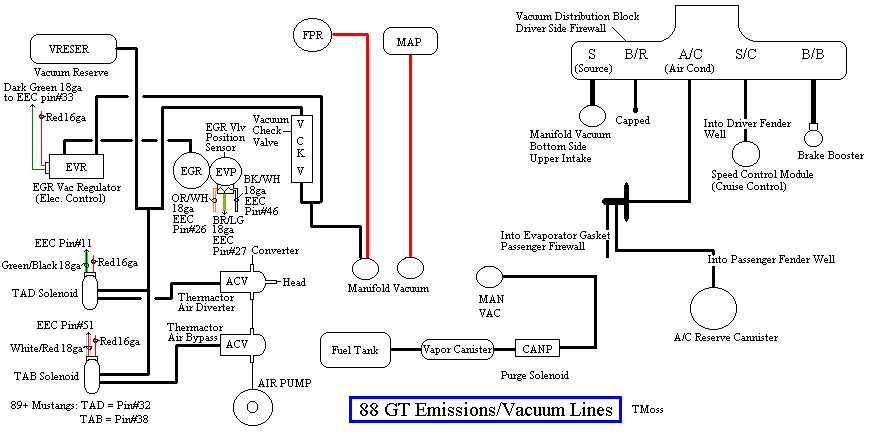
The EGR system has a vacuum source (line from the intake manifold) that goes to the EVR, computer operated electronic vacuum regulator. The EVR is located on the back of the passenger side shock strut tower. The computer uses RPM, Load. and some other factors to tell the EVR to pass vacuum to open the EGR valve. The EGR valve and the passages in the heads and intake manifold route exhaust gas to the EGR spacer (throttle body spacer). The EGR sensor tells the computer how far the EGR valve is open. Then computer adjusts the signal sent to the EVR to hold, increase or decrease the vacuum. The computer adds spark advance to compensate for the recirculated gases and the slower rate they burn at.


attachment.php


Troubleshooting:
There should be no vacuum at the EGR valve when at idle. If there is, the EVR (electronic vacuum regulator) mounted on the backside of the passenger side wheelwell is suspect. Check the vacuum line plumbing to make sure the previous owner didn’t cross the vacuum lines.

Diagram courtesy of Tmoss & Stang&2birds. (the diagram says 88 GT, but the EGR part is the same for 86-93 Mustangs)
88Stang5.0Vacuum.gif


The EGR sensor is basically a variable resistor, like the volume control on a radio. One end is 5 volt VREF power from the computer (red/orange wire). One end is computer signal ground (black/white), and the middle wire (brown/lt green) is the signal output from the EGR sensor. It is designed to always have some small voltage output from it anytime the ignition switch is the Run position. That way the computer knows the sensor & the wiring is OK. No voltage on computer pin 27 (brown/lt green wire) and the computer thinks the sensor is bad or the wire is broken and sets code 31. The voltage output can range from approximately .6-.85 volt.


EGR test procedure courtesy of cjones

to check the EGR valve:
bring the engine to normal temp.
connect a vacuum pump to the EGR Valve
apply 5in vacuum to the valve.
if engine stumbled or died then EGR Valve and passage(there is a passageway through the heads and intake) are good.
if engine did NOT stumble or die then either the EGR Valve is bad and/or the passage is blocked.
if engine stumbled, connect vacuum gauge to the hose coming off of the EGR Valve
snap throttle to 2500 RPM (remember snap the throttle don't hold it there).
did the vacuum gauge show about 2-5 in vacuum?

if not, check for manifold vacuum at the EGR vacuum valve.
if you have manifold vacuum then connect vacuum gauge to the EGR valve side of the vacuum valve and snap throttle to 2500 RPM.
should read about 2-5 in vacuum


Late Model Restoration has the Ford Racing M-12071-N302 kit with the EGR valve & sensor along with the ACT & ECT sensors for $45. See http://www.latemodelrestoration.com/iwwida.pvx?;item?item_no=M12071N302 1&comp=LRS for more details
 
Ok, that is exactly what I was looking for. Now my question is, (and this is a what if only as I do not know) what if the heads I have chosen do not have the egr passages on them? What then? I have no reason to believe any system on the car is not working (other than my air bag's-which do not affect any of my performance or other systems).

Again, the heads are the Patriot Perf to save some re reading.


EDIT. Smog pump was removed by prev owner and everything looks to have been blocked off correctly. O/R x pipe as well.
 
If there are no EGR passages in the heads, then a custom tune & chip will be needed to disable the EGR function and not set a code.
 
If you are building a custom setup, i assume a custom tune will also be on tap?

If so, it will be tuned out and fuel/timing curves adjusted.


Problems arise when guys take a stock setup and rip the EGR stuff off thinking it's robbing 20HP and do more harm than good
 
Yes, a custom tune will be done as I know it will run with the A9P but it will not be at its best.

Now my question. I need a good tuner.

Am I best off getting a Tweecer and learning how to use it? I am pretty new to this but am more than willing/capable of learning what the parameters to everything are.

Or is this something that I need to leave to a pro tuner? The closest ones I know of are going to be in the K C, Mo area (like 3 or so hours away from me).