Gas In The Oil

Take the vacuum line off your fuel pressure regulator and see that it's not wet with fuel. If the diaphragm has cracked or ruptured some how, it would cause fuel to leak past, causing a pressure drop and and excessive use of fuel. I just skimmed through the thread, but have you got an A/F gauge to tell if its running fat? Pressure bleeding off on a return system is normal after it sits a while.

Another thing to check would be your vent tube to your gas tank? If its kinked, or plugged it will build pressure in the tank and force the fuel into the system. Any pressure behind the gas cap when you take it off after it's ran a while?
 
Yes.... the regulator line is not wet with fuel but does smell like fuel, in fact all the vacuum lines seem to.
Afr is acceptable in all conditions 15afr idle 14-16 cruise but fat in boost 11.3-11.5

I don't vent the tank because I have not yet added a circuit to the megasquirt for the solenoid.
 
Alright so I got the compression test done and pulled all the plugs and set them out in order in a box for comparison all the plugs look very similar except for number 8 it was wet with oil although I find this suspect because the car does not use any oil, when I had the heads drilled for studs a few of them broke into the intake runner I'm wondering if maybe oil gets down in the cylinder that way while the car is sitting.
Either way the compression test came out beautiful cold and dry all cylinders we're at 150 +/- 5%
20161103_172212.webp

So what does everyone think bear with me a few minutes I'm going to attempt to leak down test
 
Leak down test brought nothing new to light....

Did wet compression test, all cylinders we're within 5% of the dry test......

I'm running very cold plugs, ngk iridium tr5IX this is a gt40 iron headed engine with boost should I run a step hotter? or different plug maybe?

Judging by the plugs I am Uber fat in boost this may be the issue.
 
Here's a thought:(s)

You don't have any broken rings.
Your oily #8 could be as simple as you are thinking, however if there is a leak that allows oil in, it is also probably a vacuum leak.
Fuel smell in the oil is one thing, fuel in the oil is another. As much as you've been testing this thing, how do you know that you haven't contaminated the oil in some other way short of it getting sucked into the engine?
There are several companies out there selling test kits to see just how contaminated (with fuel) your oil actually is.

leak the engine down. Although by your comp test I'm confident that you won't find a major problem.
 
  • Like
Reactions: General karthief
Not a single store in 50 miles has a leak down tester for that I can rent. And seeing that I'm not paying $60 for something I'm going to use one time I think I'm just going to put new plugs wires on this thing and let it eat. More than likely the fuel in the oil is being caused by the over Rich tune and the excessive cylinder pressures required to make 400 foot pounds of torque (at the wheels) at 2500 rpm.....

So here's what I think I'm going to do I'm going to switch to a copper plug from these iridium plugs and lean the tune out some. I'm also going to recalibrate the wideband and move it into the other header.

Does anyone have a suggestion as to what plug I should run with around 10 PSI boost. I am not buying $8 each spark plugs again.
 
Not a single store in 50 miles has a leak down tester for that I can rent. And seeing that I'm not paying $60 for something I'm going to use one time I think I'm just going to put new plugs wires on this thing and let it eat. More than likely the fuel in the oil is being caused by the over Rich tune and the excessive cylinder pressures required to make 400 foot pounds of torque (at the wheels) at 2500 rpm.....

So here's what I think I'm going to do I'm going to switch to a copper plug from these iridium plugs and lean the tune out some. I'm also going to recalibrate the wideband and move it into the other header.

Does anyone have a suggestion as to what plug I should run with around 10 PSI boost. I am not buying $8 each spark plugs again.

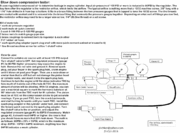
It's ben quite some time since I priced the blow down tester parts but I didn't think it would be $60.

The design for the tester comes right out of the FAA AC 43:13-1b page 8-14 for aircraft engines. You may want to reduce the orifice size in my drawing for automotive use.

See https://www.faa.gov/documentLibrary/media/Advisory_Circular/Chapter_08.pdf