HELP CODE 92, how to test egr circuit?

car stumbles when barely giving throttle

when you give just a little throttle "just trying to hold current speed without speeding" i have a massive hesitation, almost embarrassing to cruise through town cause it sounds like my car is missing big time
 
If the EGR sticks closed, it will not affect performance. It is only a problem when if opens when it is supposed to be closed.

The TAB & TAD solenoids are part of the Thermactor Air System or smog pump. They have nothing to do with the EGR or EVR.
 
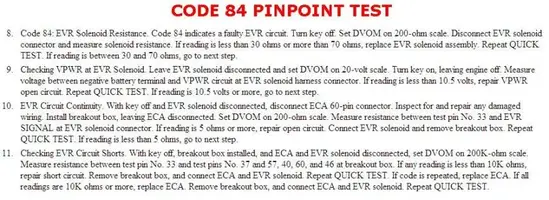
Again.... code 84 shouldn't cause the problem you're having, however, since you insist, use the pinpoint test attached.
 

Attachments

  • CODE84.webp
    CODE84.webp
    57.4 KB · Views: 141
Pull codes to see if that gives a clue.

Check for spark leak.

Also check your baseline EGR position sensor reading (if applicable). I've run into this issue when the sensor is at the ragged edge of being within spec (0.67 volts IIRC). The reading wanders as you drive and the EGR causes roughness and missing.

Good luck.
 
It would show up when you dumped the codes. You would have gotten a 41/91 or 42/92.

Here's the code 41/91 test path. It tells you how to test the O2 sensors .

Code 41 or 91 - O2 indicates system lean. Look for a vacuum leak or failing O2 sensor.

Code 41 is a RH side sensor,
Code 91 is the LH side sensor.

The computer sees a lean mixture signal coming from the O2 sensors and tries to compensate by adding more fuel. Many times the end result is an engine that runs pig rich and stinks of unburned fuel.

The following is a Quote from Charles O. Probst, Ford fuel Injection & Electronic Engine control:
"When the mixture is lean, the exhaust gas has oxygen, about the same amount as the ambient air. So the sensor will generate less than 400 Millivolts. Remember lean = less voltage.

When the mixture is rich, there's less oxygen in the exhaust than in the ambient air , so voltage is generated between the two sides of the tip. The voltage is greater than 600 millivolts. Remember rich = more voltage.

Here's a tip: the newer the sensor, the more the voltage changes, swinging from as low as 0.1 volt to as much as 0.9 volt. As an oxygen sensor ages, the voltage changes get smaller and slower - the voltage change lags behind the change in exhaust gas oxygen.

Because the oxygen sensor generates its own voltage, never apply voltage and never measure resistance of the sensor circuit. To measure voltage signals, use an analog voltmeter with a high input impedance, at least 10 megohms. Remember, a digital voltmeter will average a changing voltage." End Quote

Testing the O2 sensors
Measuring the O2 sensor voltage at the computer will give you a good idea of how well they are working. You'll have to pull the passenger side kick panel off to gain access to the computer connector. Remove the plastic wiring cover to get to the back side of the wiring. Use a safety pin or paper clip to probe the connections from the rear. The computer pins are 29 (LH O2 with a dark green/pink wire) and 43 (RH O2 with a dark blue/pink wire). Use the ground next to the computer to ground the voltmeter. The O2 sensor voltage should switch between .2-.9 volt at idle.

Note that all resistance tests must be done with power off. Measuring resistance with a circuit powered on will give false readings and possibly damage the meter. Do not attempt to measure the resistance of the O2 sensors, it may damage them.

Testing the O2 sensor wiring harness
Most of the common multimeters have a resistance scale. Be sure the O2 sensors are disconnected and measure the resistance from the O2 sensor body harness to the pins on the computer.

The O2 sensor ground (orange wire with a ring terminal on it) is in the wiring harness for the fuel injection wiring. I grounded mine to one of the intake manifold bolts

Replace the O2 sensors in pairs if replacement is indicated. If one is weak or bad, the other one probably isn't far behind.

If you get only code 41 and have changed the sensor, look for vacuum leaks. This is especially true if you are having idle problems. The small plastic tubing is very brittle after many years of the heating it receives. Replace the tubing and check the PVC and the hoses connected to it.
A secondary problem with only a code 41 is for cars with an intact smog pump and cats. If the tube on the back of the heads clogs up the driver’s side, all the air from the smog pump gets dumped into one side. This excess air upsets the O2 sensor calibration and can set a false code 41. The cure is to remove the crossover tube and thoroughly clean the insides to that there is no carbon blocking the free flow of air to both heads.
 
Usually bad..... depending on the type of failure. Having a lean or rich code though, doesn't mean the O2(s) are necessarily at fault...... they might be just, doing their job....... informing the ECM and the operator there's a problem elsewhere causing an A/F control issue. If you want to pre-check if they're causing a real problem, disconnect them and test drive the car (force a permanent open loop condition). Do you want to make sure they could be the real cause of your problems with the car, and prevent an unnecessary expenditure of ~ $150 if they're not the cause? Follow the test procedures posted above.
 
just replaced one of the o2 sensors cause i was getting code 92 or code 42 if i swapped them so i figure one is bad, well now it is the same thing, like i just wasted 50$$$$$ on a new sensor
 
Thread closed, so I can try to make this thread into something that makes some sort of sense, because I had to merge about five different threads together on the same issue. Will be reopened shortly.

Edit: Thread reopened. This is the best I can do to make this thread legible. Jssblues, do not create redundant threads on the same issue. You were told by Mustang5L5 on 8/9 not to create multiple threads regarding the same issue.
 
Please make your next update a restatement of your original problem, what you have done to correct the problem and what parts you have replaced. It is too hard to remember all that you have done and what should be done to help you resolve your problem.

I suggest that you use the Signature option in the User control panel to list all your mods. To access the user control panel, click on USER CP on the header bar at the top of the page. When the User control panel opens, Edit signature is one of the subheadings under Settings & Options.

Be sure to include things in the Signature like cold air induction kits, camshaft, cylinder heads, intake manifold, TB, ignition and all the other engine and chassis details you can think of. It helps to know what is in the car and not search through a string of scattered posts to find out.
 
ok so i checked the voltage of the 02 sensors at the computer, one side reads .02 volts at idle and the other side reads 12-13 volts.....very strange

If you did it correctly, the .02 volt side is not working at all. You should see between .2-.9 volts. Are you sure you did not misread the placing of the decimal point?

The 12-13 volt side is shorted inside the sensor, or in the wiring, to the 12 volt heater O2 voltage. Or you measured the O2 sensor heater voltage instead of the sensor output.

Remove the O2 sensors from the H pipe and get out your propane torch. Measure the voltage while heating them with a propane torch. You should see somewhere between .2-.9 volts.
 
Key in IGN ON, while monitoring pin 43 voltage with DVOM, disconnect LH O2 sensor, if voltage drops to "0"..... the problem is the O2 sensor, if it doesn't......... you need to trace the wiring from the O2 connector for a short to power.