HP vs TORQUE? What's better??

95Vert said:
:flag: thanx mo dingo, you really cleared everything up, i was gettin kind of confused with all the simple explanations but i got. now i can explain to my ricer cousin what's the difference and why their cars suck :D

:rlaugh:

But there is a catch to that. They can rev their motors to 8k+. If it's setup right, they can stay in a lower gear for even longer than, oh lets say a 99/01 cobra. But if the honda only puts out 160ft-lbs of torque, then it's likely the cobra will have a greater tractive effort because of the 320+ft-lbs of torque it puts out.

But if the honda has a very close-ratio gear setup, then it will be a different story. It all depends on gearing.

But if the cobra has some 4.56's, then it's just plain OVER!!!!!

:OT:
Can you imagine taking a mustang to 13,000 rpm's in first gear(like an indy car). That would be absolutely nuts!!!!!! Nevermind the big kaboom afterwards, i am just saying........
Scott
 
HP is simply torque at a certain rpm. The reason the S2000 has 240hp is because it has all of its torque at high rpms. It is a dog until 6k rpm. It is fast (low 14's) because it is lightweight and has very closely spaced gearing. It never drops below 6k rpm when its upshifted at redline, so it never drops out of its power curve. However, in normal driving mode you'll never shift at redline very time, thus the engine will drop out of its power range and it will feel underpowered. Some people like peaky engines, some people like alot of low end power. The trick is to have lots of low end torque and extend that torque curve all the way to redline.

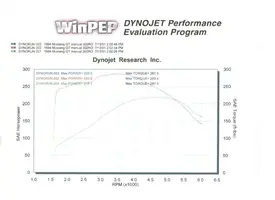
Here's some visual to help you guys out:

stangdynograph.webp


This is from my Mustang. Notice that it has an abunance of torque from 2000-4000 rpm. What you also see is that after 4500rpm the hp curve peaks and at 5k rpm it starts to fall off dramatically. You can see that the tq curve takes a dive after 4k, which means the engine is starting to fall out of its power range. In the stock 5.0L this is due to the design of the intake, heads, and cam. They designed the engine to have very good low-mid range power, but they sacrificed upper rpm power.


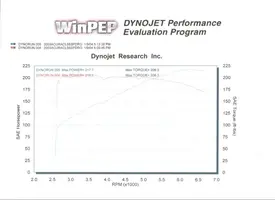
Here's another dyno of mine:
4thgeardyno.webp


This is from my Acura. As you can see it has nearly the same peak hp as my Mustang, but it has lots less torque. How is this possible you ask, if hp is simply torque? The answer is to look at the torque curve. It is making 85% of its potential torque at redline, while my Mustang is only making 50% of its potential torque at redline. You can see that the torque curve is very flat for nearly the entire rpm range, and the hp curve does not fall off much, if at all. Would you believe me if I said that the V6 in my Acura is making 45ft lbs more torque than my Mustang when both engines are at 6000 rpm? :owned:

It should be said that even though my Acura has better gearing, a flatter tq curve, and pulls to redline doesnt mean its funner to drive. It feels weak compared to my Mustang, honestly. I can tell it has more high rpm power, but who wants to ring their engine to 7k rpm to get some passing power? The Mustang with its V8 has much more daily usuable power, down below 4k rpm where you usually spend. If I shift my Mustang at 5k rpm it puts it right back into the middle of its torque curve, so theres never a point in which its out of steam, as long as you dont wring it out to redline. If I was to have both my Mustang & Acura in top gear and floor it from 60mph it would be a no-contest. The extra torque would own the smaller displacement engine, whether or not it has a flat torque curve.


This is why us 5.0L people do heads/cam/intake or forced induction and run some awesome times. It basically retains your great low end power while adding to the upper end power, for engine that has no power drop from idle to redline.


Hope I didnt confuse anyone further. :D
 

Attachments

  • stangdynograph.webp
    stangdynograph.webp
    28.6 KB · Views: 99
  • 4thgeardyno.webp
    4thgeardyno.webp
    22.4 KB · Views: 112
I'll take the combo that produces the most average torque (area under the curve) over the usable rpm band anyday over a better peak HP number. My car, untuned on the 1st dyno, made 309RWTQ but AVERAGED 284RWTQ over the entire 2,000-5,600 rom band. I have been tuning, so I know the HP and Torque are up some more.
 
95Vert said:
just to sum it up, the flatter the curve the better.


That seams a little misleading.....wouldnt u rather the curve increase from 3500rpm+ rather than staying at at a certain RPM from 3500+ up?

I agree it should atleast stay at a certain level and not go below, but i see nothing wrong with it climbing up the scale screaming through the rpm's till you get to scared and shift. :spot:
 
Just to clarify - you won't find an engine that makes increasing torque past the peak on a naturally aspirated engine and so a flat torque curve is best. If you meant HP (you didn't say which curve you meant) then that curve can keep rising to peak, but it's not "flat".
 
Looks like everyone knows there s**t. Hell i'm ready to start submitting resumes......no but very, very simply stated by one redneck gearhead( hp gone gitcha down that track like a sum bi**h and torque gone pull them godd**mn front wheel right off the blacktop.
 
The only reason a flat curve is good (for us) is becuase of our tranny ratios. We use alot of rpm range in each gear, so it's important to have the torque high throughout that band. If you we had the flexibility to choose our tranny ratios, it wouldn't really matter how flat the curve is since you'd be able to design it so that you are always within the power band. Of course if you have a torque curve like a supra (really narrow), it would be tough to stay in it for long before you run out of gears. You'd end up designing for a narrow speed range if that were the case.

But it's all relative, so there's no real point in having it flat. Usually when we talk about it being flat, we're suggesting that we have alot of low end torque as well as high end. If the torque in HairyCanary's post rose to 600-ft-lbs in the middle, it wouldn't be flat at all, but the car would be faster.

On another note, having a flat torque curve tends to make the car much more easy to control since you don't have any unexpected power spikes and you can maintain yor traction.
 
Torque is a static measure, and so it doesn't really relate to acceleration.
To get good acceleration, you need to SUSTAIN some torque over an RPM range, and that's where horsepower comes into play. Torque+RPM = Horsepower.

For example, I make almost 200lb-ft of torque when I step on the pedal of my bycicle (I'm about 190lbs, and the pedal is more than 1 foot from the axis).

The problem is that I cannot sustain those 200lb-ft of torque for more than, oh, say 60RPM. So my 200lb-ft of torque are worthless because I can't make them at high RPM. That's why a guy on a motorbike with a "mere" 20lb-ft of torque will ****** slap me in a drag race, even though I have 10 TIMES the torque he has. He'll be faster from the dig, and he'll be faster from a roll. No contest.

To accelerate, you need both torque and RPM. Horsepower is a measure that tries to capture both (HP = TQ*RPM/5252). It's not perfect, because we have gears and our torque changes as our RPM's change, but it's not bad. Torque on the other hand, is meaningless without RPM.

A hypothetical car with a 10,000,000 RPM engine that makes only 10lb-ft (yes, that's TEN) of torque would beat every single top-fuel dragster out there in a drag race. Torque doesn't win races. Horsepower/weight does.