Official 'Let's discuss Torque vs HP thread...

:lol: :lol: :lol: Better erase that one....way to easy. I will just leave it at I want to be a pawn.
I think what you say is true 411, but if I had to choose between an extra 40 hp or 40 ft/lbs I would take torque.
Case in point. Knew a guy in Fl. who had all the goodies in the bottom end h-beam, liteweight crank. Victor jr heads and intake and a huge cam. Nice motor that made 370 rwhp , but only 300ft/lbs. Now I was a little dissappointed I will admit and to this day I wonder if the dyno was off, but I only made 275 hp to the rear. But I made 360 rwtq. I'm a good .3 faster at the 60ft mark, .4-.5 at the 1/8,and .5 in the quarter. MPH are the same, which is why I wonder if the dyno was off. 100hp more than me at the wheels and I have the same mph ? And he has the aerodynamic advantage of a 5.0. I hope this isn't considered a thread highjack.
 
HistoricMustang said:
Are we discussing street or performance situations? And are we discussing just the motor or the entire vehicle.

My ride was built to build horsepower through the motor and torque through the drive train for its performance use. With a small block this can be done, with a big block you only get torque plus more torque.

Someone hit on this a few replies back.

HistoricMustang
www.historicmustang.com

BIG BLOCK TORQUE!!!

whoever said it that torque gets you moving and HP keeps you moving is dead on. Torque allows you to easily accelerate up a hill while HP allows you to just cruise along. Ideally a balance is nice, but some engines will automatically generate torque and other HP based soley on characteristics.

As far as rice goes...the only way to create big HP out of those engines is cheatin with nitrous. Can't fake torque.
 
10secgoal said:
Nitrous, cheating ? Come now. Hp is Hp right ? Or torque. :D

It is just the old school side in me coming out....nitrous was for the guys who were afraid to take their engines apart and build horsepower through cams, pistons, porting, intakes & carb tuning, etc....in other words, cheatin :) . Stuff is still cool though...I would love to strap some on once or twice and see what it does for my 429. I have read that the 385s really like N2O.
 
Look at horsepower this way. Horsepower is your engine ability to make torque at any given rpm. I bet you all would love a 347 built race motor that could rev to 8 grand. Are you saying if you buy a fat cam that needs to idle at 1200rpm, your rice? Top fuel dragsters make more HP then torque. Are they rice? Rice is an attitude, not a physical thing.
 
Horsepower is a multiplcation of torque at 5252 rpms. So it your torque is low at 5252 you will have low hp. If your torque is high at 5252 prms your horsepower will be high. However sometimes what a dyno reads and what's real are two different things. Example, my son has a 1991 Mustang vert. It has a totally stock enging even the throttle body and intake are stock. He has a t-trim blower with 40lb injectors and a 90mm mas air meter. The car has 4:30 gears and a 2600 stall convertor. It dynoed 374 rwhp and 440 ft lbs of rw torque. If you calculate on a calulator the car should run mid 12's. The car has gone 11.74-11.81 many times at 115-116 mph with a 1.69-1.71 60 ft time. Why???
 
7DMACH1 said:
Horsepower is a multiplcation of torque at 5252 rpms. So it your torque is low at 5252 you will have low hp. If your torquw is high at 5252 prms your horsepower will be high. However sometimes what a dyno reads and what's real are two different things. Example, my son has a 1991 Mustang vert. It has a totally stock enging even the throttle body and intake are stock. He has a t-trim blower with 40lb injectors and a 90mm mas air meter. The car has 4:30 gears and a 2600 stall convertor. It dynoed 374 rwhp and 440 ft lbs of rw torque. If you calculate on a calulator the car should run mid 12's. The car has gone 11.74-11.81 many times at 115-116 mph with a 1.69-1.71 60 ft time. Why???

The Dyno isnt lying. You have to look at alot more than a maximum torque and Hp rating (such as the gearing, his stall converter, what the actual hp and torque curves look like, shift points, how well the shifts were made) to determine what a 1/4 will be. Even then the 1/4 ET is what it is on the track.
 
Thank you. Someone finally agrees with me. I've had this debate many times. There are times that a car that dynos more hp can lose to a lower hp car. It's all about how the torque and hp carry thoughout the rpm range. Some cars may peak for only a split second while another carry it thoughout.
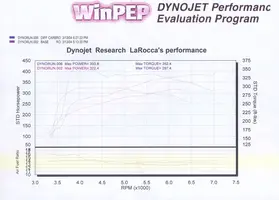
Here's my dyno on my 408c 70 Mach. I think it carrys the torque and hp well. Ray
dyno%20428hp%20final%20pull.JPG800x600.JPG
 
67GTA-FB429 said:
Another way to think about it is:

Torque is two dimensional.

HP is three dimensional.

Who can be the first to tell the rest of the class how horsepower was orginally defined?? (a clue: there was a horse invloved)


I think it had something to to how high a horse could pull on a rope attached to a pulley and raise a certain wieght off the ground. IIRC RAY
 
Seems it was how long it took a horse to raise a set weight up a well shaft, by pulley.
The weight was set, distance was set, and one horse was used.
It was something like that. It involved weight, distance, and time.
Some of the takes on the TQ/HP relationship so far are EXCELLENT!

I like the comment about building for HP then using driveline torque multiplication for grunt.
It's so simple that you miss it. That is how cars work, but I have never thought about it quite that way.

Ray: Love that dyno, it is much flatter than I would expect from a Cleveland. They are usually peaky. I guess it's the cubes shining through.

When it comes to the SBF, you won't get suitable torque with the short stroke... build for HP and gear it right. Not just the rear either. Choices like wide ratio or close ratio toploader, for example, make a world of difference.
Dave
 
It's all about the area under the curve. That's how "weaker" cars beat "stronger" ones. You see this phenomenon on the import or srt forums a lot. So many guys tune those engines with blinders on, aiming for nothing but a peak hp number to brag about, and they end up with a hp curve that looks like a spike (once the turbo spools up and you hit the nos). A car with 20% less hp and a smooth, consistent curve will win every time. The area under the curve represents the work done. Just as in life ( :p ), more work = better results.

411- your synopsis at the beginning of the thread is pretty good, and it's gotten supplemented well by everyone -- much better than what we were bickering about in the other thread! :rlaugh: :rlaugh:
 
ratio411 said:
I like the comment about building for HP then using driveline torque multiplication for grunt.
It's so simple that you miss it. That is how cars work, but I have never thought about it quite that way.
Give yourself some credit! You have thought about it that way -- just look at your handle!!
 
ratio411 said:
:nice:

Don't be afraid to use a 750 vacuum Holley... afterall, the 2 barrels that operate mechanically flow the same as your stock 2v. The back barrels don't open until your engine wants them... when properly adjusted.

I've been playing with my carb this past month. I bought a used 600 vacuum secondary Holley, removed the manual choke, cut off the air horn over the primaries, used a rebuild kit, installed a quick change secondary spring kit with the unpainted spring which should be the median spring and removed the ball bearing restrictor in the diaphram housing. I also installed a new intake gasket on the 302. Wow, this carb really pulled hard, so tried reinstalling the ball bearing and it was a little more manageable but controlling the idle was a bear. Now, I realize it could've been other issues with the idle, so installed a brand new 600 manual choke with the same size jets and secondary spring, and noticed that it doesn't pull as hard, even though I can control the idle very well. So, a 750 would work also?
 
reenmachine said:
"So many guys tune those engines with blinders on, aiming for nothing but a peak hp number to brag about, and they end up with a hp curve that looks like a spike (once the turbo spools up and you hit the nos)."
Hehehe :D exactly. See sig. below ! Is this why imports that have 400 rwhp only run 12 's ?
 
2nd Mustang said:
I've been playing with my carb this past month. I bought a used 600 vacuum secondary Holley, removed the manual choke, cut off the air horn over the primaries, used a rebuild kit, installed a quick change secondary spring kit with the unpainted spring which should be the median spring and removed the ball bearing restrictor in the diaphram housing. I also installed a new intake gasket on the 302. Wow, this carb really pulled hard, so tried reinstalling the ball bearing and it was a little more manageable but controlling the idle was a bear. Now, I realize it could've been other issues with the idle, so installed a brand new 600 manual choke with the same size jets and secondary spring, and noticed that it doesn't pull as hard, even though I can control the idle very well. So, a 750 would work also?
Let's put it this way:
If you tune the secondaries correctly, heck the whole carb correctly...
To quote Smoky Yunick: "The 3310 is the runnin'est carb on the planet!".
Yeah, you can overcarb as long as you have control of the secondary side of the carb. You could do the same with another carb, but it takes alot more effort.
For auto trans and street use, you should be fine.
I assume you have a dual plane intake?
Another tuning secret is that dual plane intakes 'tame' large carbs. Folks don't understand when they look at those carb charts that the size recommended is a minimum that your engine needs and the chart does not account for intake manifold... the dual plane intake makes a carb run smaller than it is rated.
Good luck
Dave

Btw: I wouldn't get too radical with removing check balls from your carb. That kinda defeats the purpose of softening the secondary side IMO.
DO HOWEVER: Remove the sintered bronze filters from the bowl inlets. Those are a major flow restriction. Use a carb with umbrella style accellerator pump check valve, the ball type bowl is not nearly as responsive.