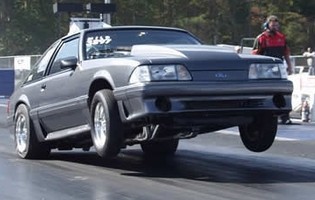
Stangbang - I meant exactly what Perky said 2 posts later, if fact we both said almost exactly the same thing - look at his launch - straight and level side to side; both front wheels pulled an even amount; rear end is level too. The more the unibody is stiffened, and the rear suspension is optimized to launch straight and level, the more the engine's torque gets applied to moving you forward quickly (assuming traction) instead of some of it being absorbed in twisting the chassis.
The engine rotates in a counterclockwise direction. As someone correctly stated about Mr. Newton's discoveries, there's an equal and opposite reaction to that tortional force. Watch your motor from the front as the throttle is goosed - it will rise on the driver's side and dip on the passenger's side - that's the equal and opposite reaction to the torque production of the motor. It would be exagerated if you could watch it while the car is actually accelerating - more torque is created than when you're just revving the engine with no load. So in response to the torque the engine's creating, it pulls up hard on the driver's side motor mount, and it pushes down hard on passenger side motor mount. Since the stock unibody is fairly flexible, if you pull hard enough, you can actually twist the unibody. That's what's happening when you see cars pull the driver's side front wheel, and dip down hard on the passenger's side rear. Related to this you now can see why people use solid motor mounts or chains/struts to limit engine movement. With elastomeric motor/tranny mounts (rubber, polyurethane) some of the engine's torque is consumed pulling against/compressing the motor mounts. It's a small amount, but in some rules-constrained classes, even 1 or 2 ft-lbs/hp can make the difference.