

Pretty good information here regarding tuning for Warmup Enrichment, and Afterstart Enrichment.
First, view this video.
View: https://youtu.be/b5xwmIMHyqU?si=AQW8YZEttMr05AV2
Second, take a look at this graphic
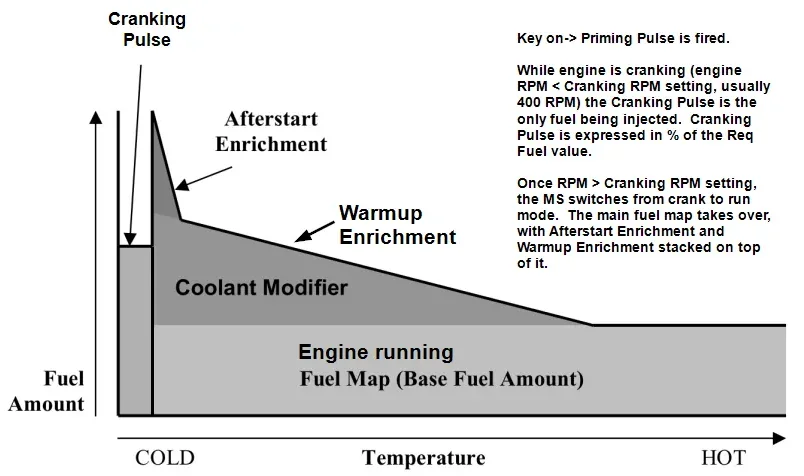
When you start a cold engine, fuel may not immediately or efficiently atomize. It may pool in the boundary layer of air flowing near the intake/cylinder inlet walls. (simplified explanation) . Because of this, you need extra fuel during cold start, and a little boost of it even during hot start.
Without it, you go lean. Do even if you nail your VE table perfectly, when you cold start or hot start, you tend to run lean. The point of WUE (warmup enrichment) and ASE (After start enrichment) is to add that extra fuel in the form of a multiplier on top of your VE table.
With megasquirt, (and other ECU setups) you can control the amount of fuel, and the taper rate with ASE. WUE taper is controlled by coolant temp. The goal (as seen in steve's video above) is to balance this out so that you provide just enough fuel to maintain proper AFR, and taper it off before you start going too rich due to no longer needing that additional fuel. SO you are adjusting your ASE % and your ASE taper rate by watching (or logging) the AFR and making adjustments.
Priming pulse and cranking pulse are also two different fuel modifiers. Priming pulse squirts fuel in prior to crank, and cranking pulse is your fuel added during the crank. You then set a crank RPM value as the transition between cranking fuel and when your VE, WUE and ASE take over...the big vertical jump in the above pic. In my case, i bumped it to 450RPM.
Now, don't be tempted to chase this with your VE table. Dial your VE table in when the car is fully warmed up and WUE and ASE are off. When you cold or warm start, if your initial AFR values seem off, this is due to improper WUE/ASE levels and taper time. If ASE is off and you are rich/lean, adjust your WUE to get back at target without any EGO correction.
That's summing it up quickly. I spent a hour or so today doing what Steve did and just starting and restarting the car as it warmed up, and then let it cool down and did some starts in the 120-150 degree range. Essentially I watched the AFR and made my adjustments. If it lean spiked about 5-10 seconds after start, i adjusted the WUE and ASE as needed in that temp range. It's tricky to balance the two because at low temps, they will work together.
Now, if you dial in the WUE/ASE, but notice as time goes on, your mixture gets richer, verify that ASE has turned off. If it hasn't, you need to shorten the taper. Basically what has happened is that you have rebuilt that fuel boundary layer, but are likely still adding it via ASE. It's only enrichening your mixture at that point, so turn car off, shorten your ASE taper, and restart and test.
First, view this video.
View: https://youtu.be/b5xwmIMHyqU?si=AQW8YZEttMr05AV2
Second, take a look at this graphic
When you start a cold engine, fuel may not immediately or efficiently atomize. It may pool in the boundary layer of air flowing near the intake/cylinder inlet walls. (simplified explanation) . Because of this, you need extra fuel during cold start, and a little boost of it even during hot start.
Without it, you go lean. Do even if you nail your VE table perfectly, when you cold start or hot start, you tend to run lean. The point of WUE (warmup enrichment) and ASE (After start enrichment) is to add that extra fuel in the form of a multiplier on top of your VE table.
With megasquirt, (and other ECU setups) you can control the amount of fuel, and the taper rate with ASE. WUE taper is controlled by coolant temp. The goal (as seen in steve's video above) is to balance this out so that you provide just enough fuel to maintain proper AFR, and taper it off before you start going too rich due to no longer needing that additional fuel. SO you are adjusting your ASE % and your ASE taper rate by watching (or logging) the AFR and making adjustments.
Priming pulse and cranking pulse are also two different fuel modifiers. Priming pulse squirts fuel in prior to crank, and cranking pulse is your fuel added during the crank. You then set a crank RPM value as the transition between cranking fuel and when your VE, WUE and ASE take over...the big vertical jump in the above pic. In my case, i bumped it to 450RPM.
Now, don't be tempted to chase this with your VE table. Dial your VE table in when the car is fully warmed up and WUE and ASE are off. When you cold or warm start, if your initial AFR values seem off, this is due to improper WUE/ASE levels and taper time. If ASE is off and you are rich/lean, adjust your WUE to get back at target without any EGO correction.
That's summing it up quickly. I spent a hour or so today doing what Steve did and just starting and restarting the car as it warmed up, and then let it cool down and did some starts in the 120-150 degree range. Essentially I watched the AFR and made my adjustments. If it lean spiked about 5-10 seconds after start, i adjusted the WUE and ASE as needed in that temp range. It's tricky to balance the two because at low temps, they will work together.
Now, if you dial in the WUE/ASE, but notice as time goes on, your mixture gets richer, verify that ASE has turned off. If it hasn't, you need to shorten the taper. Basically what has happened is that you have rebuilt that fuel boundary layer, but are likely still adding it via ASE. It's only enrichening your mixture at that point, so turn car off, shorten your ASE taper, and restart and test.
Last edited:


