
You are using an out of date browser. It may not display this or other websites correctly.
You should upgrade or use an alternative browser.
You should upgrade or use an alternative browser.
Tuning EFI vs. carb conversion
- Thread starter stdyhand
- Start date


Three50won
10 Year Member
- Jul 11, 2010
- 1,135
- 64
- 69
stdyhand, check their website. There are some tuners who will tune to your specific mods (or at least try to). You can buy the chip you need, the burner for the chip, and then purchase and download the software and write your own tunes. But you'll need a wide band to be accurate. Carbs need widebands for accuracy also mind you. Sometimes tho it takes a while to get used to tuning so you can pay the techs $50 to write you a starter tune that will get you running and close to where you need to be. From there it's pretty much a learning experience. There are many who can help you and there are other forums (even a section on here) for tuning advice.

Moates Quarterhorse and Tweecer are two of the more common add on devices for tuning and EFI setup. Both are good, and have different requirements to lean how to use them.
See http://www.moates.net/ford-pre2005-c-63.html
and
http://www.tweecer.com/
Both require the use of a laptop (for mobile tuning) or computer to read the data and write the program into the adapter device that plugs into the EEC (engine computer) test port.
Don't guess or take some wild speculation on injector sizes, do the engineering math:
Fuel injector sizing & injector photos
Revised 20-May-2011 to add MAF and custom tune requirements for use with larger injectors
Injector HP ratings: divide flow rating by.5 and multiply the result by the number of injectors. This uses a 100% duty cycle. These ratings are for naturally aspirated engines at the flywheel.
19/.5 = 38, 38 x 8 = 304 HP
24/.5 = 48, 48 x 8 = 384 HP
30/.5 = 60, 60 x 8 = 480 HP
36/.5 = 72, 72 x 8 = 576 HP
42/.5 = 84, 84 x 8 = 672 HP
The preferred duty cycle is about 85% maximum, so for a safety factor multiply the final figure times .85.
19/.5 = 38, 38 x 8 = 304 HP x .85 = 258 HP
24/.5 = 48, 48 x 8 = 384 HP x .85 = 326 HP
30/.5 = 60, 60 x 8 = 480 HP x .85 = 408 HP
36/.5 = 72, 72 x 8 = 576 HP x .85 = 490 HP
42/.5 = 84, 84 x 8 = 672 HP x .85 = 571 HP
Remember that the above ratings are at 39 PSI. Increasing the pressure will effectively increase the flow rating. Example: a 19 lb injector will flow 24 lbs at 63 PSI, and a 24 lb injector will flow 30 lbs at 63 PSI.
See http://users.erols.com/srweiss/ to get the calculators used in these examples.
Here's the duty cycle explanation. Duty cycle is how much of the time the intake is open the injectors are turned on. The 85% figure means that for 85% of the time the intake valve is open, the injectors are spraying. The idea is that you want some percentage of the duty cycle left over so that you have some room to grow the process.
If you are at 100% and you need more fuel, all you can do is turn up the fuel pressure. That means the whole fuel curve from idle to WOT is affected. Maybe you are already too rich at idle, and turning up the fuel pressure makes it worse. If you had some injector duty cycle left to play with, a custom tune could use that where it is needed. That would not over richen the whole range from idle to WOT.
With larger than stock injectors or higher that stock fuel pressure, you will need an aftermarket MAF that matches the injector size. The MAF “lies” to the computer to get a fuel delivery schedule that meets the engine’s needs and isn’t too rich or too lean. The best strategy is an aftermarket MAF and a custom tune to insure the best air/fuel ratio over all the RPM range.
Diagram courtesy of Tmoss & Stang&2birds
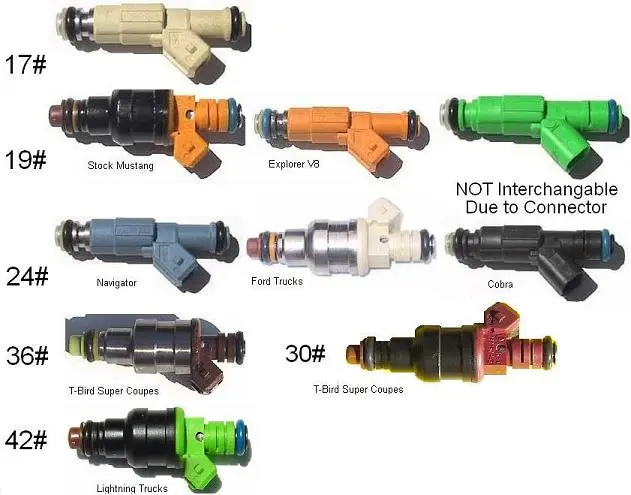
Don't forget to increase the fuel pump size when you increase injector size or significantly increase the fuel pressure
Copied from the FORD RACING PERFORMANCE PARTS catalog:
PROPERLY SIZING FUEL SYSTEM COMPONENTS
Fuel Pumps
The following information is presented assuming the above information has been taken into consideration regarding BSFC, fuel pressure and specific gravity of the fuel being used. Most fuel pumps for electronic fuel injection are rated for flow at 12 volts @ 40 PSI. Most vehicle charging systems operate anywhere from 13.2v to 14.4v. The more voltage you feed a pump, the faster it spins which, obviously, will put out more fuel. Rating a fuel pump at 12 volts then, should offer a fairly conservative fuel flow rating allowing you to safely determine the pump’s ability to supply an adequate amount of fuel for a particular application.
As previously mentioned, engines actually require a certain WEIGHT of fuel, NOT a certain VOLUME of fuel per horsepower. This can offer a bit of confusion since most fuel pumps are rated by volume, and not by weight. To determine the proper fuel pump required, a few mathematical conversions will need to be performed using the following information. There are 3.785 liters in 1 US Gallon. 1 gallon of gasoline (.72 specific gravity @ 65° F) weighs 6.009 LBS.
To be certain that the fuel pump is not run to its very limit, which could potentially be dangerous to the engine, multiply the final output of the fuel pump by 0.9 to determine the capacity of the fuel pump at 90% output. This should offer plenty of ‘cushion’ as to the overall “horsepower capacity” of the fuel pump.
To determine the overall capacity of a fuel pump rated in liters, use the additional following conversions:
(Liters per Hour) / 3.785 = Gallons
Multiply by 6.009 = LBS/HR
Multiply by 0.9 = Capacity at 90%
Divide by BSFC = Horsepower Capacity
So for a 110 LPH fuel pump:
110 / 3.785 = 29.06 Gallons
29.06 x 6.009 = 174.62 LBS/HR
174.62 x 0.9 = 157 LBS/HR @ 90% Capacity
157 / 0.5 = 314 HP safe naturally aspirated “Horsepower Capacity”
Safe “Horsepower Capacity” @ 40 PSI with 12 Volts
60 Liter Pump = 95 LB/HR X .9 = 86 LB/HR, Safe for 170 naturally aspirated Horsepower
88 Liter Pump = 140 LB/HR X .9 = 126 LB/HR, Safe for 250 naturally aspirated Horsepower
110 Liter Pump = 175 LB/HR X .9 = 157 LB/HR, Safe for 315 naturally aspirated Horsepower
155 Liter Pump = 246 LB/HR X .9 = 221 LB/HR, Safe for 440 naturally aspirated Horsepower
190 Liter Pump = 302 LB/HR X .9 = 271 LB/HR, Safe for 540 naturally aspirated Horsepower
255 Liter Pump = 405 LB/HR X .9 = 364 LB/HR, Safe for 700 naturally aspirated Horsepower
Note: For forced induction engines, the above power levels will be reduced because as the pressure required by the pump increases, the flow decreases. In order to do proper fuel pump sizing, a fuel pump map is required, which shows flow rate versus delivery pressure.
That is, a 255 liter per hour pump at 40 PSI may only supply 200 liters per hour at 58 PSI (40 PSI plus 18 lbs of boost). Additionally, if you use a fuel line that is not large enough, this can result in decreased fuel volume due to the pressure drop across the fuel feed line: 255 LPH at the pump may only result in 225 LPH at the fuel rail.
See the following website for some help from Tmoss (diagram designer) & Stang&2Birds (website host) for help on 88-95 wiring http://www.veryuseful.com/mustang/tech/engine/ Everyone should bookmark this site.
Ignition switch wiring
http://www.veryuseful.com/mustang/tech/engine/images/IgnitionSwitchWiring.gif
Fuel, alternator, A/C and ignition wiring
http://www.veryuseful.com/mustang/tech/engine/images/fuel-alt-links-ign-ac.gif
Complete computer, actuator & sensor wiring diagram for 88-91 Mass Air Mustangs
http://www.veryuseful.com/mustang/tech/engine/images/88-91_5.0_EEC_Wiring_Diagram.gif
Vacuum diagram 89-93 Mustangs
http://www.veryuseful.com/mustang/tech/engine/images/mustangFoxFordVacuumDiagram.jpg
HVAC vacuum diagram
http://www.veryuseful.com/mustang/tech/engine/images/Mustang_AC_heat_vacuum_controls.gif
TFI module differences & pinout
http://www.veryuseful.com/mustang/tech/engine/images/TFI_5.0_comparison.gif
Fuse box layout
http://www.veryuseful.com/mustang/tech/engine/images/MustangFuseBox.gif
See http://www.moates.net/ford-pre2005-c-63.html
and
http://www.tweecer.com/
Both require the use of a laptop (for mobile tuning) or computer to read the data and write the program into the adapter device that plugs into the EEC (engine computer) test port.
Don't guess or take some wild speculation on injector sizes, do the engineering math:
Fuel injector sizing & injector photos
Revised 20-May-2011 to add MAF and custom tune requirements for use with larger injectors
Injector HP ratings: divide flow rating by.5 and multiply the result by the number of injectors. This uses a 100% duty cycle. These ratings are for naturally aspirated engines at the flywheel.
19/.5 = 38, 38 x 8 = 304 HP
24/.5 = 48, 48 x 8 = 384 HP
30/.5 = 60, 60 x 8 = 480 HP
36/.5 = 72, 72 x 8 = 576 HP
42/.5 = 84, 84 x 8 = 672 HP
The preferred duty cycle is about 85% maximum, so for a safety factor multiply the final figure times .85.
19/.5 = 38, 38 x 8 = 304 HP x .85 = 258 HP
24/.5 = 48, 48 x 8 = 384 HP x .85 = 326 HP
30/.5 = 60, 60 x 8 = 480 HP x .85 = 408 HP
36/.5 = 72, 72 x 8 = 576 HP x .85 = 490 HP
42/.5 = 84, 84 x 8 = 672 HP x .85 = 571 HP
Remember that the above ratings are at 39 PSI. Increasing the pressure will effectively increase the flow rating. Example: a 19 lb injector will flow 24 lbs at 63 PSI, and a 24 lb injector will flow 30 lbs at 63 PSI.
See http://users.erols.com/srweiss/ to get the calculators used in these examples.
Here's the duty cycle explanation. Duty cycle is how much of the time the intake is open the injectors are turned on. The 85% figure means that for 85% of the time the intake valve is open, the injectors are spraying. The idea is that you want some percentage of the duty cycle left over so that you have some room to grow the process.
If you are at 100% and you need more fuel, all you can do is turn up the fuel pressure. That means the whole fuel curve from idle to WOT is affected. Maybe you are already too rich at idle, and turning up the fuel pressure makes it worse. If you had some injector duty cycle left to play with, a custom tune could use that where it is needed. That would not over richen the whole range from idle to WOT.
With larger than stock injectors or higher that stock fuel pressure, you will need an aftermarket MAF that matches the injector size. The MAF “lies” to the computer to get a fuel delivery schedule that meets the engine’s needs and isn’t too rich or too lean. The best strategy is an aftermarket MAF and a custom tune to insure the best air/fuel ratio over all the RPM range.
Diagram courtesy of Tmoss & Stang&2birds
Don't forget to increase the fuel pump size when you increase injector size or significantly increase the fuel pressure
Copied from the FORD RACING PERFORMANCE PARTS catalog:
PROPERLY SIZING FUEL SYSTEM COMPONENTS
Fuel Pumps
The following information is presented assuming the above information has been taken into consideration regarding BSFC, fuel pressure and specific gravity of the fuel being used. Most fuel pumps for electronic fuel injection are rated for flow at 12 volts @ 40 PSI. Most vehicle charging systems operate anywhere from 13.2v to 14.4v. The more voltage you feed a pump, the faster it spins which, obviously, will put out more fuel. Rating a fuel pump at 12 volts then, should offer a fairly conservative fuel flow rating allowing you to safely determine the pump’s ability to supply an adequate amount of fuel for a particular application.
As previously mentioned, engines actually require a certain WEIGHT of fuel, NOT a certain VOLUME of fuel per horsepower. This can offer a bit of confusion since most fuel pumps are rated by volume, and not by weight. To determine the proper fuel pump required, a few mathematical conversions will need to be performed using the following information. There are 3.785 liters in 1 US Gallon. 1 gallon of gasoline (.72 specific gravity @ 65° F) weighs 6.009 LBS.
To be certain that the fuel pump is not run to its very limit, which could potentially be dangerous to the engine, multiply the final output of the fuel pump by 0.9 to determine the capacity of the fuel pump at 90% output. This should offer plenty of ‘cushion’ as to the overall “horsepower capacity” of the fuel pump.
To determine the overall capacity of a fuel pump rated in liters, use the additional following conversions:
(Liters per Hour) / 3.785 = Gallons
Multiply by 6.009 = LBS/HR
Multiply by 0.9 = Capacity at 90%
Divide by BSFC = Horsepower Capacity
So for a 110 LPH fuel pump:
110 / 3.785 = 29.06 Gallons
29.06 x 6.009 = 174.62 LBS/HR
174.62 x 0.9 = 157 LBS/HR @ 90% Capacity
157 / 0.5 = 314 HP safe naturally aspirated “Horsepower Capacity”
Safe “Horsepower Capacity” @ 40 PSI with 12 Volts
60 Liter Pump = 95 LB/HR X .9 = 86 LB/HR, Safe for 170 naturally aspirated Horsepower
88 Liter Pump = 140 LB/HR X .9 = 126 LB/HR, Safe for 250 naturally aspirated Horsepower
110 Liter Pump = 175 LB/HR X .9 = 157 LB/HR, Safe for 315 naturally aspirated Horsepower
155 Liter Pump = 246 LB/HR X .9 = 221 LB/HR, Safe for 440 naturally aspirated Horsepower
190 Liter Pump = 302 LB/HR X .9 = 271 LB/HR, Safe for 540 naturally aspirated Horsepower
255 Liter Pump = 405 LB/HR X .9 = 364 LB/HR, Safe for 700 naturally aspirated Horsepower
Note: For forced induction engines, the above power levels will be reduced because as the pressure required by the pump increases, the flow decreases. In order to do proper fuel pump sizing, a fuel pump map is required, which shows flow rate versus delivery pressure.
That is, a 255 liter per hour pump at 40 PSI may only supply 200 liters per hour at 58 PSI (40 PSI plus 18 lbs of boost). Additionally, if you use a fuel line that is not large enough, this can result in decreased fuel volume due to the pressure drop across the fuel feed line: 255 LPH at the pump may only result in 225 LPH at the fuel rail.
See the following website for some help from Tmoss (diagram designer) & Stang&2Birds (website host) for help on 88-95 wiring http://www.veryuseful.com/mustang/tech/engine/ Everyone should bookmark this site.
Ignition switch wiring
http://www.veryuseful.com/mustang/tech/engine/images/IgnitionSwitchWiring.gif
Fuel, alternator, A/C and ignition wiring
http://www.veryuseful.com/mustang/tech/engine/images/fuel-alt-links-ign-ac.gif
Complete computer, actuator & sensor wiring diagram for 88-91 Mass Air Mustangs
http://www.veryuseful.com/mustang/tech/engine/images/88-91_5.0_EEC_Wiring_Diagram.gif
Vacuum diagram 89-93 Mustangs
http://www.veryuseful.com/mustang/tech/engine/images/mustangFoxFordVacuumDiagram.jpg
HVAC vacuum diagram
http://www.veryuseful.com/mustang/tech/engine/images/Mustang_AC_heat_vacuum_controls.gif
TFI module differences & pinout
http://www.veryuseful.com/mustang/tech/engine/images/TFI_5.0_comparison.gif
Fuse box layout
http://www.veryuseful.com/mustang/tech/engine/images/MustangFuseBox.gif
Attachments

I have no idea what quarterhorse is. Is that like the Bama chips you buy that are already burnt according to the information you supply them regarding your injector size, MAF, etc? Your talking 350 dollars and its something that will allow me to tune it myself, correct? I wouldn't mind paying that one time if I can use it over and over in the future. Do you hook it up to a lap top like they use on the dyno's? Does this quarterhorse say how much HP/torque your putting out or is that limited to an actual dyno?
The Quarterhorse is just a hardware device that allows you to tap into your stock computer, and you can buy software that allows you to modify the computer's programming. The Quarterhorse is also capable of saving multiple tunes and datalogging and some other functions as well. I don't know toooo much about it, because I have yet to get one myself, though I plan on picking one up sometime after the new year. Go to Moates.net for more info.
And no, it does not show you your horsepower and torque, haha. That's something that only dynos can do.

95Vert383AOD
15 Year Member
Those 351 Intakes aren't cheap. Especially the ones designed to get you to that 400+.
Also i think running stock fuel lines is cutting it pretty close in that power level on a 400-450hp motor.
I wouldn't use anything smaller than a 80mm TB with an 80+ MAF
I grazed threw the posts but $1000 302 heads wont cut it either. In 351 i would at bare minimum use around a 185cc head by Trickflkow or AFR.....If you plan on stroking to a 408 in the future skip to a 205-225cc head.
Personally the most expensive part of a 351 swap is the heads, Intake and that cowl hood you'll probably need.
Chris
Also i think running stock fuel lines is cutting it pretty close in that power level on a 400-450hp motor.
I wouldn't use anything smaller than a 80mm TB with an 80+ MAF
I grazed threw the posts but $1000 302 heads wont cut it either. In 351 i would at bare minimum use around a 185cc head by Trickflkow or AFR.....If you plan on stroking to a 408 in the future skip to a 205-225cc head.
Personally the most expensive part of a 351 swap is the heads, Intake and that cowl hood you'll probably need.
Chris
Agreed.Those 351 Intakes aren't cheap. Especially the ones designed to get you to that 400+.
Also i think running stock fuel lines is cutting it pretty close in that power level on a 400-450hp motor.
I wouldn't use anything smaller than a 80mm TB with an 80+ MAF
I grazed threw the posts but $1000 302 heads wont cut it either. In 351 i would at bare minimum use around a 185cc head by Trickflkow or AFR.....If you plan on stroking to a 408 in the future skip to a 205-225cc head.
Personally the most expensive part of a 351 swap is the heads, Intake and that cowl hood you'll probably need.
Chris
Those 351 Intakes aren't cheap. Especially the ones designed to get you to that 400+.
Also i think running stock fuel lines is cutting it pretty close in that power level on a 400-450hp motor.
I wouldn't use anything smaller than a 80mm TB with an 80+ MAF
I grazed threw the posts but $1000 302 heads wont cut it either. In 351 i would at bare minimum use around a 185cc head by Trickflkow or AFR.....If you plan on stroking to a 408 in the future skip to a 205-225cc head.
Personally the most expensive part of a 351 swap is the heads, Intake and that cowl hood you'll probably need.
Chris
I will not be using the stock fuel lines. I will be replacing those as well since the stock lines are very rusty from the last 20+ years. I am installing some new stainless steel lines. Also I have already decided on AFR heads, probably 225's to run with the super victor intake on the 351. It will get stroked to 408 later, but not right now. I'm still not sure on my cam choice. I may run a trick flow cam until I can afford a custom ground cam later.
jrichker I appreciate all that information. I normally have to browse the internet for days to get all that kind of information. Your saving me a lot of time and I'm grateful.
I've got another question. Rather than putting up another thread I'll post it here since it is related to the tuning process. This quarterhorse software/hardware has me interested in keeping the EFI since I can do this all myself.
Do I need a regular narrowband AFR gauge to read the stock O2 sensor or do I need a wideband O2 sensor and gauge?
The reason I ask is because I've been reading about how the wideband is better for tuning high performance engines. However, I also read somewhere that the stock O2, which is narrowband, only reads about 10-20 AFR and that at WOT of under heavy throttle the ECM ignores the O2 sensors reading.
How would the wideband benefit me for the tuning if the ECM ignores the O2 under heavy throttle anway?
I might not be thinking of this the right way. Thats probably why it is rather confusing.
Does the wideband plug into the laptop and automatically feed data back regaurding AFR at higher RPM's or do I have to feed that data into the laptop myself?
Do I need a regular narrowband AFR gauge to read the stock O2 sensor or do I need a wideband O2 sensor and gauge?
The reason I ask is because I've been reading about how the wideband is better for tuning high performance engines. However, I also read somewhere that the stock O2, which is narrowband, only reads about 10-20 AFR and that at WOT of under heavy throttle the ECM ignores the O2 sensors reading.
How would the wideband benefit me for the tuning if the ECM ignores the O2 under heavy throttle anway?
I might not be thinking of this the right way. Thats probably why it is rather confusing.
Does the wideband plug into the laptop and automatically feed data back regaurding AFR at higher RPM's or do I have to feed that data into the laptop myself?
efi tuning can take some time to understand.
think of it like this. the computer uses the 02 sensors to get close to a certain afr that you tell the computer you want to run at. using the wide band and data logging allows you to see what your actual afr is and tune to get it where you want it to be at.
think of it like this. the computer uses the 02 sensors to get close to a certain afr that you tell the computer you want to run at. using the wide band and data logging allows you to see what your actual afr is and tune to get it where you want it to be at.

Boydster
5 Year Member
...Do I need a regular narrowband AFR gauge to read the stock O2 sensor or do I need a wideband O2 sensor and gauge?
Wideband will give you actual AFR... 14.1:1, 15.7:1, 12.3:1 etc. At all throttle settings.
Narrowband (factory sensors) will only give you rich or lean... they are more like a switch, whereas the wideband is totally variable to the limits of the system.
Wideband will give you actual AFR... 14.1:1, 15.7:1, 12.3:1 etc. At all throttle settings.
Narrowband (factory sensors) will only give you rich or lean... they are more like a switch, whereas the wideband is totally variable to the limits of the system.
I have looked at several AFR gauges and they each say they read between 10-20 AFR. Since anything lower or higher is obviously undesirable I'm wondering why anyone uses the wideband if the narrowband can read between 10-20. From what I've been reading on an EEC tuning website, the target AFR is normally around 14.7:1 or close to that. Well the narrow band can read well above and below that target. So if your showing a 10 you know your obviously running very rich.
Does it really matter if you can see an exact ratio below 10? Either way it is too rich and means you need to adjust your injectors. Same thing with a reading above 20, you know it is too lean.
I might be thinking about it wrong, but I look at it similar to sighting in a rifle. It doesn't matter how far right you missed the target, only that it missed. Big adjustments are needed to get you on paper or in this case on the gauge between 10-20. Once your there smaller adjustments are needed until you reach your target AFR.
Again, I don't know a whole lot about the narrow vs. wide band sensors. I have been reading up on them but I haven't seen any convincing explanation for why the wideband is so much better.
The narrow band A/F gauges that use the O2 sensor signal will jump all over the place. The reason is that the O2 sensors "switch" between .2 volt lean and .6 volt rich with a curve that looks like the drop off a high cliff. The curve is almost straight up and down, so the voltage shoots from .2 to .6 and back down . again 2 or more times a second at cruse. You won't get much useful information except when the mixture is extremely lean or extremely rich, there is no middle ground. The engine control computer's program knows about the jumping around . The program is designed to use it to not only measure the A/F ratio, but also diagnose the quality of the sensors and their wiring.
Wide band A/F gauges use a sensor with more linear range that is more of a straight line slope. That gives the display device a simpler data stream to display. It is possible to use an analog display device like a meter and get excellent results.
Wide band A/F gauges use a sensor with more linear range that is more of a straight line slope. That gives the display device a simpler data stream to display. It is possible to use an analog display device like a meter and get excellent results.
Boydster
5 Year Member
I have looked at several AFR gauges and they each say they read between 10-20 AFR. Since anything lower or higher is obviously undesirable I'm wondering why anyone uses the wideband if the narrowband can read between 10-20.
I understand what you're saying... you're thinking the narrowband only reads 10-20, whereas the wideband will read say from 5 to 25... a "wider band". This is a mistake. Think of a narrowband as a simple switch... rich, lean or in the middle. That's all it knows... that's it. Wideband senses precise ratios.
The EECIV uses narrowband sensors. You cannot install widebands in place of them or it drives the computer nuts. If you want to show A/F ratios, you need to install a wideband separate from the EEC system and wire it to it's own gauge / data logger / tuner.
2002BLGT
Well-Known Member
Leave the EFI on it , and either learn how to tune it yourself or have a professional tune it , just make sure you research before going to get it tuned , some guys know what they are doing and some dont , just ask for recommendations of local tuners on here before hand
2002BLGT
Well-Known Member
As for the MAF situation , use the stock one till its pegged then upgrade if needed , most built 306s can get back with a 255lph intank pump and 24lbs injectors , I just had a car go 314rwhp on stock MAF without pegging so changing the MAF is not always needed
did EFI to carb swap on my 302 i would suggest going edelbrock for carb SO MUCH EASIER!!!!! and if you don't know summitracing.com has a carb cfm calculator when it all comes down to it if your replacing everything your going to spend more going EFI i know my car isn't anything like your planning on building (edelbrock 600 carb, intake, cam and ported stock heads) however Id do the swap, it's easy cheap and you can deffinately can make the power with the carb.
edit: you can also buy a CD for 1.99 off summit which teaches you how to tune a edelbrock carb
edit: you can also buy a CD for 1.99 off summit which teaches you how to tune a edelbrock carb
Similar threads
Digital Tuning
Going heads/cam/intake. Do I need a tune?
- Replies
- 41
- Views
- 812

- Replies
- 4
- Views
- 146
- Replies
- 67
- Views
- 1K

- Replies
- 6
- Views
- 200
