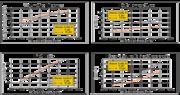
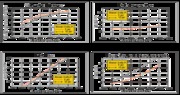
I didn't state that over all efficiency was better with the Eaton, only lower level efficiency.
The various tests article that I’ve seen printed aren't exactly objective by comparison. When most manufactures (save for Kenne Bell obviously) rate a blowers efficiency, they refer to the output of said unit alone, not the blower bolted to their particular brand of manifold, with their particular brand of inlet system, bolted to "X" car, with "X" amount of modifications. For one, the accompanying manifold the blower is saddled with has a huge effect on all characteristics. Take a look at the Saleen series IV and V kits. Both utilize screw compressors (Whipple) of the same design as Kenne Bell, but since the manifold and inlet design is inferior to the Kenne Bells, all other aspects (power output, flow potential, boost levels, discharge temperature) are affected....but not because the blower itself is any less efficient, but because the accompanying supporting parts are holding it back.
Also, not one article I've come across test any of the Positive Displacement blowers back to back in the 6psi, non intercooled range, nor do they run them in this range for any length of time. All I've seen plenty of tests where they've been pullied for 9lbs, 10lbs, 11lbs….even 20lbs of boost and run them a WOT on the dyno for a couple of seconds, then shut them down. This doesn't exactly mimic part throttle street operation that your average owner will see on a daily basis. I'll venture a guess and say full boost WOT applications only represents about 5-10% of normal driving.
If the Kenne Bell twin screws are so much greater at all levels of operation than all others, then why don’t they publish this data for all to see? It took me forever and dozens and dozens of searches through different sources to gather any data at all on them. Where are Kenne Bells hard figures stating volumetric efficiency, at a given level of boost or blower RPM, ACT’s at specific levels, horsepower required to support this level of airflow at these specific levels, etc, etc? Why do they not quote any specific figures in their sales propaganda, but instead make vague statements about superior efficiency backed with nothing more than an opinion based on their own views? I for one am all for Kenne Bell kits when looking to make high levels of power, where low end torque is still a concern, but I unlike some refuse to fall pray to creative sales pitches and self inflated opinion stated by one particular company about their product being “the best on the market”, just because they say so, when I’ve seen other tests that prove otherwise. I’m not questioning the ability of the kit itself, but their unproven claims of the power source behind it.