
You are using an out of date browser. It may not display this or other websites correctly.
You should upgrade or use an alternative browser.
You should upgrade or use an alternative browser.
Water Temp Gauge
- Thread starter Bite_ME
- Start date

Alternate placement for a temp gauge sender: Use the heater feed that comes off the intake manifold. Cut the rubber hose that connects the manifold water feed to the heater and splice in a tee adapter for the temp gauge sender. Be sure to use the same water feed line as the ECT sensor. That way you will get the most accurate temp readings.
Tee adapter info:
Make a pilgrimage to your local hardware or home supply center and get some copper pipe and a tee that fits the temp gauge sender. Solder two pieces of copper pipe onto a copper pipe tee with threads in the tee part. Find the correct brass fitting to match the temp sender threads to the tee fitting.

Tee adapter info:
Make a pilgrimage to your local hardware or home supply center and get some copper pipe and a tee that fits the temp gauge sender. Solder two pieces of copper pipe onto a copper pipe tee with threads in the tee part. Find the correct brass fitting to match the temp sender threads to the tee fitting.

LiquidGT
Member
If you still have the stock intake there is an extra 3/8 npt port on the lower; its on the drivers side near the firewall. You'll need to take off your upper plenum to get to it.

If you still have the stock intake there is an extra 3/8 npt port on the lower; its on the drivers side near the firewall. You'll need to take off your upper plenum to get to it.
For clarity, this location is not very accurate, thus you'd want to put the stock sender there and the aftermarket sender/bulb in the stock location on the lower intake.
Also, sometimes you can get away without removing the plenum.
Thanks for the response guys, does anyone have a picture of this 3/8 port on the lower intake ? What tools will I need to open that port properly, as I don't want to mess my intake up.
In the past Mustang5L5 has posted pics of the port. It's just an easy-to-spot square headed plug.
To remove it without removing the plenum, you need a 1/2" drive socket (the actual size of the socket doesn't matter - just the fact that it's 1/2" drive), some extensions and tape.
Put the socket on an extension, but put the socket on the extension upside down (so the square drive is facing away from the extension, The extension will go through the body of the socket). Use tape so the extension only extends into the square receptacle about 1/2 way (insert it half way and tape it so the extension can't slide into the square receptacle further). Now you can put the extension and socket onto the plug. The socket, which is upside down (with the square part facing downward) fits the head on the plug. Use a ratchet wrench to break the plug loose (some PB might be needed since galvanic corrosion occurs).
Then install the factory sender in this port and extend the sending unit wire (or pull it out of the factory harness) and attach the wire to the factory sender.
I suppose one should be prepared to pull the upper (just in case). A plenum gasket is requisite for that (they're a few bucks at better parts stores).
Dress the threads on the sender to help seal them and ease removal in the future.
FWIW, aftermarket senders are about 5 bucks at CSK (or so they were last time I checked).
Good luck.

Maryland Stang
Active Member
He has a mechanical gauge guys. Most of them are a pain in the behind since the "pellet" has to bottom out on a flange in order to seal. I've looked around but I've yet to see a mechanical gauge that will work on the stock 5.0 3/8" NPT water port.
He has a mechanical gauge guys. Most of them are a pain in the behind since the "pellet" has to bottom out on a flange in order to seal. I've looked around but I've yet to see a mechanical gauge that will work on the stock 5.0 3/8" NPT water port.
I'm not sure I follow. I've never had an issue. Perhaps the adapter fitting being used in your situations is creating an issue. That's about all I can think of (unless I didn't understand your concern correctly).

LiquidGT
Member
I drilled and tapped two T-stat housings, you'll need a 9/16 drill bit and a 3/8 npt thread tap and a 1/2 in chuck on the drill for the giant drill bit.
I had my mechanical gauge in it up until today; the gauge wont register untill the thermostat pops open. Which is kind of cool because you know the exact moment when your thermo opens.
This one is my spare, with my GM fan switch thats in the car now.
No leaks like the FRPP unit and is aluminum.
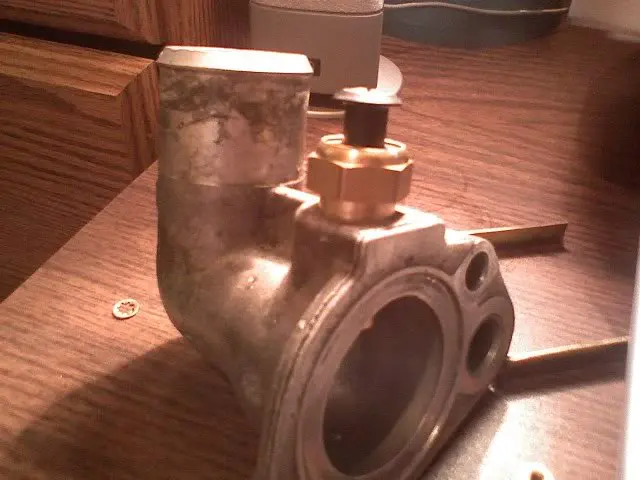
I had my mechanical gauge in it up until today; the gauge wont register untill the thermostat pops open. Which is kind of cool because you know the exact moment when your thermo opens.
This one is my spare, with my GM fan switch thats in the car now.
No leaks like the FRPP unit and is aluminum.
The Tee tube in the heater plumbing I posted is still the simplest method. You don't have to drill and tap anything. It is just as accurate as the ECT, which the computer uses for fuel control. Saves some $$$ by not having to purchase the drill and tap. Besides that, not everyone has a monster drill to chuck the drill bit in.
Maryland Stang
Active Member
In the pic above the probe has a 1/2" NPT adapter on it. That adapter has a flange at the bottom of it that keeps the probe tight and sealed up against the 3/8" NPT fitting that is not removable from the cable. If you remove the 1/2" adapter the probe falls out of the 3/8" fitting. Now the Mustang intake has a 3/8" NPT tapped hole for the temp gauge. If you put the probe and fitting into the tapped hole the probe is not pushed up tight against the fitting because there is no flange to hold the probe in place on the Mustang intake.
LiquidGT
Member
In the pic above the probe has a 1/2" NPT adapter on it. That adapter has a flange at the bottom of it that keeps the probe tight and sealed up against the 3/8" NPT fitting that is not removable from the cable. If you remove the 1/2" adapter the probe falls out of the 3/8" fitting. Now the Mustang intake has a 3/8" NPT tapped hole for the temp gauge. If you put the probe and fitting into the tapped hole the probe is not pushed up tight against the fitting because there is no flange to hold the probe in place on the Mustang intake.
After reading that five times and looking at my own mech gauge on my desk I see exactly what your saying about the flange thing. I think you have the 3/8" adapter confused for a 1/2", from what I see in the pic it appears to be 3/8" on my computer screen, the adapter stuck on the probe is something smaller.
Maryland Stang, I still don't follow (I also use an AM mech temp gauge). You have to buy the correct adapter (the guages tend to come with an adapter for a SBC but not a SBF) then you can install the adapter into the intake. Then install the bulb/capillary tube and its proprietary fitting.
For test fitment, assemble the fittings on the bench to be sure the adapter and fitting on the AM gauge will screw together hard enough to seal that bulb between the two.
A note about using the aftermarket t-stat housing. It does work well (It was 10 bucks well spent IMHO. I use one on the 94 for the totally useless stock gauge's sender). YOu dont want your good gauge sender there because if the stat sticks closed, your gauge wont let you know.
I like JRichker's idea - I just haven't had to rig that set-up together yet (all my gauge stuff has been together for awhile now).
For test fitment, assemble the fittings on the bench to be sure the adapter and fitting on the AM gauge will screw together hard enough to seal that bulb between the two.
A note about using the aftermarket t-stat housing. It does work well (It was 10 bucks well spent IMHO. I use one on the 94 for the totally useless stock gauge's sender). YOu dont want your good gauge sender there because if the stat sticks closed, your gauge wont let you know.
I like JRichker's idea - I just haven't had to rig that set-up together yet (all my gauge stuff has been together for awhile now).
Maryland Stang
Active Member
You have to buy the correct adapter (the guages tend to come with an adapter for a SBC but not a SBF) then you can install the adapter into the intake. Then install the bulb/capillary tube and its proprietary fitting.
Ahh... Sometimes I just need to be pointed in the correct direction.
Autometer part number 2272 is what is needed. 3/8" NPT inside to 3/8" NPT outside. Thanks a ton HISSIN50!


Put the mechanical prob in the stock location on the intake as it's the most accurate spot. Then extend the wire to the rear of the intake and put the stock sender in the spare port at the rear of the intake that is blocked with a 1/4" NPT fitting

Ahh... Sometimes I just need to be pointed in the correct direction.
Autometer part number 2272 is what is needed. 3/8" NPT inside to 3/8" NPT outside. Thanks a ton HISSIN50!
Hissin beat me to it. That adapter will work like a champ. I have used them when I put mechanical temp gauges on both my 93 and 88.
Similar threads

- Replies
- 21
- Views
- 637


- Replies
- 43
- Views
- 695

- Replies
- 1
- Views
- 120
