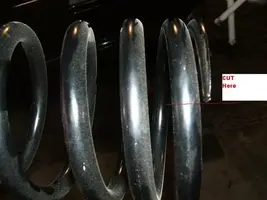
I'll also add that a drop of 1"+ screws up the CG (center of gravity) of the car (a *Stang*) as it corners. So, unless you go with very stiff race springs, don't even think of dropping the car more than ~1" if you want focus on
handling.
Summary (assuming installed in the
same car - a stock 93 Stang GT 5speed with AC):
GT spring: ~1,855 lbs of force to compress.
Mach1 Spring: ~1,800 lbs of force to compress. Coincidence? NO!
B Spring: Only ~1000 lbs of force to compress. That's because they are
not a spring made for a Stang! They are an OEM spring that Ford offered for
another vehicle!
Gee, it seems like the Mach1 & Bullitt springs were made for the Stang by
real automotive engineers and not by some aftermarket company selling BS parts, doesn't it?

CC plates will increase the NVH to the car. So will a new steering shaft (MM).
If you want a better handling car, go with the Mach1 Springs. They'll lower the car ~1/2" and up the spring rate from 425 to 600. Lowering a GT more than 1" means a LOT of stuff to consider for a PROPER setup.
IMHO, the
Prokit or "B" springs are a very poor choice! The rate is far too low for that amount of drop! You should also put in a bumpsteer kit. With ANY CC plates, IMHO, you MUST use an STB.
Also, a drop of more than 1" is a
very poor choice for a STREET car that's used in for the
majority of the U.S. There are a *few* places and a *few* people where a STREET car with a drop of over 1" may make some sense.
Fox V8 Stang came with 425/530 front springs. See pg 376 in the book by Al Kirschenbaum. The *Fox GT*'s (and V8's) have ~3.5" of jounce and rebound travel (pg 368).
So, lowering a car by 1.5" with the foolish "B" springs means that the springs bottom out with ~1000lbs of force - which isn't that uncommon in bad street bump. That means that the stock springs allow 75% more jounce than a GT with the stupid "B" springs:
1.5" (more travel with OEM springs)
------------------------------------- (divided by)
2" (total jounce with stupid B springs)
A bigger rim means a shorter sidewall. That means *more* harshness. The tires you pick also make a big difference! The sporty tires (Ultra performance tires) have very stiff sidewalls. That means a lot more harshness and also often noise. Although tread design has a lot to do with road noise.
With the Mach1 & Bullitt springs, it takes just about as much force to fully compress the spring as the Fox GT springs. It's hard to say exactly because the Fox springs are progressive.
See pg 376 in the book by Al Kirschenbaum. The *Fox GT*'s (and V8's) have ~3.5" of jounce and rebound travel (pg 368). A V8 should still have the 425/530 front springs.
So, that's a max of ~1,855 (3.5 * 530) pounds of force to compress a GT spring (assuming it was at 530 at stock height - which it isn't).
For a Mach1 Spring (~3 * 600) we get ~1.800 pounds of force to fully compress the spring. Coincidence? NO!
So, since we know that the Fox GT springs don't start out at a rate of 530 at stock height, we can see how the Mach1 and Bullitt springs are fine for the street! Gee, it even seems like they were made for the Stang by real automotive engineers and not by some aftermarket company selling BS part, doesn't it.