Black Jack: Working up to slicks


View: https://youtu.be/fjpv5aj8EIo?si=Xx6mSmQV8fUz0mfR


The tuning is coming along. It was perfectly smooth at low RPM and was seeing 12.9 at WOT with excellent street manners throughout partial load. Then, without changing a thing, I do one final pull and it runs 13.5, and bucks any lower than about 11-12mph. Still not bad.

Tuning is both awesome and frustrating. I think I just picked up on what it might be. In the vid, the AFR shows in the 16s. Later this evening, in was in the low 15s. I might lean it out intentionally way down low, now.

Overall, the car is acting a lot better. I'm pretty happy overall.

@Willybill32 Funny you mentioned the bucking at low RPM with your E303 cam today. I just kinda sorta cured that. Your response mentioned that you don't jmhave any issue with stalling. What is your idle set to? If it's still ~670 RPM, that's pretty nice. When you set the idle higher, you're building in the buffer you already had on the stock tune.
 

View: https://youtu.be/fjpv5aj8EIo?si=Xx6mSmQV8fUz0mfR


The tuning is coming along. It was perfectly smooth at low RPM and was seeing 12.9 at WOT with excellent street manners throughout partial load. Then, without changing a thing, I do one final pull and it runs 13.5, and bucks any lower than about 11-12mph. Still not bad.

Tuning is both awesome and frustrating. I think I just picked up on what it might be. In the vid, the AFR shows in the 16s. Later this evening, in was in the low 15s. I might lean it out intentionally way down low, now.

Overall, the car is acting a lot better. I'm pretty happy overall.

@Willybill32 Funny you mentioned the bucking at low RPM with your E303 cam today. I just kinda sorta cured that. Your response mentioned that you don't jmhave any issue with stalling. What is your idle set to? If it's still ~670 RPM, that's pretty nice. When you set the idle higher, you're building in the buffer you already had on the stock tune.

@FastDriver, my idle is closer to 750 RPM, and I have a tune on it. I went back to the guy who did the tune in search of a fix for the bucking, but when he hooked his laptop up and I got it to buck, the TPS hadn’t opened yet, and he said he couldn’t do anything about the condition if it was in idling mode. That probably didn’t make any sense…

On a slightly different note, my ‘86 has been a shop for a long time getting the body redone, and while that is underway I sent the ECU to ECUExchange. They reported that they’d found a few issues and fixed them, so I’m anxious to get the car back with the repaired ECU to see if that might be part of the problem.
 
Last edited:
I get what he means. When the TPS is less than 1.25 V, the computer is trying to make the car idle at the designated RPM. If it doesn't, then it'll try to lower timing and reduce air from the IAC to achieve that idle. Thing is, the tuner can set the voltage at which it leaves idle. So, instead ot the stock 1.25, he can make it 9.98. Then, when you're at all on the throttle, it leaves idle mode and only tries to achieve whatever the standard tables tell it. So, you're tuner's right, but also kinda throwing his hands up.
 
Swapped back over to my winter wheels & tires (bullets & Cross-Climates). I originally wanted to show the tuning process step-by-step as I went through it, but honestly, the process is not that clean for me. There's a science to it, but there's also a lot of trial-and-error for me. So, I'll try things, and then revert back if I didn't like something about the adjustments in each new tune.

Aside from the tuning & wheel swap, I washed the car and finally vacuumed all of the Soji hair out of the car. It was exhausting. There was at least as much dog hair as carpet, lol.
 
Last edited:
The stock A9L WOT table:
RPM Timing
16383.75 26.00
5000.00 26.00
3500.00 22.00
2600.00 22.50
2150.00 21.50
1800.00 18.50
1000.00 8.00
0.00 8.00

I took this curve and added 6*. Then, I adjusted the part where it pulls 1/2 degree to align to where I estimate the peak torque plateau ends and torque begins to drop off (4.6k), based on some old dynos. I also bumped the RPM ramp to total timing to 32* @ 5.5k RPM.

Pinging during the test drive showed me that I had gotten too agressive down low. So, I pulled a few degrees back out, and actually ended up less aggressive than the way the stock tune ramps in timing. I'm guessing this issue has something to do with the cam timing difference.

Since this is a daily, I've kept all 3 timing tables active and added 4 degrees across the board. Then, I pulled timing in the same place (higher load from 1-1.8k RPM). And I pulled out any timing adders (when ACT is cold, for example), because I don't want a bad sensor to ever push the motor into detonation.

Now, black jack feels very peppy at part throttle, and runs like a scalded dog at WOT. This is the best I'm gonna be able to do with rough estimates. I may be able to make my own 'dyno code' with the data logs, like I did before on a buddy's car, here.

It's pretty exciting to feel the differences, and I'm excited for feedback on my adjustments from track times/dyno/mpg.

I feel like I'm getting close to the point I can stop tweaking. There is a rough spot in the idle while the car is still cold where it surges, but I might have worked that out, today.

Other than that & some WOT revisions with some way to measure power, I'm pretty much done!
 
Last edited:
Curious, since I'm not a 'tuner guy' or computer literate, I've wondered what if something happens and you loose the 'tune'?
Can it be 'reloaded' from a flash drive or something or is it a 'awh-sht' thing that has to be done over?
 
The tunes are saved as files on my garage laptop called '.bins' So, in the event I lost a tune, it could simply be restored from my laptop. That said, chips can hold tunes for decades without issue. So, if it 'lost' a tune, something would be wrong with the hardware, too. If that happened, which could be anything from the need to replace the battery in a quarterhorse to a complete failure of the EEC or chip, I keep spares of everything to diagnose/replace, as needed.

I don't think it's a terrible idea to run an MAF 'calibrated' to the injectors you run. Then, should the chip fail or lose its tune, or just as a diagnostic step, you could simply unplug the chip from the A9L, and it would revert back to its stock program. With a 'calibrated' MAF, the fuel will be close enough to keep the car running. In Black Jack's case, it would run like it has for the entire period I've owned it up until I started with the Quarterhorse.
 
Last edited:
75,760: Oil change. The last time I posted an oil change was at 65.7k miles, but I 100% know I changed the oil both before and again when I first had the oil pressure sender problem at ~71k. So, I probably changed at 70k and again at 71.5 or so...

New CAI & MAF:
I've had a lot of success with tuning on the quarterhorse, and decided to get ahead of the winter build by putting in a 4" Anderson Power Pipe, a 9" conical filter for the fenderwell, a block plate for the stock airbox hole, & a Lightning MAF I purchased from Noobz for a steal. Love when I get to buy parts from folks I trust! Anyways, I'm looking forward to tuning with the LMAF. They say LMAFs are good up to around 450-500rwhp, and before the wetshot, I'll stay well under those numbers.

The LMAF, from what I gather, has a very high level of precision and a fully fleshed out MAF xfer function that should make adapting it to my setup easy.

I have some 60lbs Siemens Deka injectors that I got for free after making money on a TFS-R intake I bought and sold on FB marketplace. I may install it all at the same time. Would be pretty sweet to get it all tuned & be able just to swap everything over after the winter build knowing the tune is already spot on.
 
  • Like
Reactions: RaggedGT
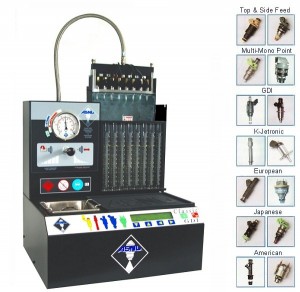
If you have the time and inclination, get the fuel injectors flowed and tuned.

Out of the box, we've seen that injectors in general, have pretty unimpressive tolerances. O_o
How do I go about doing that?

Is this the kind of tool that would let me do it myself? As far as I'm concerned, spending a few hundred on something like this and bullseye-ing a tune on my own beats dicking around with a tune endlessly because I can't effectively troubleshoot 1 or 2 injectors.

I'm tuning 3 cars on my own now and I could see making myself a small business doing tunes for folks, some day.

 
Last edited:
I knew I put this someplace it could be found again:


clicky clicky
 
  • Useful
Reactions: FastDriver
Makes total sense, but what is one to do? Buy extra injectors and just pick the closest ones? How can a single injectir be tuned?

One mixes and matches the injectors, after they are flow tested and marked, and ensures that the fat ones and lean ones are equally spread between banks.

Short of that, the OP actually ordered a matched set of injectors.
 
This kind of pisses me off. If injectors are really that bad, we ought to be monitoring individual cylinder fuel ratios and/or temperatures and use systems that allow you to control fuel injection per cylinder. If you're running 13 to 1 in one cylinder and one injector is spraying 14% less, you're running 15 to 1 in that cylinder assuming equal air distribution. At that point, I'd rather be doing throttle body injection or a carburetor to ensure fuel distribution is somewhat close.

I don't even think my Big Stuff 3 can do that. It can adjust individual cylinder timing, and if I set it up for sequential fuel injection, then it can adjust injector timing in reference to crank angle. However, I don't think it has the capability of adjusting fuel injector duty cycle on a per cylinder basis.
 
This kind of pisses me off. If injectors are really that bad, we ought to be monitoring individual cylinder fuel ratios and/or temperatures and use systems that allow you to control fuel injection per cylinder. If you're running 13 to 1 in one cylinder and one injector is spraying 14% less, you're running 15 to 1 in that cylinder assuming equal air distribution. At that point, I'd rather be doing throttle body injection or a carburetor to ensure fuel distribution is somewhat close.

I don't even think my Big Stuff 3 can do that. It can adjust individual cylinder timing, and if I set it up for sequential fuel injection, then it can adjust injector timing in reference to crank angle. However, I don't think it has the capability of adjusting fuel injector duty cycle on a per cylinder basis.

I mean... [Plenty] of folks install them cold, including me.

It had never occurred to me to flow test a new set of injectors until the date of the thread above.

Knowing what I know now, it would make tuning easier for the DIYer to [know] what each injector flows. Otherwise, if you have a bank is leaner/fatter than the others then I would begin systematically swapping injectors side-to-side until they were more equal.

Worst case scenario is that you get two particularly lean --or-- rich injectors on one side or the other. Chances are actually better than blindly putting the injectors in will mix them well enough.

Referring back the initial test sheet dynamic flow rate difference of 9.6%. The EEC-IV was designed to deal with as much of a difference as 20%.

In other words: This is rarely the end of anybody world unless they're tuning right to the bleeding edge with no adaptive strategy active.
 
When you say 'mix them well enough' are you saying that the other injectors on a bank will even out a lean injector for its cylinder?

I get that if AFR on that bank reads lean, the computer will update KAMRFs to compensate, but the problem is there's only 1 O2 sensor on that bank, and even if it were perfectly accurate, unlike the narrowbands the EEC uses, instead of reading the 15:1 cylinder for what it is, it'll read 3 13:1 cyls & a 15:1 cyl with some 25%/75% average like 13.5:1. So, it brings the whole bank down by .5, and the single cylinder is at 14.5 or so... maybe survivable, but now apply the same logic to a high boost motor, and that's probably a catastrophe.