Brought an engine home, round 2.

Yep, im putting a EFI super victor EFI on my setup, with a 4150 throttle body, i should have some dyno numbers at some point this summer. Hood clearance is so much better with these intakes too.

Whose throttle body are you using? I noticed that Accufab's 4150 actually flows less than their 5.0-style 90, but I know an elbow setup is less ideal than a carb-style TB on carb-style EFI intakes.
 
Whose throttle body are you using? I noticed that Accufab's 4150 actually flows less than their 5.0-style 90, but I know an elbow setup is less ideal than a carb-style TB on carb-style EFI intakes.

I am using accufabs 4150. It took some modification on the throttle arm to get it to clear an air filter base, and i think the lack of airflow will not be an issue, especially considering that the air has a straight path to the bores.

I talked to accufab about this throttle body for the new motor, and they said at 750hp, the 4150 would provide plenty of air to feed it.

I wish i had done some more research before i bought though, i am curious to see how this one would compare to the accufab. It has more vacuum ports, and larger throttle blades

http://www.scorpion-performance.info/performance-throttle-bodies/
 
I have a single blade throttle body (105mm) and a sheet metal elbow and have had zero trouble with it so far. Super Victor EFI on mine as well. I will say that the intake needed extensive porting to port match to the cylinder heads The base of the runners on that intake are tiny but cleaned up nicely after a few hours of porting.

What makes the elbow less ideal?
 
I have a single blade throttle body (105mm) and a sheet metal elbow and have had zero trouble with it so far. Super Victor EFI on mine as well. I will say that the intake needed extensive porting to port match to the cylinder heads The base of the runners on that intake are tiny but cleaned up nicely after a few hours of porting.

What makes the elbow less ideal?

Air does funny things when it hits the wall of the elbow. With an NA motor, its more critical to have the air make a straight shot right into the intake manifold. When you see tests where carburetors make more power than EFI stuff, usually the carb makes more power. I think this happens for two reasons, one, the fuel cools the intake charge with a carb, and the atomization is better inside the plenum area, and two, the air has a straight shot. Ive never seen a comparison of a 4150 throttle body, vs a 4150 carb(i may have access to do one this summer on my car though :) )

The new trend in power adder stuff is to put a monster elbow onto the intake, and open the flange way up. Like this one

http://bangshift.com/gallery/dmc-racing-paul-major-and-tim-meagher-cars.html?pid=134133

Also, guys have started putting air diffusers in elbows to help with distribution.

http://www.yellowbullet.com/forum/showthread.php?t=432654
 
I certainly can see your point. The air flow N/A is much more critical and I can see the benefit to a 4150 style throttle body over the elbow. As far as injected to carb I would imagine that the atomization of the fuel from the injectors would be more precise and consistent from cylinder to cylinder over the carb and would imagine a gain in hp from this. The work that Dennis DMC does is killer and I've seen John Marcella do similar things with setting back or opening up the flange on a sypder style intake for equal air flow distribution. The cars that get these types of mods are well in excess of 2,500hp and I can see how every small change in airflow has major effects in performance. In an application such as mine, conventional parts and conventional thinking yielded almost 1,600hp at the flywheel and the plugs read very well across the entire engine, showing me that the airflow is very even inside the plenum, even @ upwards of 30 pounds of boost. I guess my next question is when exactly does this type of modification start to show benefits? Furthermore, and to try and stay on the OP's original topic will this build up be N/A, Boosted, or otherwise?

One other thing, I have seen some dyno testing that Steve Morris has done with hats on top of carbs for blow through applications and the hats with divided intakes have made less power and have more problems with air distribution. I don't know however if it is only a carb issue or if that would also carry over to an injected issue... Food for thought
 
I do agree that EFI is more precise, but like i said, the fuel cools the intake charge with carbs, and i think thats where the power gains come from. This summer, i may find out. A friend said he is willing to lend me a carb, regulator, ignition box and dyno time, so we may see a nice A to B comparison. Even if the carb makes more power, i wont be in any hury to ditch my EFI.

Not saying your setup isnt right, but that stuff obviously works being that marcella, DMC, and many other big time small tire racers are doing it. I bet with one of those setups you would see more power. Mostly all of the street car technology is trickled down from race cars. Tim Meagher's x-275 car in the link i posted is probably in the 1500 to 1800 hp range. The guys with the f-1x blowers were claiming around 1600 i think.
 
I would say or 1,700 hp or so would be a reasonable assumption. My buddy ran x275 with his grand national last year and the f1x made about 1700 with his setup. I don't have an x275 budget but the xb105 Vortech that I have on mine made just about 1,600 with a really safe tune up. I'm sure there are gains to be had with some minor changes but I can't afford to class race or keep up with the Jones'. True street NMRA is all my budget allows, maybe an Outlaw 8.5 appearance this year but we'll have to see about that in a few months.
I would really be interested to see the comparison, if you do some testing please let me know how you make out.
 
Yep, airflow distribution and resistance in flow due to the sudden directional change is why I've been TOLD that elbows are less ideal than carb-style TBs. I have no personal experience, and I can't say I've even ever seen hard data supporting it. Just racers talking on sites like Yellowbullet, etc.

FWIW, 90lxcoupe some of the cast aluminum Edelbrock elbows have built-in diffusers/dividers. There definitely seems to be some logic behind it.

I have a few concerns with running spider-style intakes on the street. For one, I'm not entirely sold on the almost zero port-length thing. Also none of my current intake/fuel rail parts will carry over. And if I were to go with a 4-hole TB, my current EFI setup would have to go as well. I dunno, we'll see. I do like their simplicity.

Unless some form of boost falls into my lap this summer, this engine will start out N/A, but built with boost in mind. So, mild cam, and maybe 9.5ish compression.
 
I would really be interested to see the comparison, if you do some testing please let me know how you make out.

I plan on making a detailed thread on here and yellowbullet when i do the comparison. I would like to try an elbow and a 90mm throttle body if i had access to that too. We will see.

I have a few concerns with running spider-style intakes on the street. For one, I'm not entirely sold on the almost zero port-length thing.

Why? These intakes are used on street cars with carburetors all the time. Look at HotFox 's setup.
 
I would say or 1,700 hp or so would be a reasonable assumption. My buddy ran x275 with his grand national last year and the f1x made about 1700 with his setup. I don't have an x275 budget but the xb105 Vortech that I have on mine made just about 1,600 with a really safe tune up. I'm sure there are gains to be had with some minor changes but I can't afford to class race or keep up with the Jones'. True street NMRA is all my budget allows, maybe an Outlaw 8.5 appearance this year but we'll have to see about that in a few months.
I would really be interested to see the comparison, if you do some testing please let me know how you make out.

if daveV made 1700ish then the one of them X cars that got everyone pissed off had to be near 1800hp
 
^^ No doubt. I would think Bruder made every bit of 1,800 hp with the f1x. If I can make 1,600 with standard degree heads and out of the box cnc runners 8.7:1 compression and 21* of timing then Bruders with a billet head, sheet metal intake 10:1+ and serious timing made every bit of 1,800.
 
Still curious, if flow distribution of air inside of the intake are so variable from cylinder to cylinder then why do my plugs read the same? The plugs show similar burn patterns front to back left to right.
 
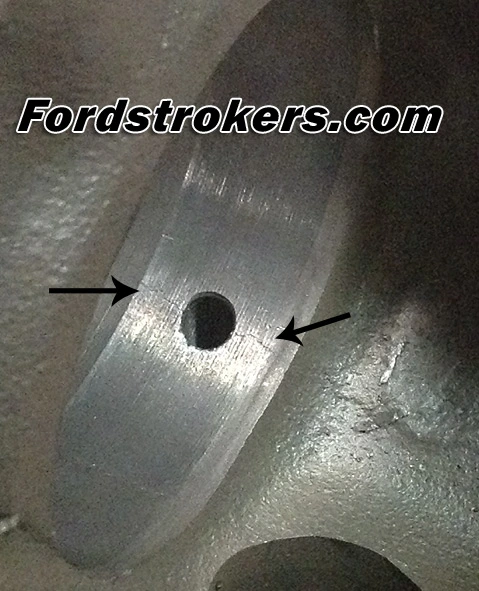
You know where to check those roller blocks for cracks, right?
They are prone to cracking in the cam bores, down the middle of the block.
Gotta pull the cam bearings to check.
qODEh.webp
 

Attachments

  • qODEh.webp
    qODEh.webp
    93.8 KB · Views: 187
  • qODEh.webp
    qODEh.webp
    93.8 KB · Views: 148
  • Like
Reactions: toolow91
You know where to check those roller blocks for cracks, right?
They are prone to cracking in the cam bores, down the middle of the block.
Gotta pull the cam bearings to check.

qODEh.webp

Yea I have seen that, and I'm going to ask my machinist specifically to look there. In fact, job 1 on this engine is going to be getting the block and crank cleaned and magnafluxed. I'd like to know more about that crack and exactly what the cause/effect is. I know that Woody says that maybe 2 or 3 in 10 blocks come into his shop like that, but: 1. How does that happen on sub-300 hp stock engines but not 600+ hp race engines? 2. The typical failure mode of high-HP Windsors doesn't really have anything to do with the cam bearings, in fact I think Woody said he has yet to even see any failures related to this.

Woody has kind of implied that it might happen in engines that have been severely overheated and driven into the ground, which I can see. So it might be more of a thermal thing than a structural thing...?

Anyway, if mine is cracked like that, it's going back to the JY and I'm pulling a non-roller block and just coughing up the ~$400 on link bar roller lifters.
 

Attachments

  • qODEh.webp
    qODEh.webp
    93.8 KB · Views: 143
  • qODEh.webp
    qODEh.webp
    93.8 KB · Views: 174
Yeah, I also find it funny that 5.0 blocks split in half regularly compared to the 5.8 block which failure is almost unheard of, yet 1/4 to 1/3 of the blocks carry this fracture. It was just a heads up.

For me, I am not even going to look for the crack when I get my block. I am just going with the ignorance is bliss strategy... Mainly because I only want a relatively mild build.