Cam Change = Firing Order Change= Injector Change

Here's a long,stolen post from another forum-some of the info isn't necessary for your situation-but basically explains what the tfi and pip actually do,and how I think its related to your issues.

I can't verify all info in this copied article (cause I didn't read it all :D)
Is correct-but mostly useful.

"push start", TFI module.
This module was used to control the dwell time of the ignition coil, and provide a "limp home" mode, at base timing, in
case the timed
spark signal to the module is lost. Ford refers to the trigger signal as
PIP, (profile ignition
pickup). It is produced by a hall effect sensor in the distributor at system
voltage, and has
it's rising edge at 10 degrees before top dead center on the crankshaft. In
the case of the
distributor I'm working on, the duty cycle is 50% for all cylinders except #
1, which is
35%. This is used to identify #1 for fuel injector sequencing in some
applications.
This PIP signal is sent to the TFI module, and the ECU, (engine control
unit).
Which uses it to calculate RPM, and as a camshaft position indicator to
calculate timed
spark. The SPOUT signal, (timed spark out), is an output at system voltage
and 50% duty
cycle, and is sent back to the TFI module. It is delayed from the point of
PIP, and
calculated to occur so that it's rising edge coincides with the desired
timing angle to fire
the coil for the following cylinder in the firing order. The rotor on the
distributor routes
the coil secondary current to the appropriate spark plug. The TFI module
fires the coil
when it receives a rising edge of SPOUT. If it does not receive a SPOUT
before the next
PIP, it will fire the coil on that PIP, (base timing, limp home mode). It
appears to charge
the coil only when PIP is low.
There is also an input the TFI module from the starter circuit which is
supposed to
provide increased dwell time during cranking to offset decreased system
voltage. Also,
some printed information available on the module has stated that if the
"start" input is not
present during crank, it will latch into "limp home" mode and stay there
until the key has
been cycled and start signal restored.
I am, along with some others, are trying to use this module with a home
built
engine management computer, "Megasquirt", in particular. I've taken some
existing
Megasquirt codes and have modified them so they should work with the TFI
module but
have run into some difficulties, probably because of my lack of
understanding on exactly
how this module works.
The discussion has come up as to how the TFI handles the dwell time, which
is
fairly basic theory.
It is my understanding that the primary winding of the coil is connected to
system
voltage for a short period of time, say 4 or 5 ms. During this time, the
current ramps up,
opposed by the induced voltage in the windings, up to a maximum steady state
current
determined by the resistance of the circuit. When it's time to "fire', the
circuit to the
primary is opened. The field collapses, inducing a high voltage in the
primary, and a
proportional higher voltage in the secondary.
In a conventional Kettering, (points) system. the current is limited by a
ballast
resistor in series with the coil primary, and the time available to charge
the coil due to the
points being open and closed by a lobe on the distributor shaft.
Information on the TFI module states that it controls dwell with current
control.
The question is, what is the value of this controlled current, and when
does it
occur?
I say, the amount of energy available to fire the coil depends, not only on
the
inductance of the coil, but the amount of current flowing in the primary, at
the time of
current break. This is usually limited to 4 to 6 amps.
So, my theory is, the coil is not actually charged until SPOUT is received
.. At this
point, it is charged and fired in quick succession.
Others have said, the coil can be charged to it's fully charged state, any
time
before SPOUT goes high, with the current still limited to about the same
value, but then
decreased to some milliamp value until time to fire the coil, then break the
current, and
the coil will fire.
Thanks for the info but it really didn't answer any questions I had as to whether the TFI's are different, sounds like they all due the same thing, HO or not HO.
The only difference I can find in reference to HO and not HO is the cam used in HO engines which then changes the firing order.
 
There are differences

IMG_0898.GIF
 
Ok guys I give up !!!! I have tried everything I know to do . I went back and checked the firing order by cranking the engine over to tdc and then verifying that the next cylinder up on compression was #3 thus it is an HO firing order.
Checked timing, 10 btdc advanced to 30 with jumper in.
Rechecked dist. firing order ok.
Verified injector wiring from ecu to injector, all were good.
engine starts right up but idles rough and it will not take any throttle, has a very bad miss like some cylinders are not firing.
no backfires
I can hear a high pitched whistle at idle but I can't locate where it's coming from (possible vacuum leak?) I don't think it would cause this issue.
I still don't know if changing to 24# injectors has messed everything up.
It has a ford E9ZF-12B579-AA MAF sensor in a 70mm housing.
Is it possible that the engine is leaning out due to the smaller injector size (down from 42#).??
I ran the self test koeo and just got egr error codes (egr is gone)
What else is there?
Can the ecu be tested free from the car?
A lot of the main wiring harness had bare wires melted together and touching that I'm thinking it may have gone back to the ecu. ???
Next thing I can do is pull the upper intake to get to all the injectors and pull the injectors and test them making sure they are all working.(the were new but made in China).
seeing 35# fuel pressure at the fuel rails
Any ideas ??
 
I would try another ecm, pull that one out and smell it, maybe take the cover off and check if it has any burnt traces, also that fire may have got hot enough to cook the lower intake gasket or did you change that? A vacuum leak thats bad enough can cause major issues. Just try'n help, you got a ton of work into that thing.
 
Sounds like you didn't get my clue from one of my previous posts. Have you replaced the distributor with a known good unit?

What you are describing is the symptom of a PIP sensor in failure mode. PIP sensors don't always set code 14, since the computer's diagnostic routine doesn't have a way to detect missing pulses with any degree of accuracy. There is no alternate sensor to compare the PIP pulse train to so that missing pulses can be accurately detected.


Code 14 - Ignition pickup (PIP) was erratic – the Hall Effect sensor in the distributor is failing. Bad sensor, bad wiring, dirty contacts. Factory tach will sometimes read erratically.

Revised 8-Apr-2017 to correct SPOUT problem symptoms wording

The PIP is a Hall Effect magnetic sensor that triggers the TFI and injectors. There is a shutter wheel alternately covers and uncovers a fixed magnet as it rotates. The change in the magnetic field triggers the sensor. They are often heat sensitive, increasing the failure rate as the temperature increases.

PIP Sensor functionality, testing and replacement:
The PIP is a Hall Effect magnetic sensor that triggers the TFI and injectors. There is a shutter wheel alternately covers and uncovers a fixed magnet as it rotates. The change in the magnetic field triggers the sensor. A failing PIP sensor will often set code 14 in the computer. They are often heat sensitive, increasing the failure rate as the temperature increases.

Some simple checks to do before replacing the PIP sensor or distributor:
You will need a Multimeter or DVM with good batteries: test or replace them before you get started.. You may also need some extra 16-18 gauge wire to extend the length of the meter’s test leads.
Visual check first: look for chaffed or damaged wiring and loose connector pins in the TFI harness connector.
Check the IDM wiring – dark green/yellow wire from the TFI module to pin 4 on the computer. There is a 22K Ohm resistor in the wiring between the TFI and the computer. Use an ohmmeter to measure the wire resistance from the TFI to the computer. You should see 22,000 ohms +/- 10%.
Check the PIP wiring - dark blue from the TFI module to pin 56 on the computer. Use an ohmmeter to measure the wire resistance from the TFI to the computer. You should see 0.2-1.5 ohms.
Check the SPOUT wiring – yellow/lt green from the TFI module to pin 36 on the computer. Use an ohmmeter to measure the wire resistance from the TFI to the computer. You should see 0.2-1.5 ohms.
Check the black/orange wire from the TFI module to pin 16 on the computer. Use an ohmmeter to measure the wire resistance from the TFI to the computer. You should see 0.2-1.5 ohms.
Check the red/green wire; it should have a steady 12-13 volts with the ignition switch on and the engine not running.
Check the red/blue wire; it should have a steady 12-13 volts with the ignition switch in Start and the engine not running. Watch out for the fan blades when you do this test, since the engine will be cranking.
If you do not find any chaffed or broken wires, high resistance connections or loose pins in the wiring harness, replace the PIP sensor or the distributor.

The PIP sensor is mounted in the bottom of the distributor under the shutter wheel. In stock Ford distributors, you have to press the gear off the distributor shaft to get access to it to replace it. Most guys just end up replacing the distributor with a reman unit for about $75 exchange

PIP problems & diagnostic info
Spark with the SPOUT out, but not with the SPOUT in suggests a PIP problem. The PIP signal level needs to be above 6.5 volts to trigger the computer to pulse the fuel injectors, but only needs to be 5.75 volts to trigger the TFI module. Hence with a weak PIP signal, and the SPOUT in, you could get spark but no injector pulse. You will need an oscilloscope or graphing DVM to measure the output voltage since it is not a straight DC voltage.

See http://www.wellsmfgcorp.com/pdf/counterp_v8_i2_2004.pdf and http://www.wellsmfgcorp.com/pdf/counterp_v8_i3_2004.pdf for verification of this little detail from Wells, a manufacturer of TFI modules and ignition system produc
 
  • Like
Reactions: RaggedGT
^^^^ that's what I was gonna say. When my maf harness had corrosion it would start right up and run rough and it was a fight to get it to idle.

Just incase , is the replacement wiring from the right year car?

More than anything, do the troubleshooting listed above.

Do you live near someone that would let you mix and match parts and try to find the issue?
 
PO tells me it's an x-cam
A lot of variables here. I agree with poster who said step back and look at it.

1) Do you still have the old cam? If so, maybe you can find a number on it and learn exactly what you had compared to what you have. Compression orders tells what you have now. I've run into too many people who say something "is" when they don't know (but you've met PO so maybe know he's accurate).

2) After changing cam, I assume timing marks are lined up properly.

3) Changing in a used wire harness is a major deal. It's probably okay (if appeared good), but you're right to wonder if it's compatible with what you have now. I got a lot of respect for people with patience to check pinouts for wiring harnesses.

4) If can drive it (though probably not), it might be good to get a diagnostic check. I used a scope to find a bad coil on an 89 Cavalier V6 with an intermittent miss (3 coils feed 6 cylinders/no distributor). Experienced guys can look at the ignition signal (induction pickup on wire at spark plug) and tell if it's running lean/rich, etc. Black plugs (carbon, not oil) say it's running rich - is a clue if not on all cylinders (I forget .. was much to read).

5) Codes don't always get set, but do you have a scanner that shows real time data? You might see something obvious... this especially true on "dumber" old computer controls (new computers tell which cylinder is missing... amazing). There were no codes set, but I saw engine temp = 0 degrees on a Jeep due to bad temp sensor feeding computer (temp gauge/sensor was fine), and my Camino cruise control was flaky and I saw erratic speed info (jumping around by 10 mph) to computer, which was probably also feeding cruise control module (sold car before fixing but told buyer about it).

6) ECMs don't fail too often, but melting a harness/shorting wires could definitely damage something. Since the car runs to a degree, the ECM's not completely blown, but maybe figuring out which circuits had shorted wires will tell you something. As example: If two outputs shorted together, or 12v shorted to an output wire (output is like the signal going to a fuel injector), it could blow the output circuit and give you zero volts or 12v all the time. ===> AH - makes me think to check/compare fuel injector signals - a scope would be best, but maybe one is open all the time - that would account for a miss and carbon fouled plugs. A DVM "might" show average pulse voltage on an AC scale, but not sure - will definitely show if an injector's held open with a steady 12v signal. (Now curious if it's blowing black smoke/smelling rich while running)

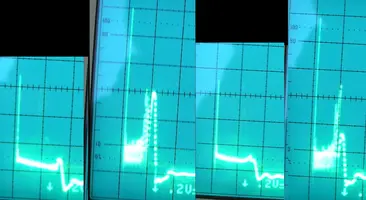
You'll get it fixed.. just remember it's an inanimate object and is not intentionally fighting you. Attached is that Cav scope pix - the big "dotted" spikes are abnormal (guys have been using scopes on cars for decades - is like a vacuum gauge where an experienced guy can see much).
 

Attachments

  • 00-cav cyl 6.webp
    00-cav cyl 6.webp
    140.5 KB · Views: 207
Last edited:
A lot of variables here. I agree with poster who said step back and look at it.

1) Do you still have the old cam? If so, maybe you can find a number on it and learn exactly what you had compared to what you have. Compression orders tells what you have now. I've run into too many people who say something "is" when they don't know (but you've met PO so maybe know he's accurate).

2) After changing cam, I assume timing marks are lined up properly.

3) Changing in a used wire harness is a major deal. It's probably okay (if appeared good), but you're right to wonder if it's compatible with what you have now. I got a lot of respect for people with patience to check pinouts for wiring harnesses.

4) If can drive it (though probably not), it might be good to get a diagnostic check. I used a scope to find a bad coil on an 89 Cavalier V6 with an intermittent miss (3 coils feed 6 cylinders/no distributor). Experienced guys can look at the ignition signal (induction pickup on wire at spark plug) and tell if it's running lean/rich, etc. Black plugs (carbon, not oil) say it's running rich - is a clue if not on all cylinders (I forget .. was much to read).

5) Codes don't always get set, but do you have a scanner that shows real time data? You might see something obvious... this especially true on "dumber" old computer controls (new computers tell which cylinder is missing... amazing). There were no codes set, but I saw engine temp = 0 degrees on a Jeep due to bad sensor feeding computer (temp gauge was fine), and my Camino cruise control was flaky and I saw erratic speed info (jumping around by 10 mph) to computer, which was probably going also feeding to cruise control module (sold car before fixing but told buyer about it).

6) ECMs don't fail too often, but melting a harness/shorting wires could definitely damage something. Since the car runs to a degree, the ECM's not completely blown, but maybe figuring out which circuits had shorted wires will tell you something. As example: If two outputs shorted together, or 12v shorted to an output wire (output is like the signal going to a fuel injector), it could blow the output circuit and give you zero volts or 12v all the time. ===> AH - makes me think to check/compare fuel injector signals - a scope would be best, but maybe one is open all the time - that would account for a miss and carbon fouled plugs. A DVM "might" show average pulse voltage on an AC scale, but not sure - will definitely show if an injector's held open with a steady 12v signal. (Now curious if it's blowing black smoke/smelling rich while running)

You'll get it fixed.. just remember it's an inanimate object and is not intentionally fighting you. Attached is that Cav scope pix - the big spikes are abnormal (guys have been using 00-cav cyl 6.webp scopes on cars for decades - is like a vacuum gauge where an experienced guy can see much).

Real time date checking isn't available on production model Ford EEC IV series computers (it can be done with aftermarket add-on tuners like the Tweecer RT or Moates Quarterhorse). Real time data flow didn't happen until Ford switched to EEC V, which was 1994 for 6 cylinder Mustangs and 1996 for V8 Mustangs.
 
  • Like
Reactions: Chris Snyder 1955
I would try another ecm, pull that one out and smell it, maybe take the cover off and check if it has any burnt traces, also that fire may have got hot enough to cook the lower intake gasket or did you change that? A vacuum leak thats bad enough can cause major issues. Just try'n help, you got a ton of work into that thing.
thanks for your input, Tomorrow I'm pulling the upper intake off so I can get to the injectors hidden underneath it. I see they have an injector tester called a noid light (I've never heard of it) but you plug it into your injector connector and it shows if that injector is being fired by the ecm. Its my last hope in seeing that gas and spark are present at the cylinder at the same time. I'm going to check the compression also, it should be fine since the motor ran so strong before the fire.
I don't have another ecm and I hate to start throwing parts at it but I am looking for one.
Are all ecu IV's HO oriented?
 
Sounds like you didn't get my clue from one of my previous posts. Have you replaced the distributor with a known good unit?

What you are describing is the symptom of a PIP sensor in failure mode. PIP sensors don't always set code 14, since the computer's diagnostic routine doesn't have a way to detect missing pulses with any degree of accuracy. There is no alternate sensor to compare the PIP pulse train to so that missing pulses can be accurately detected.


Code 14 - Ignition pickup (PIP) was erratic – the Hall Effect sensor in the distributor is failing. Bad sensor, bad wiring, dirty contacts. Factory tach will sometimes read erratically.

Revised 8-Apr-2017 to correct SPOUT problem symptoms wording

The PIP is a Hall Effect magnetic sensor that triggers the TFI and injectors. There is a shutter wheel alternately covers and uncovers a fixed magnet as it rotates. The change in the magnetic field triggers the sensor. They are often heat sensitive, increasing the failure rate as the temperature increases.

PIP Sensor functionality, testing and replacement:
The PIP is a Hall Effect magnetic sensor that triggers the TFI and injectors. There is a shutter wheel alternately covers and uncovers a fixed magnet as it rotates. The change in the magnetic field triggers the sensor. A failing PIP sensor will often set code 14 in the computer. They are often heat sensitive, increasing the failure rate as the temperature increases.

Some simple checks to do before replacing the PIP sensor or distributor:
You will need a Multimeter or DVM with good batteries: test or replace them before you get started.. You may also need some extra 16-18 gauge wire to extend the length of the meter’s test leads.
Visual check first: look for chaffed or damaged wiring and loose connector pins in the TFI harness connector.
Check the IDM wiring – dark green/yellow wire from the TFI module to pin 4 on the computer. There is a 22K Ohm resistor in the wiring between the TFI and the computer. Use an ohmmeter to measure the wire resistance from the TFI to the computer. You should see 22,000 ohms +/- 10%.
Check the PIP wiring - dark blue from the TFI module to pin 56 on the computer. Use an ohmmeter to measure the wire resistance from the TFI to the computer. You should see 0.2-1.5 ohms.
Check the SPOUT wiring – yellow/lt green from the TFI module to pin 36 on the computer. Use an ohmmeter to measure the wire resistance from the TFI to the computer. You should see 0.2-1.5 ohms.
Check the black/orange wire from the TFI module to pin 16 on the computer. Use an ohmmeter to measure the wire resistance from the TFI to the computer. You should see 0.2-1.5 ohms.
Check the red/green wire; it should have a steady 12-13 volts with the ignition switch on and the engine not running.
Check the red/blue wire; it should have a steady 12-13 volts with the ignition switch in Start and the engine not running. Watch out for the fan blades when you do this test, since the engine will be cranking.
If you do not find any chaffed or broken wires, high resistance connections or loose pins in the wiring harness, replace the PIP sensor or the distributor.

The PIP sensor is mounted in the bottom of the distributor under the shutter wheel. In stock Ford distributors, you have to press the gear off the distributor shaft to get access to it to replace it. Most guys just end up replacing the distributor with a reman unit for about $75 exchange

PIP problems & diagnostic info
Spark with the SPOUT out, but not with the SPOUT in suggests a PIP problem. The PIP signal level needs to be above 6.5 volts to trigger the computer to pulse the fuel injectors, but only needs to be 5.75 volts to trigger the TFI module. Hence with a weak PIP signal, and the SPOUT in, you could get spark but no injector pulse. You will need an oscilloscope or graphing DVM to measure the output voltage since it is not a straight DC voltage.

See http://www.wellsmfgcorp.com/pdf/counterp_v8_i2_2004.pdf and http://www.wellsmfgcorp.com/pdf/counterp_v8_i3_2004.pdf for verification of this little detail from Wells, a manufacturer of TFI modules and ignition system produc
not sure what clue you think I missed ??
I did go through the timing check you described and verified the HO firing order.
I never saw this dist. work, I pulled it from a salvage yard car.
I will check the tfi wiring today as far as I can.
 
^^^^ that's what I was gonna say. When my maf harness had corrosion it would start right up and run rough and it was a fight to get it to idle.

Just incase , is the replacement wiring from the right year car?

More than anything, do the troubleshooting listed above.

Do you live near someone that would let you mix and match parts and try to find the issue?
Not sure where the wiring harness came from ?? It is wired exactly like my original harness, I checked the pins and colors.
 
A lot of variables here. I agree with poster who said step back and look at it.

1) Do you still have the old cam? If so, maybe you can find a number on it and learn exactly what you had compared to what you have. Compression orders tells what you have now. I've run into too many people who say something "is" when they don't know (but you've met PO so maybe know he's accurate).

2) After changing cam, I assume timing marks are lined up properly.

3) Changing in a used wire harness is a major deal. It's probably okay (if appeared good), but you're right to wonder if it's compatible with what you have now. I got a lot of respect for people with patience to check pinouts for wiring harnesses.

4) If can drive it (though probably not), it might be good to get a diagnostic check. I used a scope to find a bad coil on an 89 Cavalier V6 with an intermittent miss (3 coils feed 6 cylinders/no distributor). Experienced guys can look at the ignition signal (induction pickup on wire at spark plug) and tell if it's running lean/rich, etc. Black plugs (carbon, not oil) say it's running rich - is a clue if not on all cylinders (I forget .. was much to read).

5) Codes don't always get set, but do you have a scanner that shows real time data? You might see something obvious... this especially true on "dumber" old computer controls (new computers tell which cylinder is missing... amazing). There were no codes set, but I saw engine temp = 0 degrees on a Jeep due to bad temp sensor feeding computer (temp gauge/sensor was fine), and my Camino cruise control was flaky and I saw erratic speed info (jumping around by 10 mph) to computer, which was probably also feeding cruise control module (sold car before fixing but told buyer about it).

6) ECMs don't fail too often, but melting a harness/shorting wires could definitely damage something. Since the car runs to a degree, the ECM's not completely blown, but maybe figuring out which circuits had shorted wires will tell you something. As example: If two outputs shorted together, or 12v shorted to an output wire (output is like the signal going to a fuel injector), it could blow the output circuit and give you zero volts or 12v all the time. ===> AH - makes me think to check/compare fuel injector signals - a scope would be best, but maybe one is open all the time - that would account for a miss and carbon fouled plugs. A DVM "might" show average pulse voltage on an AC scale, but not sure - will definitely show if an injector's held open with a steady 12v signal. (Now curious if it's blowing black smoke/smelling rich while running)

You'll get it fixed.. just remember it's an inanimate object and is not intentionally fighting you. Attached is that Cav scope pix - the big "dotted" spikes are abnormal (guys have been using scopes on cars for decades - is like a vacuum gauge where an experienced guy can see much).
I don't have the old cam but again this engine ran great before the fire so I'm sure there is nothing wrong internally.
 
Does it make sense that you have the wrong MAF for your injectors?

It is just fine to go looking for other things that may be wrong. But, that car will never run right with the MAF injector setup you have right now.

Just want to make sure that makes sense... It's real easy to get distracted in these threads....
 
  • Like
Reactions: General karthief
thanks for your input, Tomorrow I'm pulling the upper intake off so I can get to the injectors hidden underneath it. I see they have an injector tester called a noid light (I've never heard of it) but you plug it into your injector connector and it shows if that injector is being fired by the ecm. Its my last hope in seeing that gas and spark are present at the cylinder at the same time. I'm going to check the compression also, it should be fine since the motor ran so strong before the fire.
I don't have another ecm and I hate to start throwing parts at it but I am looking for one.
Are all ecu IV's HO oriented?
No, stick with a9l, a9m and there is another one thats a cobra computer, m3c or something like that but likely you won't find one of those, if yours is burnt there is a guy in tx that fixes them, I think that's where he is, I going to send one to him soon, I can let you know. Grab a 92 to 94 grand marquis/crown vic maf, check the tech section here for jy mods, I think there is a list of compatable maf upgrades for 24lb injectors.