EGR/Smog Savvy Peoples!

Strype

Cuthbert catcher
Founding Member
May 11, 1999
61
34
104
Huntsvegas, AL
Sorry for the Swmi-repost but I'm not understanding this EGR stuff... I know what it does but I'm lost as how to reconnect/disconnect on my set up or if I should reconnect it or diconnect it.

I plan on putting an Explorer intake on my 93 Coupe. It (93 Coupe) is bone stock with all EGR connections still hooked up but the smog pump is bypassed via belt. So, is there any point to me reconnecting the EGR on the Explorer intake? We don't have enforced emissions laws btw in Alabama. I don't even know if it can be done because apparently it's missing a provision for EGR that the stock intake has or so I've heard-

Should I diconnect the EGR system?
How do I do that?
How could I make it work?
What kind of TB/Spacer should I buy? EGR or Not, Water Jackets or not?

Whew- thanks :hail2:

 
I have a FAQ on my site which may answer some of your general Qs. It is on the FAQ page.
I would post it, but I can't acces my site from work. :bang:

As I have heard, one year of the explorer has the egr routed externally. If this is the intake you have, you can route the egr externally, or eliminate the egr.


jason
 
Cool thanks mang! I'll check out your site after work... so do i simply cap off the vacuum going to the egr and plug my piece that lies to the computer in and I'm done? Will this affect my idle? Anything else I need to do?
 
Some basic theory to clarify how things work is in order…

The EGR shuts off at Wide Open Throttle (WOT), so it has minimal effect on performance. The addition of exhaust gas drops combustion temperature, increases gas mileage and reduces the tendency of the engine to ping. It can also reduce HC emissions by reducing fuel consumption.

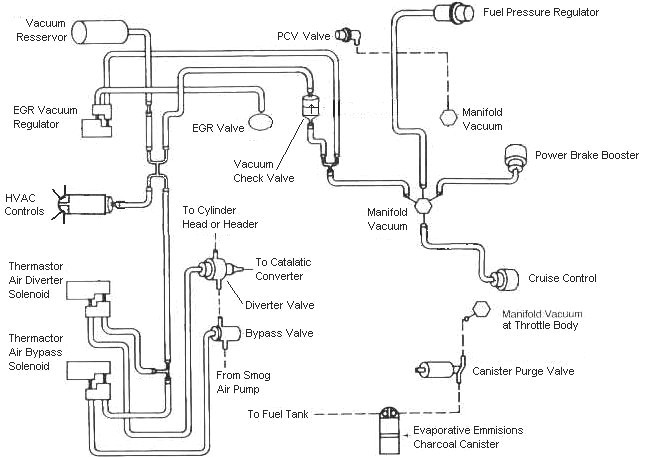
The EGR system has a vacuum source (line from the intake manifold) that goes to the EVR, computer operated electronic vacuum regulator. The EVR is located on the back of the passenger side shock strut tower. The EGR valve and the passages in the heads and intake manifold route exhaust gas to the EGR spacer (throttle body spacer). The computer uses RPM, Load. and some other factors to tell the EVR to pass vacuum to open the EGR valve. The EGR sensor tells the computer how far the EGR valve is open. Then computer adjusts the signal sent to the EVR to hold, increase or decrease the vacuum. The computer adds spark advance to compensate for the recirculated gases and the slower rate they burn at.

Diagram courtesy of Tmoss & Stang&2birds.
mustangFoxFordVacuumDiagram.jpg


The EGR sensor is basically a variable resistor, like the volume control on a radio. One end is 5 volt VREF power from the computer (red/orange wire). One end is computer signal ground (black/white), and the middle wire (brown/lt green) is the signal output from the EGR sensor. It is designed to always have some small voltage output from it anytime the ignition switch is the Run position. That way the computer knows the sensor & the wiring is OK. No voltage on computer pin 27 (brown/lt green wire) and the computer thinks the sensor is bad or the wire is broken and sets code 31. The voltage output can range from approximately .6-.85 volt.

EGR test procedure courtesy of cjones

to check the EGR valve:
bring the engine to normal temp.
connect a vacuum pump to the EGR Valve
apply 5in vacuum to the valve.
if engine stumbled or died then EGR Valve and passage(there is a passageway through the heads and intake) are good.
if engine did NOT stumble or die then either the EGR Valve is bad and/or the passage is blocked.
if engine stumbled, connect vacuum gauge to the hose coming off of the EGR Valve
snap throttle to 2500 RPM (remember snap the throttle don't hold it there).
did the vacuum gauge show about 5in vacuum?

if not, check for manifold vacuum at the EGR vacuum valve.
if you have manifold vacuum then connect vacuum gauge to the EGR valve side of the vacuum valve and snap throttle to 2500 RPM.
should read about 5in vacuum