Progress Thread Let's try this again...

Gentlemen,

I got some fan shroud hardware from LMR that was missing from my kit that this install uses to secure the fans to the radiator. It has been about 4 hours since I received the package, and I am no closer to getting the fans secured, mostly because of the lower clips. I can't seem to get them to clip onto the radiator. I've tried pushing down on them with a breaker bar, I've tried pulling them down with the edge of a wrench, I've tried prying them open with a flathead screwdriver, I've moved the radiator around to try to get a better angle, and nothing seems to have worked. They either spring off, or don't reach high enough to secure the bottom of the fans. I'm thinking about using zipties and just accepting that the fans will be a little loose on the bottom, but if anybody else has a better idea, please let me know.
IMG_3828.webp


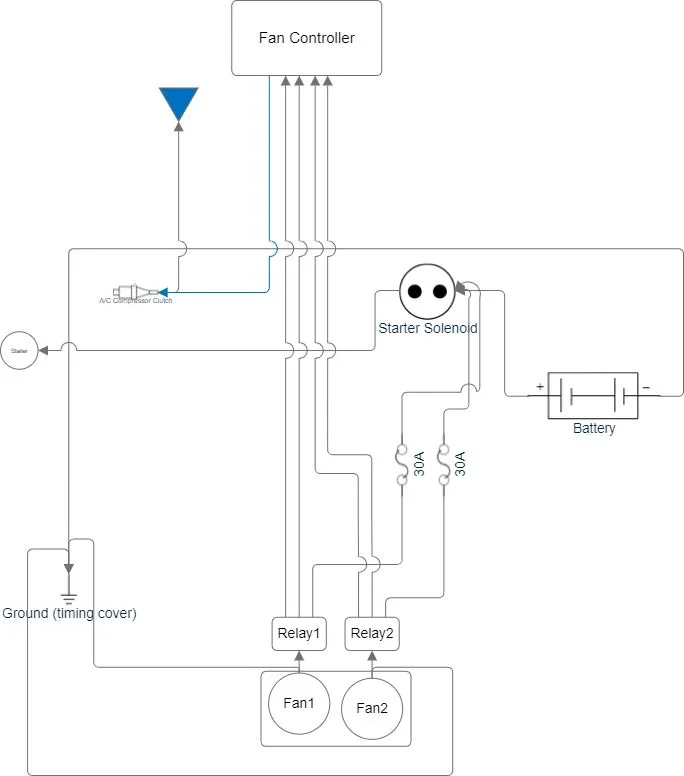
I have completed a simple wiring diagram to demonstrate how I plan to connect this thing once I have everything installed, I'll update it with wire colors later when I can check:
Fan Wiring Diagram.jpg
 
Last edited:
Those clips are a pain but are you installing them where there are slots in the metal? Would be like in this picture:

Fox Mustang Radiator.jpg


The slots would be line the ones next to the clips already on the radiator above.

From what I understand the Contour fans are wired with 60A maxi fuses from the factory and you will need to run that supply to 75A relays so one run per fan. I have Mark VIII fans on both my Foxes with DCC controllers. Tried the fuse/relay method for a year or so on the Coupe and burned the motor up on the fan. Have not replaced another motor since and that has been over 15 years ago. There are several controllers out there but you need to get one with a soft start function so it does not create the inrush when the motor is first started.
 
  • Like
Reactions: General karthief
Those clips are a pain but are you installing them where there are slots in the metal? Would be like in this picture:

Fox Mustang Radiator.webp


The slots would be line the ones next to the clips already on the radiator above.

From what I understand the Contour fans are wired with 60A maxi fuses from the factory and you will need to run that supply to 75A relays so one run per fan. I have Mark VIII fans on both my Foxes with DCC controllers. Tried the fuse/relay method for a year or so on the Coupe and burned the motor up on the fan. Have not replaced another motor since and that has been over 15 years ago. There are several controllers out there but you need to get one with a soft start function so it does not create the inrush when the motor is first started.
Those are the slots I was trying to use, no dice. I gave up and used a couple of zip-ties that seem to be working.

The kit from LMR included the relays, I have 30A fuses going to the solenoid and the controller is connected to a 12V constant and key-on power source via fuse taps. The controller is from Dakota Digital, so I'm not sure if it has the soft-start feature you described, but I did notice all the lights dimmed for a second when I turned the high fans on so my guess is it probably doesn't.

Everything is wired up and tucked in, my problem now is that the controller's temp sender isn't registering a high enough temp to turn the fans on. Assuming my car has a stock thermostat, what should the low/high on/off ranges be? I'm reading that 200 degrees is the ideal operating temp for fuel injected 5.0s and that the temp gauge should be at the "M" in "NORMAL" or a little higher at that temp, but the controller's sensor was registering 184 and the dial on the dash was at the "L."

I'm thinking there may be an air bubble in the heater tube and the sensor is reading air temp rather than coolant temp, that's the only reason I can think of for the discrepancy unless the sensor is defective somehow. I'm going to try burping the system tomorrow if I have the energy after work.

Edit: This is the controller I'm using.
 
Last edited:
Went to burp the cooling system and noticed that it was low, so I topped it off and got out the bubbles.

As for where the coolant went, I honestly have no idea. I do know that my last overflow tank had dried streaks of coolant running down the side, so I guess that means it leaked out when the engine got too hot? Or I had too much coolant in it? Maybe both?

Anyway, it’s filled up to the neck just below the cap, so we’ll soon find out which is the case once I drive it around. I tried to find info on where in the radiator the level should be. Some people say if you see coolant (which I did) you’re good, and others say it should be filled to the neck.

Overfilled or not, it did seem to improve or possibly solve my sensor issues. The controller was reading 195 and the gauge was at the beginning of “A” in “NORMAL.”

For the sake of caution and my own anxiety looking at the gauge in traffic, I have the low fan set to turn on/off at 195/193, and the high fan set to turn on/off at 205/200.

Idling in my 80 degree garage, the low speed fan had no problem keeping the engine at around 193 degrees.
 
So I’m still having problems with this cooling setup.

After some time idling, the temp gauge on the interior looks like this:
IMG_3838.webp


But the temp sender diagnostic page looks like this:
IMG_3837.webp


It’s my understanding, as stated in previous posts, that at 200 degrees, the needle in the dash should be at the “M” in “NORMAL,” so clearly there’s some shenanigans going on between the fan controller sensor and the gauge sending unit.

Either my gauge has been inaccurate and my car has never been getting up to temperature, or there’s still an air pocket on the controller’s sensor that’s keeping it from measuring the temperature of the coolant.

I burped the system and added more coolant which helped for a little while, but some has drained from the overflow tank, so there’s probably some bubbles again.

Speaking of that overflow tank, all the research I’ve done says that in lieu of proper fill lines, the tank is supposed to be filled about half way. I tried that, and it puked out all the coolant and is now empty again. My radiator, however, is still full.

After looking at the coolant, I think a flush would be a good idea. Since I’m going to be draining the coolant for that anyway, I’m thinking I’m going to pull the thermostat housing and have it drilled and threaded somewhere so I can put the controller’s sensor in a place that I’d imagine is less likely to have air pockets than an added y-pipe in the heater tube.
 
  • Like
Reactions: Alldegree
Or just get one of these and skip the cost of having the stock one drilled and tapped in case you change your mind later down the road.


Can you post up a couple of pictures of the install so we can see how the fan is mounted and how the temperature sensor is currently installed?
I’ll definitely check that out, thanks!

As for pictures, here they are:
IMG_3848.webp

This is the top of the fan mount

IMG_3850.webp

And the bottom, showing the zip tie setup and some wiring.

As for the area I think I’m having trouble, this is what the “Y-block” looks like in the heater tube:
IMG_3853.webp

The controller sensor is on the left, and the ecu sensor is on the right.

IMG_3855.webp

Aside from the potential for air bubbles, I really don’t like how cluttered it looks, and it also puts a lot of strain on the ecu sensor wires because of the angle.
 
Two problems with that. One the ECT sensor needs to be in the coolant flow so by putting it on the tee it’s now in stagnant coolant so that’s no bueno. The second is the fan is used to reduce the temperature of the coolant in the radiator and not the motor. If the sensor is in the motor then the fan is coming on when the coolant in the motor gets up to the set point. This is problematic because the coolant moves into the radiator and it’s hot. The fluid on the radiator moves into the motor and its coolers so the sensor isn’t hitting point and starting the fan to help the radiator remove the heat from the coolant. When the sensor finally hits the set point it’s too late because the coolant in the motor is getting hot fast and the thermostat is coming up on set point and there goes the fluid into the radiator and the now heat soaked coolant from the radiator enters the motor. This just keeps compounding.

Won’t matter as much at constant speeds of 45 mph or so as you are getting enough air across the radiator to do the job. This is if you have a good deflector under the chin of the car.

To fix this you really need to have the sensor near the outlet of the radiator.

Just my .02.
 
Thank you for that explanation. I knew bubbles could be a problem, I hadn’t even thought about where in the system the sensor should be.

So would the thermostat housing be an ideal place for the sensor? And if so, would this be an ok option rather than having to drill and tap a housing?
 
Ideal spot is close to the outlet of the radiator. DCC controller has a sensor you wedge into the radiator fins. With a screw in style I would weld a bung on the radiator tank down by the outlet but that’s me.
Just to clarify, by radiator tank you mean the side of the radiator itself, right?

Regardless, I’m definitely going to find a shop to do this because I know nothing about welding and I feel like this isn’t the project to learn on.

Edit: Something like this?
IMG_3862.webp
 
Last edited:
That is exactly what I would do. If they can put it above the outlet that would work but make sure where ever you have them install it that you have access to the lower radiator hose clamp and the sensor can be removed/installed with the radiator installed.
 
  • Like
Reactions: Alldegree
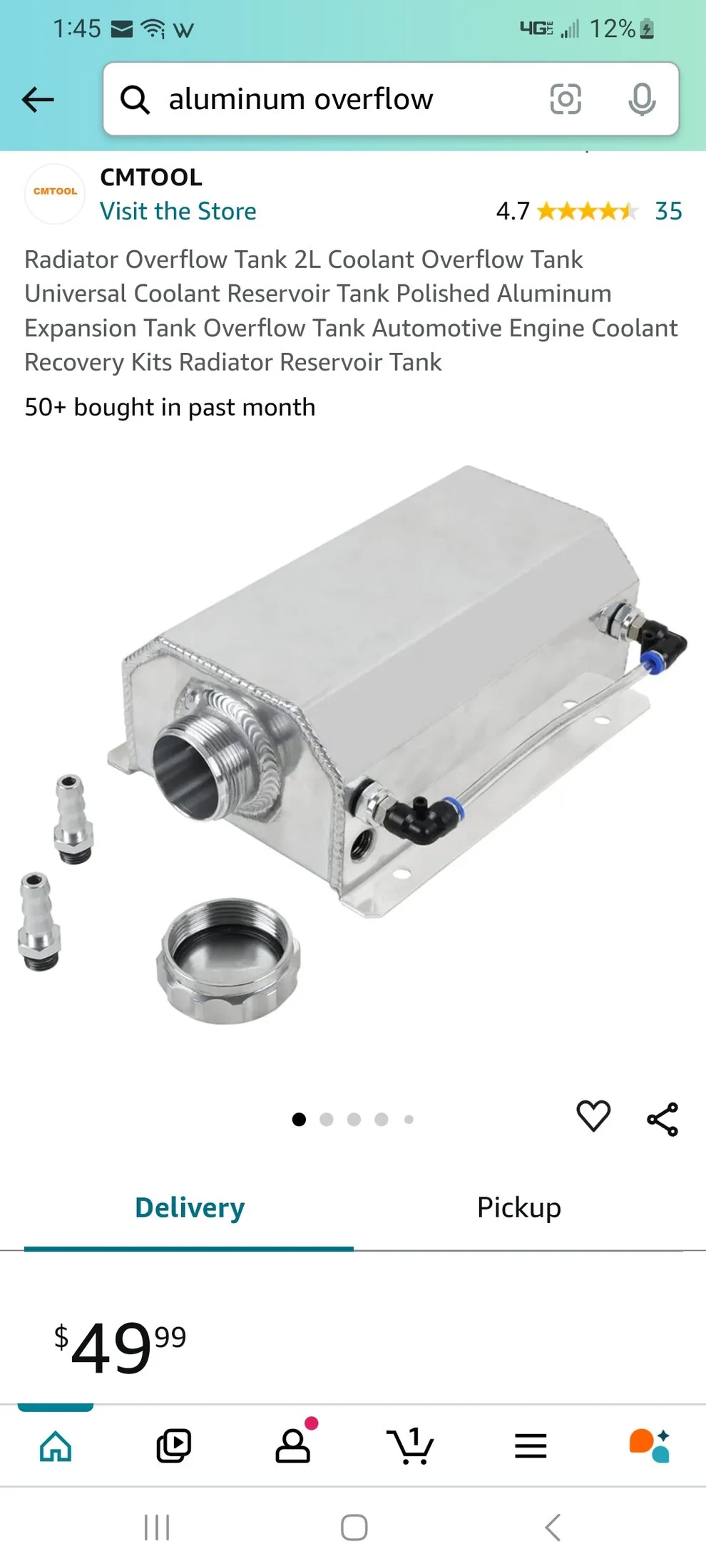
I wrote all this stuff and looked back at your photos. That overflow is too small. I always exhange those out for 2L tanks. Way more room for expansion. Need to get creative with location and mounting. My car has been like this since about 2015.

Screenshot_20240820_134510_Amazon Shopping.webp


20210703_193542.webp


Theres a sensor adapter that allows you to put the sensor in the lower radiator hose. Coolant is always circulated through the heater pipes. It bypasses the thermostat on our cars. For fan control you really want to read the temp of the coolant in the block. The thermostat outlet is a good idea and I've set cars up that way. If you have an air compressor a vacuum coolant fill tool is a great thing to have. Gets all the air out.

The radiators function is to cool the coolant going in the engine. The biggest factor is how hot that coolant is when it comes out. Hotter temps means fan has to cool coolant faster or start earlier. Its a balancing game and is way more than just choosing a thermostat temp. I run a 192 degree in my turbo 331. 3 row radiator and Contour fans. Temp stays around 202...highest is 212 after a boost pull. My fan control is run through the stock ect in the heater pipe through an aftermarket ecu ( mspnp2 ).

A system that moves coolant too fast ( high flow water pumps ) can circulate coolant faster than the car can cool down. Same issue as running no thermostat on the street.

The most important parts of our cooling systems are the flaps that surround the outside of tge radiator for air flow. Without the bumper support to radiator air dams the air can move around the radiator instesd of through it. I had this on a few cars...including one of my own. Woukd cause coolant to push out the overfow after driving highway speeds.
 
That overflow is too small. I always exhange those out for 2L tanks. Way more room for expansion. Need to get creative with location and mounting. My car has been like this since about 2015.
I wondered about that, the price on the one in your picture is pretty reasonable, I’ll look into it. I don’t know where I would put it because I have wires running through the location where you have yours mounted.

The thermostat outlet is a good idea and I've set cars up that way. If you have an air compressor a vacuum coolant fill tool is a great thing to have. Gets all the air out.
By thermostat outlet, you mean on the housing, right? I do have an air compressor, so I’ll definitely pick up one of those.

The most important parts of our cooling systems are the flaps that surround the outside of tge radiator for air flow. Without the bumper support to radiator air dams the air can move around the radiator instesd of through it. I had this on a few cars...including one of my own. Woukd cause coolant to push out the overfow after driving highway speeds.
I’ll have to check and see if I have those, I don’t remember seeing anything. Hopefully that’s why my coolant is getting puked out of the overflow tank.
 
  • Like
Reactions: 90sickfox
Gentlemen, an update.

I have a new thermostat housing that has a plug for a sensor. I may need a new sensor wire from Dakota to reach through the firewall, but I’m going to try to make this one work first.

I also have a shop in mind for welding a bung in the radiator if I decide to go that route, I’m going to try the thermostat housing first since it’s cheaper and I can do it myself.

Either way, I’m going to install a higher capacity expansion tank which I have in the box, I just need to figure out where I’m going to put it.

The next step would be to flush the cooling system, and I have all the tools and fluids for that process. However, I’m reading that you’re supposed to replace the thermostat when you flush? Is this really necessary, or can I just clean the one I have and plop it back in there?

Hope everyone has a good Labor Day weekend, I’m definitely going to enjoy mine.
 
Gentlemen, an update.

I have a new thermostat housing that has a plug for a sensor. I may need a new sensor wire from Dakota to reach through the firewall, but I’m going to try to make this one work first.

I also have a shop in mind for welding a bung in the radiator if I decide to go that route, I’m going to try the thermostat housing first since it’s cheaper and I can do it myself.

Either way, I’m going to install a higher capacity expansion tank which I have in the box, I just need to figure out where I’m going to put it.

The next step would be to flush the cooling system, and I have all the tools and fluids for that process. However, I’m reading that you’re supposed to replace the thermostat when you flush? Is this really necessary, or can I just clean the one I have and plop it back in there?

Hope everyone has a good Labor Day weekend, I’m definitely going to enjoy mine.
Probably replacing it is just for "peace of mind". You're in there, so you may as well. Its probably fine its not a part I replace often
 
  • Like
Reactions: Alldegree
Every time I try to do anything with this car, I find myself wondering how something that seemed so simple at the outset could escalate into a multi-weekend project involving hundreds of extra dollars in new parts and tools.

Then I remember what a colossal idiot I am and it all makes sense.

While removing the ecc temp sensor from the stupid “y-block” I managed to bend my heater tube in such a way that now the fuel line prevents me from plugging in the sensor after it’s installed.

To try and fix this, I took the end of a ratchet wrench, stuck it into the port on the tube, and tried to pry it back in the correct direction.

Now, not only is my heater tube still bent in the wrong direction, but now the port seems to be bent out of round and the sensor won’t quite seat properly in the threads. So basically, I now need a new heater tube.

Based on my—vastly—limited knowledge, I’ll have to remove the intake plenum to do this, which means I’ll have to remove the strut tower bar, which means I’ll have to remove the nuts on the outer apron, which means I’ll have to remove the wheel well liners, which means I’ll have to remove the front wheels. All told, I’ll probably have a drivable car in a few months.

All because I wanted to be able to sit in traffic without overheating.

The coolant system definitely needs to be flushed, the thermostat housing looks like it came off the titanic:
IMG_3922.webp

Also looked in the bumper, and I don’t think I have those air deflectors.
IMG_3913.webp


That’s where I’m at, and probably where I will be for some time. Covered in dirt, oil, sweat, and various toxic chemicals, wondering why I even like cars in the first place, and why am I even bothering to do this when I could be on a beach in a tent with a cooler full of drinks?
 
Every time I try to do anything with this car, I find myself wondering how something that seemed so simple at the outset could escalate into a multi-weekend project involving hundreds of extra dollars in new parts and tools.

Then I remember what a colossal idiot I am and it all makes sense.

While removing the ecc temp sensor from the stupid “y-block” I managed to bend my heater tube in such a way that now the fuel line prevents me from plugging in the sensor after it’s installed.

To try and fix this, I took the end of a ratchet wrench, stuck it into the port on the tube, and tried to pry it back in the correct direction.

Now, not only is my heater tube still bent in the wrong direction, but now the port seems to be bent out of round and the sensor won’t quite seat properly in the threads. So basically, I now need a new heater tube.

Based on my—vastly—limited knowledge, I’ll have to remove the intake plenum to do this, which means I’ll have to remove the strut tower bar, which means I’ll have to remove the nuts on the outer apron, which means I’ll have to remove the wheel well liners, which means I’ll have to remove the front wheels. All told, I’ll probably have a drivable car in a few months.

All because I wanted to be able to sit in traffic without overheating.

The coolant system definitely needs to be flushed, the thermostat housing looks like it came off the titanic:
IMG_3922.jpeg

Also looked in the bumper, and I don’t think I have those air deflectors.
IMG_3913.jpeg


That’s where I’m at, and probably where I will be for some time. Covered in dirt, oil, sweat, and various toxic chemicals, wondering why I even like cars in the first place, and why am I even bothering to do this when I could be on a beach in a tent with a cooler full of drinks?
To remove strut tower brace, wheels yes (or jack it up high enough for wheel to drop) but I don’t think you have to remove the inner liners. (I absolutely hate removing and installing those things)!
 
  • Like
Reactions: General karthief
To remove strut tower brace, wheels yes (or jack it up high enough for wheel to drop) but I don’t think you have to remove the inner liners. (I absolutely hate removing and installing those things)!
Wouldn’t I need to remove them to get to the nuts that attach to the bolts on the brace? I don’t think they’re tack-welded in, although that’s definitely something I want to have done at some point.

I agree, the fender liners are horrible. They never seem to fit properly, and the screw holes never line up, so if I can get the brace out without having to play with them, I’d be ecstatic.

I think if I get up early enough next Saturday, I could get this done in a weekend provided I don’t break anything else. LMR has a pretty in depth instructional page on how to replace the heater tube and while a lot has to come out of the way, it doesn’t sound too horrible. I figure I’ll order the parts I need tomorrow and they’ll be here by the weekend.

Edit: After watching the video, this may be more than I’m willing to tackle right now. Might be safer to outsource this one, going to take a few days to call my shop and think about it. I’m all for learning new things, but at this point I kind of just want it to be done.
 
Last edited:
To remove strut tower brace, wheels yes (or jack it up high enough for wheel to drop) but I don’t think you have to remove the inner liners. (I absolutely hate removing and installing those things)!
Just looked in the wheel wells and you’re right, I won’t have to remove the liners, which is awesome. I will have to remove the wheels to get enough clearance, but that’s nothing I haven’t done before.

What has me worried is the disconnection of multiple systems and keeping track of everything like screws and brackets and such.

Also, in the video, they seem to have a special blue pry tool to disconnect the throttle cable and I have no idea what it is or where to get it. I know I’d need a special fuel line disconnect tool, but aside from that I’m not sure what tools I should order.

As for parts, I know I’ll need a cobra style heater tube (I have an EGR delete) and a new temp sensor (trying to thread it into the bent port stripped a few of the threads.)