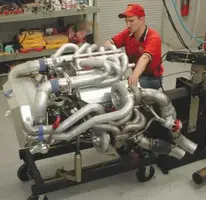
Twin Superchargers?

Shadrack said:
I was just using a random number really, and yes it is a bit excessive.

40 hp would seem like a more reasonable number to use, probably a little less if it is ported, even less if it is a roots type blower (Kenne Bell, etc.).

Still, Turbo's rule all. :D

Actually, a roots type supercharger is the least efficient. Centrifugal would be more efficient then the lysholm. The most efficient is obviously the turbo. Don't know any parasitic power numbers off the top of my head though.

The reason the turbos run twins is not only to increase flow at high boost levels, but to improve turbo lag. Two turbos geared to supply sufficient flow at redline will provide boost at a lower rpm than a single (much larger) turbo that provides the same flow at the same redline. So, twin turbos will provide boost in the low rpms and still be ablle to flow in the top end.

Superchargers don't have the low rpm / throttle response issues of a turbo. I seriously doubt there to ever be a design justification for twin SC.
 
Gearbanger 101 said:
Only in the upper ranges. The latest generation Eatons are actually the most efficient of the Positive Displacement blowers below 6psi. :)

That, I would like to see data on. To my knowledge, the twin screws still hold record for efficiency.
 
Would't it be efficient if you had custom intakes? You could have two intakes, one for each cylinder bank. I think that would make it more efficient, although i'm guessing you'd have to lower the boost, because the pressure might be too high. I dunno, i'm just thinking out loud.
 
I suppose that one advantage would be that spinning two superchargers at lower speeds could provide the same amount of boost with lower disharge temperatures (since most of the heat generated by screw type SCs is in the case and not the manifold). What I don't know is, if the lower discharge temps would make up for the increase in parasitic loss. Twin screws are approximately 90% efficient. I imagine that if you doubled the parasitic loss (20%) and also doubled the amount of air displacement that you WOULD in fact, net a pretty good gain. The increase in boost from running two positive displacement superchargers would be exponential, not just a matter of adding boost from one to the other when given a rotational speed.
 
Daggar said:
That, I would like to see data on. To my knowledge, the twin screws still hold record for efficiency.
I have posted the numbers several times already. Do a couple of searches under my name over the last couple of months and you'll see them too. :) If that doesn't satisfy your curiosity, check out the “adiabatic efficiency” rating of a 1.6L or 1.7Ltwin screw pullied for 6psi and compare it to an M90. You'll see that "efficiency" takes on a whole new meaning. It's not just about moving a larger volume of air...it's about doing it while being able to keep discharge temperatures under control. The drawback with the “Screw” compressor is that it produces higher discharge temperatures at lower levels due to the nature of the internal compression design itself. It's not a fault of the blower; they're just made to utilize a higher efficiency rating as the boost climbs to keep them from falling off in the upper levels like an Eaton does. But they still sacrifice one strongpoint for another....as all blowers do. There is no “one size” fits all I’m afraid. You have to make compromises somewhere. :shrug:
 
I looked over the last 200 of your posts and didn't see what you were referring to. I'm interested though. If you get the chance, can you PM me the links? I've probably scanned right over the top of them. I'm guessing that type of efficiency you're referring to is psi vs. diascharge temp or is it psi vs. temp vs. parasitic loss? What is an M90 rated for? I mean, what is it's displacement per revolution? I do understand that the cooler discharge temps at lower pressures is what is desireable to the OEM companies for the Eaton but how do they compare when we're talking power improvement vs. parasitic loss?

Thanks
 
it has been done on aircraft to great success in the late 40's but they were installed in series one feeding into another. Another idea that came off very well was a turbo/ supercharger combo that was used on the lockheed constalation the supercharger was left off until you were passed 15,000ft then it was engaged to help with cruise speed, great idea's on HUGE radials but not realy practical in the auto world
 
A roots blower sitting on top of the intake manifold and then a CSC pumping air up under the intake manifold would be a pretty cool "twin supercharged" setup.....but I don't see an advantage to it at all, just the "wow" factor from doing something like that. Tuning a setup like that would probably be a pretty daunting task, not to mention routing everything properly. :p
 
Daggar said:
That, I would like to see data on.

I would like to see that too. What Gearbanger 101 said is contrary to everything I have read and been taught in university classes.

Maybe the difference is in the definition of efficiency? Efficiency could be defined as boost created per hp of drag on the crank. OR as boost created per unit of heat added to the intake charge.

just a thought
jason
 
pssssh... real men use 4 turbos. hahahaha


attachment.php
 

Attachments

  • crazy turbo.webp
    crazy turbo.webp
    19 KB · Views: 156