CMA, the cam you have now was designed around a turbo instillation, on a Ford in line six that has EFI, and overscavanges.
I'd get the engine analyser runs to confirm the improvement over your 114 LSA cam.
To match Boss 351 level ooomph, (They called it a 330 hp engine, but it was 380 hp gross at 5800 rpm, 350 flwheel net with mods) you need much better than 351C 4V cam duration, lift and off the seat intensity. Despite it all even back in 1972, the E49 level 302 horse Stage 4 cam was in actually fact very tame, even at 306 degrees duration.
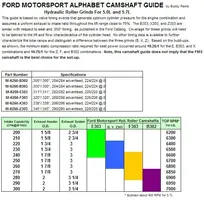
Looks like a tonned down TFS Stage II is Duration at 50 thou 224/232 degrees
Valve Lift with 1.73 Rocker 586/608 thou
Lobe Separation 112 degrees
I'm not going to call into question a US cam grinders knowledge on his craft. On the many 2V 250 and Classic In lines headed engine swaps, Schneiders US cam grinds have woken up a normally latent 200 or 250 engine.
On everything six cylinder, this company keep dolling out Aces every time it grinds a cam.
Background info:-
Traditional Big Six for race and hot street performance have kept the standard tightened inlet to exhaust lobes. The Ford 250 six isn't a 265 Hemi. but its close. It has less port area, less cylinder bore, more long stroke, a worse rod ratio, and its bore centers of 4.08 make it harder to make as much power as the 4.46" bore spacing Mopar Hemi 6 does. But Ford used ALL of its Cleveland, Honda and PROCO engine developlemt to ensure the X-flow head is cutting edge.
Traditional cam lobe centers are:
Stock 1960-1996 144/170/187/188/221/250 Ford sixes have always been 109.
So have 1963-1985 in line 179/186/202 Holdens and
Aussie 1969-1982 215/245/265 Chrysler Hemi sixes.
Aftermarket cams wilder than the 265 4.3 liter Hemi E49 or 202 3.3 liter XU1 GTR cam specifications are for specialist racing engines with more than 11:1 compression ratio.
Its common for these to have the "at lash" duration pulled right back...they become High intensity regrinds of the stock Aussie Muscle Car cam grinds. The 20 and 50 thou lift checking durations are the same as the stock E49/XU1 durations. Modern cam re-grinds are reground off whateve rmasters the cam grinder has. So peak duration figures of 306 and 304 for the E49 or XU1 (or 312 for the HX cam 1973 Bathurst Torana with triple DCO 56 carbs)....all of it is unrelated to these 1972 designed 160 mph camshafts.
Common for regrinds is to keep the Cobra Jet Fords 1968 style overscavenging increased exhaust over lap, with 10 degrees more exhaust duration than intake duration. They are split pattern cams. A feature of every factory Ford 351/427/428/429 with the term Cobra Jet or Super Cobra Jet in the 335, FE or 385 Lima family.
Any time tubing headers or a really good intake was added, like in the Boss 302 or Boss 351, they cam got taken back to a non split lobe solid cam, and power would go up without a huge loss of midrange torque compared to the lower tier engines. That's why solid grinds are so good for performance, you can optimise the extraction and intake to eliminate the "over compensating" split intake and exhasut duration lobe design.
The modern penchant for wide lobe angles hasn't hit the in line six cam market.
The 10 degrees over on exhaust split duration concept hasn't continured on with wild sixes either, but in Australia, any 4-bbl inline six above the 350 hp level in 4.1 to 4.3 liter sixes will have different +/- 5 degrees duration on 50 thou and at lash intake and exhaust.
An ITB or 4-bbl cam design won't differ, the aftermarket doesn't seam to tailer the cams to suit the application. On an in line six, a 650 or 750 cfm 4-bbl with normally be supplied as for a 6-bbl Triple 45DOE with 40 mm choke design.
Past 300 rear whee brake horspower, a six cylinder ITB will need a heck of a lot more average independent Throttle Bore diameter. On a 45DCOE, a 1.75" throttle is neacked down to 1.575". On all ITB Webers from 45 to 56 mm, the venturi is 12.5 % smaller.
When EFi, a 45DCOE work-a-like system like JENVEY's 45, 48 or 50, the internal diameter will be 1.75 or 1.875" or 2" right thru. The EFi system will make moe power than a traditional Weber DCE, DCO or IDA/IDF, IDF3 or IDC independent runner 6- barrel carb system
Somewhere, someone feeds all that port area, L/R ratio, bore to stroke ratio info into the best Electronic Dyno package, and then decides on what cam to supply.
If Schnieder has done that, and knows what the goals are on a chasiss dyno, then your good to go.
A comparison between all over 300 rear wheel horspower cams follows along the lines of reduced Lobe Angle (106 to 108 average is indeed the only options aftermarket cam grinders provide).
I use US 302 lofting roller cam grinds on my engines,as Dick Johnson used on his 5.0 4-bbl Mustang Race cars. The turbo and non turbo cams differ in intake and exhaust lobe duration, the lobe center I chose was 114, and it dosn't differ.
The ages old Mopar Six pack 265 Hemi E49 cam duration figures comes in at w-a-y more than the Schneider cam durations and lifts, but advertised duration isn't always compariable.
The E49 cam is a turkey cam, low intensity from the ramp to the at lash duration, low load stress, but it does have high duration. It was always designed to make the best of a 6-bbl Hemi six so it could survive 6 hours of almost 100 mph aveage lap speeds in a road racing envirornent..
What I know is this. A factory Vitamin Orange E49 was rated at only 306 bhp SAE Gross. Absolute fact. Leo Leonard engine dynoed his blueprinted factory E49 at 295 hp net at the flywheel.
Despite the duration figures, its a tractor cam. A six pack idles slow and smooth, but its rpm peak where power hits is only 5000 to 5600 tops, despite its ability to rev past the 5500 rpm redline with distain.
View: https://www.youtube.com/watch?v=7CaE6xqKSuI
It is only a 295 flywheel to perhaps 337 horspower cam, restricted by the stock E49 6 packs restricted intake sizing. Even EFi, the cam is a restriction point. No way it'll ever make enough extra power to make an automatic in line six with less bore, longer stroke, and less intake port area pass the 250 rwhp level.
View: https://www.youtube.com/watch?v=1iH8RoV0HDI
View: https://www.youtube.com/watch?v=tgKRTj8H5bU
Back calculated, 245 rwhp is 310 hp at the flwheel on a 4 speed manual.
243 rwhp on the Red EFi car is 307 flywheel hp net. He got 316 BHP @ 4950 and 362 lb-ft torque @ 3100 lb-ft on the final tune, re-calulated.
When Dell Orto DHLA 48's were added with 43 mm chokes, a 265 Hemi then needs the next size up from E49 cam to even gain some tangiable gain in peak horspower. 1.69" is the intenal venturi diameter. Power goes up to 340 flywheel hosepower
Six 1.575" venturis restrict the rev range power peak to about 5600 rpm, even though the engine will rev right up to 6500 or even 7000 rpm safely. The cam duration growth at 50 thou and at lash is mated with an extreme drop in average of intake and exhaust lobe angle, is right on the Vizard "Green line" recomendations.
The 115-D Kelford solid lifter, flat tappet cam is a modern day E49 cam that passes the working to rule SAE cam duration rules. Its better than the orginal E49 cam. In stages, its a Stage 4 cam like a Q code Boss 302 or Shelby K code 289 310 degree or J code 302 or H code 351 aftermarket 290 cam is.
Stage 4 "
https://www.kelfordcams.com/nz/camshafts/chrysler/hemi-245-265-6-cylinder/115-d-camshaft.html"
Stage 5 "
https://www.kelfordcams.com/nz/camshafts/chrysler/hemi-245-265-6-cylinder/115-sb-camshaft.html"
Stage 6 "
https://www.kelfordcams.com/nz/camshafts/chrysler/hemi-245-265-6-cylinder/115-sc-camshaft.html"
Stage 7 "
https://www.kelfordcams.com/nz/camshafts/chrysler/hemi-245-265-6-cylinder/115-x-custom-camshaft.html"
In post
#7321
This was a Chevy Off Road and Marines cam profile for a methonal six. 340 rwhp with 4-bbl.
An auto in line six will need a way to limit the duration when both valves are open 30 thou to reduce off idle torque loss.
My thinking back in 2013 when I got Kelfords to do my cam was to
remove off idle torque loss,
reduce load stress, and
keep the torque peak and power peak apart and up in the rev range.
The 3rd Gen Cathedral port and wide lobe center LS1 5.7 was exactly where Ford ended up with the last Saleen S351 non supercharged engine.
The fourth generation Fox 4 351 of 1994 by Saleen had either big valve EB Performer RPM or TFS alloy heads, flycut pistons for a TFS II spec cam and 371 hp at 5100 rpm, before the Edlebrock heads and the Paxton 495 hp version came out. The aspirations index was just 4836 with this combination, it in fact was better than the later 2002 5.6 factory Falcon T3 342 stoker.
(351.86*5100)/371 HP = 4836.
Lots to consider if your aiming for a streetable 250 rwhp auto in line, ITB six.
The work done back then was the last stuff Ford allowed with a push rod small block V8 in the USA.
8.5 DCR is considered max for 93 octane, I went through this process.
https://eectuning.org/forums/viewtopic.php?f=2&t=17683






 .
.