Status
Not open for further replies.
No the pic of the car like 2 or 3 pages ago where you tantalize the masses with the intercooler that's gone and big orange coupler that's gone. If you can stick a long neck between the cowl and the wiper at park position, it's a little high.

I did read the iron lung donut child labor China posts. I'm still in awe of the exhaust though! The downside up right do over is down right puuuurty! The 6 itb ready to roar are pretty cool too. As are the brass fittings against the backdrop of the red tubing.

You coordinate so well. And strangely enough, I completely understood every word of your Jameson post.

Funny you mention Nam. I was born in the 60's and my dad had already put in 20 yrs in the AF by 70. And if I take this new job, there's a chance I'll be taking a trip to Chi-Na and Nam in the next year or 2 to look at manufacturing sites. I'll tell them you said, Heeeeey.
 
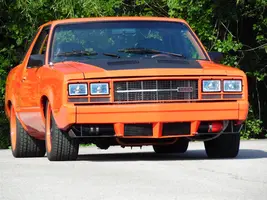
sam_0580-jpg.585375.webp There's the pic. High wipers or not, you CMA, have done a fantastic job on that Fairmont. That's a mean look. The car has really great lines. Good job!
 
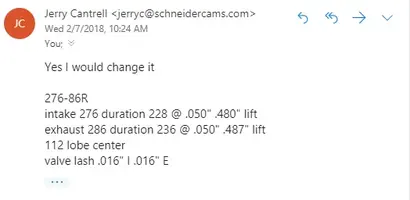
I heard back from Schneider Cams......

Unless he's talking about cam lift, He essentially wants to decrease the lift considerably, and increase the duration by about 7 degrees on both events.....
upload_2018-2-10_7-20-30.webp


this is what I have:

upload_2018-2-10_7-18-44.webp


He knows what I got for my combo, I included that in my initial email. But I'm confused. Look above.
.315 x 1.75 (my actual rocker ratio) = .551 (intake)
.330 x 1.75 = .577 (exhaust)

Is this guy talking about almost taking .090 off of the cam?

And speaking of my cam,....what is up with the last spec (Cam lift @ TDC)? How is it that the exhaust lift is less than the intake lift on that row, where it's more everywhere else? Or is this because it's already in some sort of overlap, and at TDC, the exhaust is already starting to open? :shrug:
 

Attachments

  • upload_2018-2-10_7-9-2.webp
    upload_2018-2-10_7-9-2.webp
    8.4 KB · Views: 283
And speaking of my cam,....what is up with the last spec (Cam lift @ TDC)? How is it that the exhaust lift is less than the intake lift on that row, where it's more everywhere else? Or is this because it's already in some sort of overlap, and at TDC, the exhaust is already starting to open? :shrug:

I’m no cam expert, but taking an educated guess.

Looking at the exhaust closing and intake opening events and what looks like a negative overlap value, it appears both valves are closed at true zero degree TDC. The exhaust is closed before TDC (1.13 BTDC) and the intake opens after (0.39 ATDC). Added up, total time with both valves closed equals 1.52, which is on the cam card as -1.5 overlap.

So to answer your question, the cam lift at TDC must be measured at some value BTC for the exhaust value and some value ATDC for the intake. If these are both measured 10 degrees on either side of TDC, the exhaust is closer to the base circle (10 - 1.13) than the intake (10 - 0.39). Assuming symmetric lobes, this could explain why the exhaust lift is lower.

Maybe some of the cam gurus will jump in and provide their thoughts.
 
CMA, the cam you have now was designed around a turbo instillation, on a Ford in line six that has EFI, and overscavanges.

I'd get the engine analyser runs to confirm the improvement over your 114 LSA cam.

To match Boss 351 level ooomph, (They called it a 330 hp engine, but it was 380 hp gross at 5800 rpm, 350 flwheel net with mods) you need much better than 351C 4V cam duration, lift and off the seat intensity. Despite it all even back in 1972, the E49 level 302 horse Stage 4 cam was in actually fact very tame, even at 306 degrees duration.


Looks like a tonned down TFS Stage II is Duration at 50 thou 224/232 degrees
Valve Lift with 1.73 Rocker 586/608 thou
Lobe Separation 112 degrees


I'm not going to call into question a US cam grinders knowledge on his craft. On the many 2V 250 and Classic In lines headed engine swaps, Schneiders US cam grinds have woken up a normally latent 200 or 250 engine.

On everything six cylinder, this company keep dolling out Aces every time it grinds a cam.


Background info:-

Traditional Big Six for race and hot street performance have kept the standard tightened inlet to exhaust lobes. The Ford 250 six isn't a 265 Hemi. but its close. It has less port area, less cylinder bore, more long stroke, a worse rod ratio, and its bore centers of 4.08 make it harder to make as much power as the 4.46" bore spacing Mopar Hemi 6 does. But Ford used ALL of its Cleveland, Honda and PROCO engine developlemt to ensure the X-flow head is cutting edge.


Traditional cam lobe centers are:

Stock 1960-1996 144/170/187/188/221/250 Ford sixes have always been 109.
So have 1963-1985 in line 179/186/202 Holdens and
Aussie 1969-1982 215/245/265 Chrysler Hemi sixes.

Aftermarket cams wilder than the 265 4.3 liter Hemi E49 or 202 3.3 liter XU1 GTR cam specifications are for specialist racing engines with more than 11:1 compression ratio.


Its common for these to have the "at lash" duration pulled right back...they become High intensity regrinds of the stock Aussie Muscle Car cam grinds. The 20 and 50 thou lift checking durations are the same as the stock E49/XU1 durations. Modern cam re-grinds are reground off whateve rmasters the cam grinder has. So peak duration figures of 306 and 304 for the E49 or XU1 (or 312 for the HX cam 1973 Bathurst Torana with triple DCO 56 carbs)....all of it is unrelated to these 1972 designed 160 mph camshafts.

Common for regrinds is to keep the Cobra Jet Fords 1968 style overscavenging increased exhaust over lap, with 10 degrees more exhaust duration than intake duration. They are split pattern cams. A feature of every factory Ford 351/427/428/429 with the term Cobra Jet or Super Cobra Jet in the 335, FE or 385 Lima family.

Any time tubing headers or a really good intake was added, like in the Boss 302 or Boss 351, they cam got taken back to a non split lobe solid cam, and power would go up without a huge loss of midrange torque compared to the lower tier engines. That's why solid grinds are so good for performance, you can optimise the extraction and intake to eliminate the "over compensating" split intake and exhasut duration lobe design.

The modern penchant for wide lobe angles hasn't hit the in line six cam market.

The 10 degrees over on exhaust split duration concept hasn't continured on with wild sixes either, but in Australia, any 4-bbl inline six above the 350 hp level in 4.1 to 4.3 liter sixes will have different +/- 5 degrees duration on 50 thou and at lash intake and exhaust.

An ITB or 4-bbl cam design won't differ, the aftermarket doesn't seam to tailer the cams to suit the application. On an in line six, a 650 or 750 cfm 4-bbl with normally be supplied as for a 6-bbl Triple 45DOE with 40 mm choke design.

Past 300 rear whee brake horspower, a six cylinder ITB will need a heck of a lot more average independent Throttle Bore diameter. On a 45DCOE, a 1.75" throttle is neacked down to 1.575". On all ITB Webers from 45 to 56 mm, the venturi is 12.5 % smaller.

When EFi, a 45DCOE work-a-like system like JENVEY's 45, 48 or 50, the internal diameter will be 1.75 or 1.875" or 2" right thru. The EFi system will make moe power than a traditional Weber DCE, DCO or IDA/IDF, IDF3 or IDC independent runner 6- barrel carb system

Somewhere, someone feeds all that port area, L/R ratio, bore to stroke ratio info into the best Electronic Dyno package, and then decides on what cam to supply.


If Schnieder has done that, and knows what the goals are on a chasiss dyno, then your good to go.

A comparison between all over 300 rear wheel horspower cams follows along the lines of reduced Lobe Angle (106 to 108 average is indeed the only options aftermarket cam grinders provide).


I use US 302 lofting roller cam grinds on my engines,as Dick Johnson used on his 5.0 4-bbl Mustang Race cars. The turbo and non turbo cams differ in intake and exhaust lobe duration, the lobe center I chose was 114, and it dosn't differ.

The ages old Mopar Six pack 265 Hemi E49 cam duration figures comes in at w-a-y more than the Schneider cam durations and lifts, but advertised duration isn't always compariable.

The E49 cam is a turkey cam, low intensity from the ramp to the at lash duration, low load stress, but it does have high duration. It was always designed to make the best of a 6-bbl Hemi six so it could survive 6 hours of almost 100 mph aveage lap speeds in a road racing envirornent..


What I know is this. A factory Vitamin Orange E49 was rated at only 306 bhp SAE Gross. Absolute fact. Leo Leonard engine dynoed his blueprinted factory E49 at 295 hp net at the flywheel.


Despite the duration figures, its a tractor cam. A six pack idles slow and smooth, but its rpm peak where power hits is only 5000 to 5600 tops, despite its ability to rev past the 5500 rpm redline with distain.


View: https://www.youtube.com/watch?v=7CaE6xqKSuI


It is only a 295 flywheel to perhaps 337 horspower cam, restricted by the stock E49 6 packs restricted intake sizing. Even EFi, the cam is a restriction point. No way it'll ever make enough extra power to make an automatic in line six with less bore, longer stroke, and less intake port area pass the 250 rwhp level.


View: https://www.youtube.com/watch?v=1iH8RoV0HDI


View: https://www.youtube.com/watch?v=tgKRTj8H5bU

Back calculated, 245 rwhp is 310 hp at the flwheel on a 4 speed manual.

243 rwhp on the Red EFi car is 307 flywheel hp net. He got 316 BHP @ 4950 and 362 lb-ft torque @ 3100 lb-ft on the final tune, re-calulated.


When Dell Orto DHLA 48's were added with 43 mm chokes, a 265 Hemi then needs the next size up from E49 cam to even gain some tangiable gain in peak horspower. 1.69" is the intenal venturi diameter. Power goes up to 340 flywheel hosepower


Six 1.575" venturis restrict the rev range power peak to about 5600 rpm, even though the engine will rev right up to 6500 or even 7000 rpm safely. The cam duration growth at 50 thou and at lash is mated with an extreme drop in average of intake and exhaust lobe angle, is right on the Vizard "Green line" recomendations.

The 115-D Kelford solid lifter, flat tappet cam is a modern day E49 cam that passes the working to rule SAE cam duration rules. Its better than the orginal E49 cam. In stages, its a Stage 4 cam like a Q code Boss 302 or Shelby K code 289 310 degree or J code 302 or H code 351 aftermarket 290 cam is.

Stage 4 "https://www.kelfordcams.com/nz/camshafts/chrysler/hemi-245-265-6-cylinder/115-d-camshaft.html"
Stage 5 "https://www.kelfordcams.com/nz/camshafts/chrysler/hemi-245-265-6-cylinder/115-sb-camshaft.html"
Stage 6 "https://www.kelfordcams.com/nz/camshafts/chrysler/hemi-245-265-6-cylinder/115-sc-camshaft.html"
Stage 7 "https://www.kelfordcams.com/nz/camshafts/chrysler/hemi-245-265-6-cylinder/115-x-custom-camshaft.html"

In post #7321

img_1021-jpg.597796.webp


This was a Chevy Off Road and Marines cam profile for a methonal six. 340 rwhp with 4-bbl.


An auto in line six will need a way to limit the duration when both valves are open 30 thou to reduce off idle torque loss.

My thinking back in 2013 when I got Kelfords to do my cam was to

remove off idle torque loss,
reduce load stress, and
keep the torque peak and power peak apart and up in the rev range.


The 3rd Gen Cathedral port and wide lobe center LS1 5.7 was exactly where Ford ended up with the last Saleen S351 non supercharged engine.


The fourth generation Fox 4 351 of 1994 by Saleen had either big valve EB Performer RPM or TFS alloy heads, flycut pistons for a TFS II spec cam and 371 hp at 5100 rpm, before the Edlebrock heads and the Paxton 495 hp version came out. The aspirations index was just 4836 with this combination, it in fact was better than the later 2002 5.6 factory Falcon T3 342 stoker.


(351.86*5100)/371 HP = 4836.

Lots to consider if your aiming for a streetable 250 rwhp auto in line, ITB six.

The work done back then was the last stuff Ford allowed with a push rod small block V8 in the USA.

8.5 DCR is considered max for 93 octane, I went through this process.

https://eectuning.org/forums/viewtopic.php?f=2&t=17683
 
Last edited:
Are you sure he isn't just trying to sell you an off the shelf grind and be done with you? I mean, I would at least give you a little reasoning behind my recommendation. That's a lot of lift to give up. Does he know the mods to your heads? Does he know what heads your using? Most heads have a 'stall' lift...where more lift gives little to none or even less flow. Maybe he is confused about the Monster induction setup. I've read every page of this so far and I sometimes am!

:bang:
 
  • Like
Reactions: General karthief
CMA, the cam you have now was designed around a turbo instillation, on a Ford in line six that has EFI, and overscavanges.

I'd get the engine analyser runs to confirm the improvement over your 114 LSA cam.

To match Boss 351 level ooomph, (They called it a 330 hp engine, but it was 380 hp gross at 5800 rpm, 350 flwheel net with mods) you need much better than 351C 4V cam duration, lift and off the seat intensity. Despite it all even back in 1972, the E49 level 302 horse Stage 4 cam was in actually fact very tame, even at 306 degrees duration.


Looks like a tonned down TFS Stage II is Duration at 50 thou 224/232 degrees
Valve Lift with 1.73 Rocker 586/608 thou
Lobe Separation 112 degrees


I'm not going to call into question a US cam grinders knowledge on his craft. On the many 2V 250 and Classic In lines headed engine swaps, Schneiders US cam grinds have woken up a normally latent 200 or 250 engine.

On everything six cylinder, this company keep dolling out Aces every time it grinds a cam.


Background info:-

Traditional Big Six for race and hot street performance have kept the standard tightened inlet to exhaust lobes. The Ford 250 six isn't a 265 Hemi. but its close. It has less port area, less cylinder bore, more long stroke, a worse rod ratio, and its bore centers of 4.08 make it harder to make as much power as the 4.46" bore spacing Mopar Hemi 6 does. But Ford used ALL of its Cleveland, Honda and PROCO engine developlemt to ensure the X-flow head is cutting edge.


Traditional cam lobe centers are:

Stock 1960-1996 144/170/187/188/221/250 Ford sixes have always been 109.
So have 1963-1985 in line 179/186/202 Holdens and
Aussie 1969-1982 215/245/265 Chrysler Hemi sixes.

Aftermarket cams wilder than the 265 4.3 liter Hemi E49 or 202 3.3 liter XU1 GTR cam specifications are for specialist racing engines with more than 11:1 compression ratio.


Its common for these to have the "at lash" duration pulled right back...they become High intensity regrinds of the stock Aussie Muscle Car cam grinds. The 20 and 50 thou lift checking durations are the same as the stock E49/XU1 durations. Modern cam re-grinds are reground off whateve rmasters the cam grinder has. So peak duration figures of 306 and 304 for the E49 or XU1 (or 312 for the HX cam 1973 Bathurst Torana with triple DCO 56 carbs)....all of it is unrelated to these 1972 designed 160 mph camshafts.

Common for regrinds is to keep the Cobra Jet Fords 1968 style overscavenging increased exhaust over lap, with 10 degrees more exhaust duration than intake duration. They are split pattern cams. A feature of every factory Ford 351/427/428/429 with the term Cobra Jet or Super Cobra Jet in the 335, FE or 385 Lima family.

Any time tubing headers or a really good intake was added, like in the Boss 302 or Boss 351, they cam got taken back to a non split lobe solid cam, and power would go up without a huge loss of midrange torque compared to the lower tier engines. That's why solid grinds are so good for performance, you can optimise the extraction and intake to eliminate the "over compensating" split intake and exhasut duration lobe design.

The modern penchant for wide lobe angles hasn't hit the in line six cam market.

The 10 degrees over on exhaust split duration concept hasn't continured on with wild sixes either, but in Australia, any 4-bbl inline six above the 350 hp level in 4.1 to 4.3 liter sixes will have different +/- 5 degrees duration on 50 thou and at lash intake and exhaust.

An ITB or 4-bbl cam design won't differ, the aftermarket doesn't seam to tailer the cams to suit the application. On an in line six, a 650 or 750 cfm 4-bbl with normally be supplied as for a 6-bbl Triple 45DOE with 40 mm choke design.

Past 300 rear whee brake horspower, a six cylinder ITB will need a heck of a lot more average independent Throttle Bore diameter. On a 45DCOE, a 1.75" throttle is neacked down to 1.575". On all ITB Webers from 45 to 56 mm, the venturi is 12.5 % smaller.

When EFi, a 45DCOE work-a-like system like JENVEY's 45, 48 or 50, the internal diameter will be 1.75 or 1.875" or 2" right thru. The EFi system will make moe power than a traditional Weber DCE, DCO or IDA/IDF, IDF3 or IDC independent runner 6- barrel carb system

Somewhere, someone feeds all that port area, L/R ratio, bore to stroke ratio info into the best Electronic Dyno package, and then decides on what cam to supply.


If Schnieder has done that, and knows what the goals are on a chasiss dyno, then your good to go.

A comparison between all over 300 rear wheel horspower cams follows along the lines of reduced Lobe Angle (106 to 108 average is indeed the only options aftermarket cam grinders provide).


I use US 302 lofting roller cam grinds on my engines,as Dick Johnson used on his 5.0 4-bbl Mustang Race cars. The turbo and non turbo cams differ in intake and exhaust lobe duration, the lobe center I chose was 114, and it dosn't differ.

The ages old Mopar Six pack 265 Hemi E49 cam duration figures comes in at w-a-y more than the Schneider cam durations and lifts, but advertised duration isn't always compariable.

The E49 cam is a turkey cam, low intensity from the ramp to the at lash duration, low load stress, but it does have high duration. It was always designed to make the best of a 6-bbl Hemi six so it could survive 6 hours of almost 100 mph aveage lap speeds in a road racing envirornent..


What I know is this. A factory Vitamin Orange E49 was rated at only 306 bhp SAE Gross. Absolute fact. Leo Leonard engine dynoed his blueprinted factory E49 at 295 hp net at the flywheel.


Despite the duration figures, its a tractor cam. A six pack idles slow and smooth, but its rpm peak where power hits is only 5000 to 5600 tops, despite its ability to rev past the 5500 rpm redline with distain.


View: https://www.youtube.com/watch?v=7CaE6xqKSuI


It is only a 295 flywheel to perhaps 337 horspower cam, restricted by the stock E49 6 packs restricted intake sizing. Even EFi, the cam is a restriction point. No way it'll ever make enough extra power to make an automatic in line six with less bore, longer stroke, and less intake port area pass the 250 rwhp level.


View: https://www.youtube.com/watch?v=1iH8RoV0HDI


View: https://www.youtube.com/watch?v=tgKRTj8H5bU

Back calculated, 245 rwhp is 310 hp at the flwheel on a 4 speed manual.

243 rwhp on the Red EFi car is 307 flywheel hp net. He got 316 BHP @ 4950 and 362 lb-ft torque @ 3100 lb-ft on the final tune, re-calulated.


When Dell Orto DHLA 48's were added with 43 mm chokes, a 265 Hemi then needs the next size up from E49 cam to even gain some tangiable gain in peak horspower. 1.69" is the intenal venturi diameter. Power goes up to 340 flywheel hosepower


Six 1.575" venturis restrict the rev range power peak to about 5600 rpm, even though the engine will rev right up to 6500 or even 7000 rpm safely. The cam duration growth at 50 thou and at lash is mated with an extreme drop in average of intake and exhaust lobe angle, is right on the Vizard "Green line" recomendations.

The 115-D Kelford solid lifter, flat tappet cam is a modern day E49 cam that passes the working to rule SAE cam duration rules. Its better than the orginal E49 cam. In stages, its a Stage 4 cam like a Q code Boss 302 or Shelby K code 289 310 degree or J code 302 or H code 351 aftermarket 290 cam is.

Stage 4 "https://www.kelfordcams.com/nz/camshafts/chrysler/hemi-245-265-6-cylinder/115-d-camshaft.html"
Stage 5 "https://www.kelfordcams.com/nz/camshafts/chrysler/hemi-245-265-6-cylinder/115-sb-camshaft.html"
Stage 6 "https://www.kelfordcams.com/nz/camshafts/chrysler/hemi-245-265-6-cylinder/115-sc-camshaft.html"
Stage 7 "https://www.kelfordcams.com/nz/camshafts/chrysler/hemi-245-265-6-cylinder/115-x-custom-camshaft.html"

In post #7321

img_1021-jpg.597796.webp


This was a Chevy Off Road and Marines cam profile for a methonal six. 340 rwhp with 4-bbl.


An auto in line six will need a way to limit the duration when both valves are open 30 thou to reduce off idle torque loss.

My thinking back in 2013 when I got Kelfords to do my cam was to

remove off idle torque loss,
reduce load stress, and
keep the torque peak and power peak apart and up in the rev range.


The 3rd Gen Cathedral port and wide lobe center LS1 5.7 was exactly where Ford ended up with the last Saleen S351 non supercharged engine.


The fourth generation Fox 4 351 of 1994 by Saleen had either big valve EB Performer RPM or TFS alloy heads, flycut pistons for a TFS II spec cam and 371 hp at 5100 rpm, before the Edlebrock heads and the Paxton 495 hp version came out. The aspirations index was just 4836 with this combination, it in fact was better than the later 2002 5.6 factory Falcon T3 342 stoker.


(351.86*5100)/371 HP = 4836.

Lots to consider if your aiming for a streetable 250 rwhp auto in line, ITB six.

The work done back then was the last stuff Ford allowed with a push rod small block V8 in the USA.

8.5 DCR is considered max for 93 octane, I went through this process.

https://eectuning.org/forums/viewtopic.php?f=2&t=17683


Can somebody please tell me what this man is trying to tell me.:shrug:

So, uh. Have you fabbed anything new?
Yes,...but I'll never tell.

Are you sure he isn't just trying to sell you an off the shelf grind and be done with you? I mean, I would at least give you a little reasoning behind my recommendation. That's a lot of lift to give up. Does he know the mods to your heads? Does he know what heads your using? Most heads have a 'stall' lift...where more lift gives little to none or even less flow. Maybe he is confused about the Monster induction setup. I've read every page of this so far and I sometimes am!

:bang:

He'd be regrinding my cam...but he cited an "off the shelf" grind # in his reply.

I don't think he has a clue what is really the intended usage of the engine. I don't think he even remotely knows what my expected goals are for power. I don't think he knows that the current cam makes over 19" of vacuum at idle. I don't think he has an inkling what the Monster is all about.

I don't think he remembers that I talked to him years ago, and he recommended that I run the cam at 110.5*
https://www.stangnet.com/mustang-fo...ted-going-forward.871263/page-37#post-8837253
I think that if he knows anything, he thinks that I have a Aussie speed intake bolted on the the side of the head w/ a 600 CFM vacuum secondary Holley four bbl sitting on top.
Not 6 ITB's from a BMW M3.

I'm gonna call the guy tomorrow and follow up with him to see what he thinks after I fill him in with all of the true objective dealios.
(besides,..I wanna learn how he justifies scrubbing off 70-80 thousandths of valve lift when the objective w/ a roller cam is to make as much power as possible.)

I am making good progress on the intake box,...I hope to have the thing to at least a rough completion stage tomorrow night. I have everything I need to do that,......Except time.
 
@a91what has a point. Run what you got. It's a good vacuum at idle cam. And since it was ground for boost, it would be pretty good with NOS on it too! That's what those extra holes in the itbs are for. NOS nozzles. Go ahead and plumb up a fogger setup. In a contrasting color, please. Red for vacuum, so Yellow, Orange, or maybe Blue for NOS. At 150 shot will give you the 'highway passing gear' you're gonna miss with the turbo on someone else's :poo:.
 
In English, Schneider has an exceptional track record, but things don't match up for me. I cited reasons. I'll cite them again.

Advertised isn't the same on 50 thou basis, but on peak lift, lobe center and all that, Its a No No No No meme for me.

My guess is that too often, people are old fuddy duddies, and talk about big cams but are too inept to figure out that a nice big cam and fat carb can really idle nice in a bigger engined Ford. Even an automatic I6. All those Aussie 250's with 340 rwhp are autos, and there are 100% driven at exhitions, drags, and aren't trailer queens.

In summary, all aftermarket very high performance cams for in line sixes down here have narrower lobe angle splits between intake and exhaust.

I personally think thats stupid with an EFi car, more so if its got six throttles instead of a big a$$ 75 mm throttle body.

Independent Runner Port on Port engines are just a tiny group, and US cam design cattered for them only with the GT40 289 and the 289 Cobra...these cars then got scaled back to use a big 715 4-bbl Holley or Dual Quads in the Shelby era, the only IR made was the aftermarket Shelby's, some GT40 road cars, and the Tunnel Port 302 Dual Quad.

Basciallly, a 5.0 "331" stroker with Comp cam and Dual Fours won't make 335 flywheel hp below 6000 rpm and 335 lb-ft with a Comp Xtreme Energy hydraulic roller with 224/230 degrees duration at 0.050, and 0.513-inch lift. Won't make 265 hp and 265 lb-ft at the rear wheels with the self imposed 6 k red line.


I'd trust the backwards 114 lobe cam you have now first.....


Lop two cylinders off a dual quad 8bbl 331, and you get a 6-bbl EFi like 250.


The cam has to have more lift, duration and 50 thou, and more lobe to cool it's wildness through the rev range.


http://www.mustangandfords.com/project-vehicles/mdmp-1206-dual-quad-carburetors-testing-part-1/
http://www.mustangandfords.com/how-to/engine/mdmp-1207-dual-quads-twin-win-or-double-trouble-part-2/

David Vizard said all reverse split cams he's used don't work well unless the engine is supercharged or turbo charged.

A shorter exhaust duration cam is designed for a cylinder head that has too much flow in the exhaust port...or a turbo or supercharger.

Ford X flow sixes are very bad idling cars because of it head has very good scavanging, yet realtively large diameter exhaust port, and which has tiny intake ports. The short turn radius on the X-flow is one of the best ever made. Nothing should ever be done to a 250 X-flow exhaust port.


You get great vaccum because the advice I had from all Aussie Turbo in line 6 turbo builders, from Nizpro, from Benson's, to Ray Hall, to AIT, to NormalAir Garret ....and David Vizard. They all said keep the lobe center wide and reduce over lap by reducing duration on the on the exhaust side. Then don't be afraid to give it a sh!+ load of INTAKE duration and lift, but there is a time in a turbo engine when more can cause problems. George's Turbo Cortina X flow was the example of how much a Turbo X flow loves intake duration and lift. 291 degrees, and well over 540 tjhou lift, and it just screamed. A big turbo and It just lapped it up!

A traditional Cobra Jet or Torino 73 351 Marine cam was what the 5.0 GT's and the non Saleen SVT R351 1994 Mustang used....split lobe cams were Fords total solution to getting cars to make low end torque. The culmination of them was the Deadly Letter Roller Cams, the

Ford via SVO Motorsport, supplied , eventually, about Seven Deadly aftermarket 303-style letter cams (now known as
A311,
A312,
E303,
B303,
F303,
X303
and Z303 as non dealer fitted items,

These are effectively Cobra Jet or SuperCobra Jet style roller cam remasters of the best hydraulic "335", Windsor and Boss 302/351 cams from the 70's. These got swapped into 5.0 HO's on a fairly regular basis.....An X 303 with 1.7 rockers makes 577 thou lift, a Z 303 587 thou......


A six cylinder non turbo cam that works on a 250 long stroke six lookes a lot like an aftermarket Jaguar XJ-6 camshat spec.

One that came close to working, but are still a little too mild are the reverse pattern 279/269 at lash items for the Triple Weber DCOE 45 cams,.https://www.terrysjag.com/product/TJP81.html

None of Dean Tighes cams go that high, but the 4.2 is rev limited by stroke and immense crank and rod weight

https://tighecams.com.au/cars.htm

Schneiders cam is pretty much like the TJP81, but its got more exhaust duration, and it over scavenges.Intake mix ends up right out the exhaust.


And its gonna HAVE to be way more radical than the wilder Ford 5.0 and 5.8 Windsor OHV letter cams.

Here is a smattering of the 10 most Revolutionary Roller and Solid cams for post 1986 Port Fuelie 5.0and 5.8's.

50 thou figures show a lot more on what was going on.
Stock 85-90 cam is 204°/204° at 50 thou 444 in. 444 ex thou lift ( Version 1 and Version 2 again, Roller cam)

Overall Roller cam Production figures are effectively four types, revised four times:
85-88 5.0: E5ZE-6250-AA 266°/266° at lash 444/444 thou lift (Version 1)..................................................1st
89-90 5.0 : E8ZE-6250-CA 276°/266° at lash 444/444 thou lift (Version 2)................................................2nd
91-93 5.0: F1ZE-6250-AA 276°/266° at lash 444/444 thou lift (Version 2)
93 Cobra 5.0: F3ZE-6250-CA 270°/270° at lash 479/479 thou lift with 1.7 rocker arm ratio (Version 3)...3rd
94 Cobra 5.0: F1ZE-6250-AA 276°/266° at lash 444/444 thou (Version 2)
95 Cobra 5.0: F4ZE-6250-DA 276°/266° at lash 444/444 thou lift (Version 2)
96-01 Explorer 5.0:F4TE-6250-BA 256°/266°at lash 422/448 thou lift (Version 4)....................................4th


A-cam (Ist flat tappet hyd ) is 204°/214° at 50 thou 448 in. 472 ex...............Deadly Letter A'.....................5th
A-cam (2ndflat tappet hyd ) is 204°/214° at 50 thou 472 in. 496 ex..............Deadly Letter A''....................6th
E-cam is 220°/220° at 50 thou 498 in. 498 ex thou lift..................................Deadly Letter E.....................7th
B-cam is 224°/224° at 50 thou 480 in. 480 ex thou lift..................................Deadly Letter B......................9th
F-cam is 226°/226° at 50 thou 512 in. 512 ex thou lift..................................Deadly Letter F......................10th
X-cam is 224°/224° at 50 thou 542 in. 542 ex thou lift..................................Deadly Letter X.....................11th
Z-cam is 228°/228° at 50 thou 552 in. 552 ex thou lift..................................Deadly Letter Z......................12th

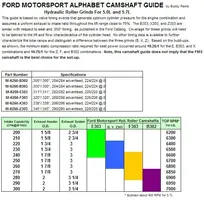
Alphabetcamguide.webp

Cam operation speed for a 331 would be 200 rpm above the right hand column. You add a bit more lift with your 1.73 to 1.75 ratio rockers, then you rip off two cylinders, and end up with just 250 horsepower. Smaller engines do haul a lot harder, but thats my summary.


These wilder cams are a bare minimum to make 265 rwhp in a manual Mustang stroker EFi.


A Kelford style Stage 5 to 6 cam is what you need, and on a wider lobe.
 

Attachments

  • doodle-snow-games-day-4-6047722892165120.5-s.webp
    doodle-snow-games-day-4-6047722892165120.5-s.webp
    1.5 KB · Views: 213
  • Alphabetcamguide.webp
    Alphabetcamguide.webp
    53.7 KB · Views: 384
Last edited:
In English, Schneider has an exceptional track record, but things don't match up for me. I cited reasons. I'll cite them again.

Advertised isn't the same on 50 thou basis, but on peak lift, lobe center and all that, Its a No No No No meme for me.

My guess is that too often, people are old fuddy duddies, and talk about big cams but are too inept to figure out that a nice big cam and fat carb can really idle nice in a bigger engined Ford. Even an automatic I6. All those Aussie 250's with 340 rwhp are autos, and there are 100% driven at exhitions, drags, and aren't trailer queens.

In summary, all aftermarket very high performance cams for in line sixes down here have narrower lobe angle splits between intake and exhaust.

I personally think thats stupid with an EFi car, more so if its got six throttles instead of a big a$$ 75 mm throttle body.

Independent Runner Port on Port engines are just a tiny group, and US cam design cattered for them only with the GT40 289 and the 289 Cobra...these cars then got scaled back to use a big 715 4-bbl Holley or Dual Quads in the Shelby era, the only IR made was the aftermarket Shelby's, some GT40 road cars, and the Tunnel Port 302 Dual Quad.

Basciallly, a 5.0 "331" stroker with Comp cam and Dual Fours won't make 335 flywheel hp below 6000 rpm and 335 lb-ft with a Comp Xtreme Energy hydraulic roller with 224/230 degrees duration at 0.050, and 0.513-inch lift. Won't make 265 hp and 265 lb-ft at the rear wheels with the self imposed 6 k red line.


I'd trust the backwards 114 lobe cam you have now first.....


Lop two cylinders off a dual quad 8bbl 331, and you get a 6-bbl EFi like 250.


The cam has to have more lift, duration and 50 thou, and more lobe to cool it's wildness through the rev range.


http://www.mustangandfords.com/project-vehicles/mdmp-1206-dual-quad-carburetors-testing-part-1/
http://www.mustangandfords.com/how-to/engine/mdmp-1207-dual-quads-twin-win-or-double-trouble-part-2/

David Vizard said all reverse split cams he's used don't work well unless the engine is supercharged or turbo charged.

A shorter exhaust duration cam is designed for a cylinder head that has too much flow in the exhaust port...or a turbo or supercharger.

Ford X flow sixes are very bad idling cars because of it head has very good scavanging, yet realtively large diameter exhaust port, and which has tiny intake ports. The short turn radius on the X-flow is one of the best ever made. Nothing should ever be done to a 250 X-flow exhaust port.


You get great vaccum because the advice I had from all Aussie Turbo in line 6 turbo builders, from Nizpro, from Benson's, to Ray Hall, to AIT, to NormalAir Garret ....and David Vizard. They all said keep the lobe center wide and reduce over lap by reducing duration on the on the exhaust side. Then don't be afraid to give it a sh!+ load of INTAKE duration and lift, but there is a time in a turbo engine when more can cause problems. George's Turbo Cortina X flow was the example of how much a Turbo X flow loves intake duration and lift. 291 degrees, and well over 540 tjhou lift, and it just screamed. A big turbo and It just lapped it up!

A traditional Cobra Jet or Torino 73 351 Marine cam was what the 5.0 GT's and the non Saleen SVT R351 1994 Mustang used....split lobe cams were Fords total solution to getting cars to make low end torque. The culmination of them was the Deadly Letter Roller Cams, the


A six cylinder non turbo cam that works on a 250 long stroke six lookes a lot like an aftermarket Jaguar XJ-6 camshat spec.

One that came close to working, but are still a little too mild are the reverse pattern 279/269 at lash items for the Triple Weber DCOE 45 cams,.https://www.terrysjag.com/product/TJP81.html

None of Dean Tighes cams go that high, but the 4.2 is rev limited by stroke and immense crank and rod weight

https://tighecams.com.au/cars.htm

Schneiders cam is pretty much like the TJP81, but its got more exhaust duration, and it over scavenges.Intake mix ends up right out the exhaust.


And its gonna HAVE to be way more radical than the wilder Ford 5.0 and 5.8 Windsor OHV letter cams.

Here is a smattering of the 10 most Revolutionary Roller and Solid cams for post 1986 Port Fuelie 5.0and 5.8's.

50 thou figures show a lot more on what was going on.
Stock 85-90 cam is 204°/204° at 50 thou 444 in. 444 ex thou lift ( Version 1 and Version 2 again, Roller cam)

Overall Roller cam Production figures are effectively four types, revised four times:
85-88 5.0: E5ZE-6250-AA 266°/266° at lash 444/444 thou lift (Version 1)..................................................1st
89-90 5.0 : E8ZE-6250-CA 276°/266° at lash 444/444 thou lift (Version 2)................................................2nd
91-93 5.0: F1ZE-6250-AA 276°/266° at lash 444/444 thou lift (Version 2)
93 Cobra 5.0: F3ZE-6250-CA 270°/270° at lash 479/479 thou lift with 1.7 rocker arm ratio (Version 3)...3rd
94 Cobra 5.0: F1ZE-6250-AA 276°/266° at lash 444/444 thou (Version 2)
95 Cobra 5.0: F4ZE-6250-DA 276°/266° at lash 444/444 thou lift (Version 2)
96-01 Explorer 5.0:F4TE-6250-BA 256°/266°at lash 422/448 thou lift (Version 4)....................................4th


A-cam (Ist flat tappet hyd ) is 204°/214° at 50 thou 448 in. 472 ex...............Deadly Letter A'.....................5th
A-cam (2ndflat tappet hyd ) is 204°/214° at 50 thou 472 in. 496 ex..............Deadly Letter A''....................6th
E-cam is 220°/220° at 50 thou 498 in. 498 ex thou lift..................................Deadly Letter E.....................7th
B-cam is 224°/224° at 50 thou 480 in. 480 ex thou lift..................................Deadly Letter B......................9th
F-cam is 226°/226° at 50 thou 512 in. 512 ex thou lift..................................Deadly Letter F......................10th
X-cam is 224°/224° at 50 thou 542 in. 542 ex thou lift..................................Deadly Letter X.....................11th
Z-cam is 228°/228° at 50 thou 552 in. 552 ex thou lift..................................Deadly Letter Z......................12th

Alphabetcamguide.webp

Cam operation speed for a 331 would be 200 rpm above the right hand column. You add a bit more lift with your 1.73 to 1.75 ratio rockers, then you rip off two cylinders, and end up with just 250 horsepower. Smaller engines do haul a lot harder, but thats my summary.


These wilder cams are a bare minimum to make 265 rwhp in a manual Mustang stroker EFi.


A Kelford style Stage 5 to 6 cam is what you need, and on a wider lobe.
See,....here's where you lose me.

What does any other brand, or any other engine other than a Ford 250 I-6 have to do with this discussion?:shrug:

In the end, if I don't feel like somebody can take what I have, and make it work better in the new combination, I'll leave the one that's in the engine alone. It just makes sense to me that at 114, my cam CL is entirely too lazy to make good power when it has to coordinate making power with the confines of a naturally aspirated engine.
 
  • Like
Reactions: xecute
Man am I clueless when it comes to what I can and can't do based on the time it takes to do it. I cannot imagine having to work on a job clock like a mechanic does,...I'd freakin' starve.

I woulda swore that I was gonna be able to get the entire air box built, and was even thinkin that I could get the CAI mocked up as well.

Like I said,.......clueless.

This is all the farther that I am on the thing.
IMAG0040_zpslxmekvfb.webp

Because I'm stupid, I cut the thing short thinking that the ends would be different, but It's just one more thing that I get to do twice. Now I'll have to add a piece and there'll probably be a visible seam. I was thinking that I'd have some sort of 3" exhaust elbow merged on the lower end, and alot of that would just be sectioned in, but after looking at it, think maybe I'll just put a 3" stub straight out the end, and use the 90 degree couplers that I have laying around from the turbo stuff.
IMAG0042_zpsi5zxjzvj.webp

After looking at it initially I decided that I should open up the top more, so I cut another inch off along the short end.
IMAG0043_zpsz8ipbwxt.webp

IMAG0041_zps836dy3dl.webp

This looking down at the donuts before I cut the extra inch off.

Now I know what you're thinkin.....You're thinkin that I'm leaving that center space open for some future piece of acrylic to show off the TB's.

Wrongo.

The Donuts look far too rough to display them,...and for what ever reason, I welded the low side from the inside, instead of from underneath,..and the fitment required that I weld the piss out of it. Needless to say,.it looks like ass on a plate.

The reason for the center cut out is so that the steel top will be flat. On the same plane as top of the valvecover. I'll do a similar raised rib like I did on the old intake...

All in all I'm very happy with the way it looks...but I sure hope all of this sht works.
 
Last edited:
Dont hate me for saying it, but it seems you are damn near covering the ITBs completely. Once you put your valve cover on, you wont really be able to see them...
I don't hate you regardless of what you think.
The side view of the TB's leaves alot of those things exposed. They'll stand well above the top of the valve cover.
There is nothing else short of velocity stacks, or those little K&N individual filters that will truly keep the feel of the ITB's intact.

The airbox will probably run far nicer than the individual filters would because each TB will share each others pulses. The good thing is however, The air box is removeable. Two bolts and the thing is off. So,...depending on how it runs with the thing all sealed up, I may swap out the individual filters as an option.

But im quite confident that it's gonna be good. And I think it'll be the only thing that I run on this change up.
 
  • Like
Reactions: 90sickfox
Dumb a$$.


Noboddy puts six 50 thousand watt light bulbs under a table. A city on a hill cannot be hit.

3832-50kW-Bulb-EM.webp


If your engines gonna make 400 hp, it will do so by making about 300 killer wats, um , 300 Kilo Watts.

300, 000 watts.


Thats 6 50, 000 watt bulbs of input required somewhere, probably more when allowing for chemical transfer and friction loss.


But dang they look good, and well done.....I liked that post....brilliant, bright, but you win the Prince of Darkness Award for hidding all your goodies in a trunk. B-a-a-a-ad Mike M. But you'll keep em all gessing while your gassing them, for certain.


Wire lined glass for a cover. They had them in my school to stop students getting out....


Ah well,


See,....here's where you lose me.

What does any other brand, or any other engine other than a Ford 250 I-6 have to do with this discussion?:shrug:

In the end, if I don't feel like somebody can take what I have, and make it work better in the new combination, I'll leave the one that's in the engine alone. It just makes sense to me that at 114, my cam CL is entirely too lazy to make good power when it has to coordinate making power with the confines of a naturally aspirated engine.

Maybee a good idea for the start.


Inter Troupe Comparisons mean Everything.

The things different between engines are what you should look at. On three engines, they come out with the same cam choice.

hemi_265_solid_cams.webp


Jason S's Cyco_250


Three things B-A-D for the X-flow head 250 compared to

6 pack Hemi,
5.0 EFi,
8-BBL 302 or
4 or 8v stroked 331. .

Ball one. X-flows over scavenge.

X-flows don't need extra duration on exhaust because the exhaust is already as efficient as it can be. Even 5.0's, which have bad exhaust ports, don't use split intake and exhaust durations with extra on the exit. Bad idea. Strike One . Miss

Ball two. It has no lift. X-flows can take nearly all the lift they can fit as the pistons don't need flycutting. Why would you say no to more lift?. Even 1.6:1 ratio, 4 " piston 5.0's can take all the lift the cam can give, and yes, you have to flycut the piston to get space. Strike Two. Miss

Ball three. On the basis of other engines, the cam is a fail. Mopar Hemis just aren't like canted valve Clevelands or Lima 429's in those engines abilty to savagely become wild on the idle and have a big 2800 rpm hump in the torque delivery curve. The Hemi 6 Pack is a very, very noisey engine, but its essenally tappet and timning chain and starter and induction roar. Once filtered out, its a very steady and tame idling engine that just beggs for more duration and 50 thou lift like the 115SB and115 SC cams... just the same a Jason S's old roller cam for his 4-bbl 365 hp engine. Strike three. OUT.


Jason Stoddards Cyco_250 six for a time had 45 mm R32 syline GTR throttle bodies, a gift for a time from a very smart EFi tuner who teamed up with Jason.

Speedflow fuel rail ends and 550 cc/min injectors, Motec lambda and temp sensors, Corse EFi computer

Internally, it wasn't changed from what it was like when it was thrown together in the late Noughtees....it still runs the old Ivan Tighe solid Roller cam with 256 deg @ 50 thou inlet, 265 deg @ 50 thou exhaust with 107 lobe separation.


This lost a few hp from his 650 cfm 4-bbl, but with EFi and this cam, it made 250 rwhp with 4-bbl and C4 auto, and with less hp from EFi, made his 2701 pound TF Cortina 250 EFI X-Flow do 11.59 second 1/4 miles @ 114.60mph. 6200 rpm rev limit.


Reverse tested based on a 50% power loss, its flywheel hp is


345.5hp @ 6100 rpm
333.3 lb-ft @ 4700 on California Texaco Vortex 98

353.0 hp @ 6100 rpm
336.7 lb-ft @ 4700 on Sucrogen E85


Aspirations index, 4320. (253*6100)/353 hp. Bang on DJR 320 with 429 hp 5.4 quad cam territory.

A ball bustin' bad b@$+@rd Six

The 2007 build Tighe cam wasn't designed for an ITB from a Nissan Skyline GTR twin turbo, it was for a stock exhaust 4-bbl that needed to make 350 flywheel horsepower. So the lobe center and extra exhasut duration won't be helping to keep the fuel air mix flowing the right direction.


Ford use the same kind of ideas. Adding a V8 style cam like Schnedier is suggesting will strangle the arse out of your 250 X-flow. To say I'm a little disapointed is an understatment.


Everything about that cam recomendation is wrong for an ITB I6 with EFi.

All fine aspiration fuel delivery systems hate narrow lobe center cams, and all X-flow sixes hate over scavanging extra duration exhaust profiles. Nothing, NOTHING in the recomendation gells with me. I quickly took you through the A to Z of Ford roller cams. They work fine for a restricted intake EFi 302 Windsor, but anything like them in 50 thou lift or at lash duration won't make anymore than 250 horsepower. As a V8, they don't break the 300 rwhp mark at all untill you go MUCH wilder.


I don't even think a narrow lobe will help make an ITB give better torque and streetable power....it'll F it up the A with a knock off Anderson N41 verses TFS Stage II hybrid....with next to no lift.
 
Status
Not open for further replies.