Progress Thread Komo's 1990 GT - Parts Gathering Purgatory & Home Remodel

E-brake cables are attached to the e-brake handle in the center console so doubtful. Speedo cable is what I would guess as well.
Ok, makes sense. I drove it tonight actually to pick up some food. Speedo still worked so that cable must be hanging on by a thread. If it is a Speedo cable, any place in particular I should look to buy a replacement from? NPD for a NOS one or are those long gone? I can research, but if anyone has the P/N off the top of their head that would be helpful too.

On an unrelated note, I was getting more of a vibration from the engine than I remember… wonder if it has anything to do with that cylinder balance test that died on me. I don’t know if the paranoia was getting to me but I swore I heard a little knocking type noise at idle as well. I also got a backfire in 2nd gear at low RPMs with the engine up to temp that was unexpected. No bueno.

No time to sit and diagnose or even play with it at the moment unfortunately.
 
Last edited:
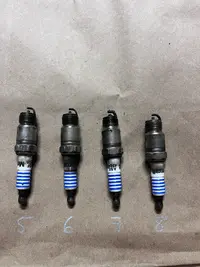
Might be a dumb question, but going way back in my thread to this post:


Would spraying a SeaFoam type product in through the #7 cylinder plug hole and letting it sit to maybe help free a potential stuck ring help with the plug having so much oil on it?

Again, need to dig into this more, but if i do have more of a vibration (and i did notice it on the drivers side when doing the CBT, i watched the engine shake a lot more than normal), maybe i do have an issue with the #7 cylinder/piston?

I really need to pull that plug again and see how it looks. Just remember, i have since replaced the above pictured plugs with new ones gapped .01 down. I'm curious if the new #7 plug is all gunked up and causing me some issues.
 
Last edited:
My suspicions may have been correct. CBT today came back with cylinder #7.

I put some seafoam in the crankcase, will run it for 100 miles and change the oil, and change the plug again and see if it helps.
 
I would try to figure out where the excess oil is coming from.

Do you have oil in the TB and intake?
When I took the upper/EGR/TB off, the EGR and inside of the intake were all pretty gunked up.

I have a feeling my PCV system was clogged (now fixed), and maybe my piston rings are stuck in cylinder #7 and gunking up that plug by letting too much oil past.

The PO clearly didn’t take great care of the car.
 
When I took the upper/EGR/TB off, the EGR and inside of the intake were all pretty gunked up.

I have a feeling my PCV system was clogged (now fixed), and maybe my piston rings are stuck in cylinder #7 and gunking up that plug by letting too much oil past.

The PO clearly didn’t take great care of the car.

Alright, consider this a [good] sign. :nice:

I can think of a few way to improve this and also recall that you're adding boost.

IMO, you need an [additional] path for PCV gasses to flow. Double the size of the PCV = Cut air velocity into the PCV, in half. Slower speed = More time for oil vapor to separate from the air before it enters the PCV (the oil droplets have more time to fall).
 
  • Like
Reactions: gkomo
Have you confirmed you have good spark in the #7 hole?
No, just going off the condition of the previous plug and how it was completely covered in sludge and just assuming the new plug is doing the same.

I really need to remove the #7 plug and see how it looks now. Thankfully that’s an easy plug to get to and shouldn’t take more than 10 minutes to get my tools together and remove it. Or is there a other way I should be testing if it has spark? Like my distributor isn’t putting out good spark to that cylinder? Plugs/wires/cap/rotor are new.

Another thing I noticed with the CBT was the engine definitely shook more when (I’m assuming) it was testing cylinders 5,6 and 8… because 7 is already troublesome so it was probably like having two dead cylinders on that bank when doing the test.
 
Last edited:
Alright, consider this a [good] sign. :nice:

I can think of a few way to improve this and also recall that you're adding boost.

IMO, you need an [additional] path for PCV gasses to flow. Double the size of the PCV = Cut air velocity into the PCV, in half. Slower speed = More time for oil vapor to separate from the air before it enters the PCV (the oil droplets have more time to fall).
Is there a tried and true method to do this, while keeping things CARB legal?

About the boost, boost doesn’t really come on until about 3k rpm and all these tests are done well below that. Does that make a difference?
 
#4
Is there a tried and true method to do this, while keeping things CARB legal?

About the boost, boost doesn’t really come on until about 3k rpm and all these tests are done well below that. Does that make a difference?

It does make a difference because under boost, you're going to get more blow-by and therefore more crank case pressure that needs to go somewhere.
 
  • Like
Reactions: gkomo
And yes, you can plumb in another PCV into a vacuum source with a one-way valve to either valve cover.

I would recommend doing this before adding separators or catchers.

It will just give you a good idea of much oil you're still getting or not getting.
 
  • Like
Reactions: gkomo
Unless I go the route of installing a catch can and then removing it every SMOG appointment, where would I add a new PCV line from, and to where on a valve cover? I only have the one port on the oil fill neck but that’s routed to the Paxton airbox.
 
Pull the plug and use a spark tester to verify how good the spark is. I have done this by keeping the plug wire on the plug and the electrode end one ground and cranked the motor to see how much spark and what color it is. Not very scientific to say the least but its what my dad taught me. There is this tool and similar ones like it:


Decent video on the use but the volume is kind low:


Have you also verified that the distributor cap is good on the #7 hole? I think once you verify you have good spark you should do a leak down test. Could be the rings (air will move past them and into the crank case) or bad valves (air will move past then and into the valve cover area). The other thing is listen to Noobz as he knows his stuff on boosted applications.
 
  • Like
Reactions: gkomo
I did not find images that I was looking for but here is the crux of it:

Keep the OEM lower-intake PCV exactly as-is.


Add a breather grommet to a valve cover (driver or passenger)
and plumb it to the intake pipe after the MAF and before the throttle body (if MAF is used).


That gives you:

Metered air
No extra vacuum leaks
Proper crankcase flow
No tune weirdness


These are the things I might add [after], if you still have oil entering the intake.

Inline oil separator in that hose
Good baffling under the grommet
 
  • Like
Reactions: gkomo
I did not find images that I was looking for but here is the crux of it:

Keep the OEM lower-intake PCV exactly as-is.


Add a breather grommet to a valve cover (driver or passenger)
and plumb it to the intake pipe after the MAF and before the throttle body (if MAF is used).


That gives you:

Metered air
No extra vacuum leaks
Proper crankcase flow
No tune weirdness


These are the things I might add [after], if you still have oil entering the intake.

Inline oil separator in that hose
Good baffling under the grommet
Again, maybe dumb question, but if my filler neck port already has a vent line going from it to the airbox, can i also have a breather situation/oil fill cap combo that accomplishes this? Or is that like too much for the oil fill neck?

This sounds pretty simple, and easily removable for SMOG appointments when needed. Could just take off the breather/cap combo, plug whatever hole i add to the intake piping between MAF and TB, go SMOG the car, come home and put it back on.
 
Again, maybe dumb question, but if my filler neck port already has a vent line going from it to the airbox, can i also have a breather situation/oil fill cap combo that accomplishes this? Or is that like too much for the oil fill neck?

This sounds pretty simple, and easily removable for SMOG appointments when needed. Could just take off the breather/cap combo, plug whatever hole i add to the intake piping between MAF and TB, go SMOG the car, come home and put it back on.

Again, it is a question of volume. This is a way to [slow] the amount of air being pushed through these hoses so that it picks up [less] oil.

Double the size of the orifice cuts the airflow in half.
 
I'm still confused (and i know nicholase talked about this previously in my thread) why Paxton has the oil fill neck port venting air (without a check valve) to BEFORE my MAF. Its basically like a filter oil fill cap in a way. Doesn't seem to be the right way to do it.

Anyways, i'm having trouble finding a 1987-1993 oil fill cap that has an orifice for a hose to run anywhere. My other option would be to find new valve covers that have another port open or something. Wasn't wanting to do that.

I sort of get why some people stray away from going forced induction.
 
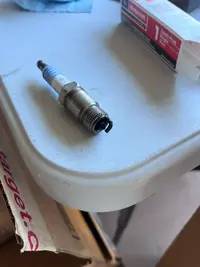
Ok back to my bunk CBT. I replaced the #7 spark plug which looked like this:

IMG_9781.webp

Reran the CBT and got code 90. All good. Engine barely vibrated/shook this time.

I didn’t remember, but the plug I took out was Motorcraft P/N ASF-42P (platinum) and the plug I put in is ASF-42C (copper). Is it ok to have a mismatched plug for a little while?