WOW, and not whishing to upset anyone BUT WHAT A LOAD OF CRAP RESPONSES. (obviously not all of them but most of them


)
Its almost embarrising being a member of this board with some of these dumn ass posts.
An engine makes X amount of BHP, if this is measured at the wheels there will be a loss due to the power required to turn the drive train, differnt lubicants/oils or worn out bearings and components will all affect the amount of friction and the amount of loss. Also the tyres will affect the results right down to the tread pattern, pressures and balance as well as size and weight of them.
Then you have atmospheric factors, altitude, temp, humidity and so on.
And then all the different rating systems (there are 10 or so different ratings of power BHP, SAE, Net, Gross, HP, PS, KW) with different correction calculations which can be used. The variance between even the HP readings could be 10hp +-.
Then there is whether the dyno is actually calibrated correctly, and whether any of the correction calculations are used and how accuratly they are.
In short ANY rolling road dyno is inaccurate to start with. This is an import fact to understand in relation to getting readings from them.
Your car may well dyno 250rwhp and a friend might only get a reading of 220rwhp but they live a 1000 miles away (hence different dyno and test conditions), there is every chance that even though they have lower numbers their car is more powerful than yous - EXCEPT IT, because its true.
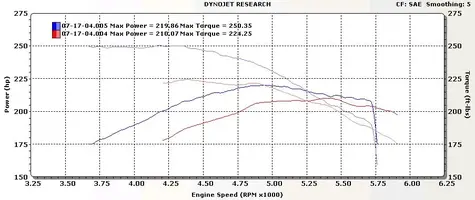
No matter what gear you are in the engine WILL ALWAYS produce the same power with the same profile (look at the dyno graph), the profile of how the power is delivered is much more important than the PEAK nummbers!!!!!!
To get a rwhp reading the dyno must induce load onto the engine, but becuase you have a gearbox which is designed to reduce load thru gearing (less effort (easier to turn) but more work (more revolutions)), the readings can become even more inaccurate.
What you need to do is select the gear that has the closest (as not all car will have one, hence comparing rwhp from different makes of cars is pointless) ratio of 1:1. One turn of the gear is equal to one turn of the propshaft. This way the load is not being increased/reduced by gearing.
So in essence a lower gear (such as 1st or 2nd) is reducing the load on the engine, which makes it easier to turn the wheels. A higher gear such as 5th maybe a ratio of less than 1 to 1 (0.x:1) will mean more effort is required to rotate the wheels with load on them. Hence a car will accelarate from 1200rpm in 1st gear faster than it will at 1200rpm in top gear.
The final drive ratio (often referred to as 'gears', such as 4.10's 3.73's) will have no bearing on this at all, as it is after the gearbox in the drive line. What it does do is have a bearing on how many rotions the propshaft makes to rotate the wheels.
So what does this mean on the dyno?
Well no matter what is done to the drive line it will have no affect what so ever on the power of the engine. So having 4.10's will not affect the amount of bhp you have. However it may dyno a different number because of many reasons, such as:
-Fresh oil and components causing a lsight reduction in firction loss through the crown wheel and pinion.
-Lower rotaing mass, if steel parts are replaced with aluminium they weigh less and require less effort to rotate them.
-And due to the gearing ratio change of propshaft rotations in relation to wheel rotaions.
All in all the change of final dirve ratio should affect the dyno numbers, but only because it is polluting already INACCURATE numbers.
It should be noted that dyno's do record accuratly, but it is not How they record it but WHAT they record. As the information (ie the hp & torque numbers) are polluted and inaccurate to begin with.
A change of final drive ratio should alter the accelaration of the car, and make it appear to have more/less power depending on which gears you went for. A numerically higher gear (4.10) is making it easier for the engine to turn the wheels, the ofset is that the wheels have to spin faster to maintain the same speed, hence you may have to be a gear higher than before to reach a particular speed. This process is finite however as if you increase the gears too much you will have a very limited low top speed in each gear, and the engine will be over revving and not being able to make use of the power it is generating.
A numerically lower gear should reduce engine rpms at set speeds, but it requires more effort to accelarate to that point, hence accelaration is slower. By going this route you should be able to theorestically increase the potential top speed, the downside is that as the gearing is higher it will require more power to acheive the same speeds, so in most cases the top speed remains constant unless a mssive power increase is also achieved.
IN SHORT DON'T WORRY ABOUT IT, IF YOU DYNO LOWER NUMBERS WITH 4.10'S JUST PUT IT DOWN TO THE PHYSICS AND BE REASURRED THAT YOUR ENGINE IS STILL PRODUCING THE SAME POWER. AND IN TERMS OF ACCELARATION YOUR CAR WILL NOW BE FASTER.


 too many people on this board care about dyno numbers. the dyno is a tool that is usefull too tune a car. who cares about peak numbers. there are just too many factors into why your buddy jimbob's 01 gt put down 244 stock and you put down 240..