

You are using an out of date browser. It may not display this or other websites correctly.
You should upgrade or use an alternative browser.
You should upgrade or use an alternative browser.
Fox Please help: Electrical load creates missfire ?!
- Thread starter martroy
- Start date

Update: I've unplugged harness from Alternator and give a try in the garage to climp up RPM higher than 2K RPM and while tuning on blower, no more misfire. Dont know if the random issue would be gone that way so I will bypass the harness temporary.
Update: I've unplugged harness from Alternator and give a try in the garage to climp up RPM higher than 2K RPM and while tuning on blower, no more misfire. I've bypass alternator connector yellow and green wire straight to alternator stud. Issue is still present in that configuration.
Based on logs, the voltage doesnt change that much. 14,5v to 14,4v and the voltmeter needle drops a bit in the dash, that's all.I think you need to check what happens to the voltage when you turn on the blower.
Update: When disconnecting harness from alternator regulator and stator (not the 4 gauge battery wire), I can't reproduce the issue on demand.
I've changed Distributor and TFI with motorcraft brand and issue still the same. Any idea on this?
Thank you very much
I've changed Distributor and TFI with motorcraft brand and issue still the same. Any idea on this?
Thank you very much
Update:
I do have battery in trunk and when I hook an electric fan just to create a load straight on the battery when at 2k RPM or higher, engine get misfire. Engine ground are good and I've used booster cable to add ground engine to chassis and I do get same issue.
When I unhook ground from battery, voltage jumps from 14,4v to 15.0v. No sure what to think on this test since regulator is 14,5v ??? Any help would be appreciated.
Thanks,
Martin
I do have battery in trunk and when I hook an electric fan just to create a load straight on the battery when at 2k RPM or higher, engine get misfire. Engine ground are good and I've used booster cable to add ground engine to chassis and I do get same issue.
When I unhook ground from battery, voltage jumps from 14,4v to 15.0v. No sure what to think on this test since regulator is 14,5v ??? Any help would be appreciated.
Thanks,
Martin

Do [not] disconnect the battery in a running fuel injected vehicle. It makes EECs go "boom".
For s and grins, run a [new] length of 4 ga cable from the battery to wherever you have the other end connected already.
Don't pull or disconnect your old cable, yet. Just run this additional cable for testing. Hell, you could use household Romex cable for this test if you wanted or jumper cables clipped end-to-end.
Could be your feed cable connections are poor, a connector swage could be bad, or even a damaged portion.
Unless you're road course racing, I'd put the battery back in the engine bay. The effect of having it in the hatch on a street light to street light car is negligible.
For
s and grins, run a [new] length of 4 ga cable from the battery to wherever you have the other end connected already.Don't pull or disconnect your old cable, yet. Just run this additional cable for testing. Hell, you could use household Romex cable for this test if you wanted or jumper cables clipped end-to-end.
Could be your feed cable connections are poor, a connector swage could be bad, or even a damaged portion.
Unless you're road course racing, I'd put the battery back in the engine bay. The effect of having it in the hatch on a street light to street light car is negligible.
Don't pull or disconnect your old cable, yet. Just run this additional cable for testing. Hell, you could use household Romex cable for this test if you wanted or jumper cables clipped end-to-end.
Could be your feed cable connections are poor, a connector swage could be bad, or even a damaged portion.
Unless you're road course racing, I'd put the battery back in the engine bay. The effect of having it in the hatch on a street light to street light car is negligible.
I dont have with me something enought long to make that test but, here's new updates
Update:
Misfire happens when there is a voltage load so it's not just blower but can be an electric fan straight to the battery (it's in the trunk)
Tests #1: I've disconnected 3G alternator (regulator and stator disconnected) while leaving main feed on the stud.
Result Test #1: Start the car and no misfire
Test #2: I've disconnected 3G alternator (main feed on the stud) while leaving regulator and stator.
Result Test #2: Can't keep engine running. Electric fan trie to starts as soon as engine starts ASE with strange noise when it shouldnt and engine stops.
2 speed Electric fan is driven with a built-in volvo relay.
Power feed is on the alternator stud
Ground is to chassis
Switched 12v is from ignition switch
Trigger fan speed 1 is from PIN 27 (IAC1B) from Megasquirt
Trigger fan speed 2 is from PIN 31 (IAC2B) from Megasquirt
When disconnecting trigger harness, I can start the car and no misfire. I do understand I get a voltage feedback that I'm not suppose to but I'm not sure how to troubleshoot that one?!
Help would be appreciate.
Thanks,
Martin
Few more test today. Fan and wires are out of equation, they are unplugged. Basically, as soon as Alternator is not charging, I cant repeat the behavior. (Unplugged B+ or Regulator or just green wire)
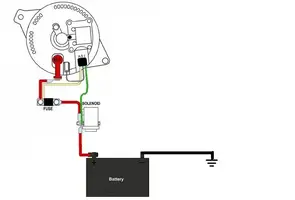
Only for testing, I've moved green wire to solenoid to avoid dash involve and here's a basic diagram. When connected like shown in diagram, alternator is charging and I get "RPM spike,misfire". Alternator has been replaced but issue still there. I've done voltage drop test from alternator case to battery ground and I do have 73 mV, what seems to me correct.
Any idea or suggestion on this please?
Thanks
Only for testing, I've moved green wire to solenoid to avoid dash involve and here's a basic diagram. When connected like shown in diagram, alternator is charging and I get "RPM spike,misfire". Alternator has been replaced but issue still there. I've done voltage drop test from alternator case to battery ground and I do have 73 mV, what seems to me correct.
Any idea or suggestion on this please?
Thanks
Attachments
Does the battery load test OK?
Are any cables getting hot?
It will act up when free revving the engine or just under load?
Are any cables getting hot?
It will act up when free revving the engine or just under load?

Mcmahst
5 Year Member
It sounds like a bad or missing ground somewhere. Maybe run an axillary ground from the battery to the engine block and car apron. Good luck.


Mcmahst
5 Year Member
My “grounds” logic is, we’re searching for a significant load change issue and a lack of proper grounds can be hiding the diagnosing the problem. We know that electrical systems are lazy and will find a grounding path if the primary one is missing/defective, etc. That’s all I was asserting.
I do have a tester and SOH and SOC were at 99%. Its a 2 years old red top optima battery.My opinion: don't add any new wires, grounds or anything,
How was the battery 'load tested'?
Voltage drop has been done and wrote in that thread.If the grounds or battery cables are of concern you can do a voltage drop test to make sure they are in good shape.
73mV from alternator case to ground battery in the trunk.
Make sense but my question is, how to troubleshoot that? LolMy “grounds” logic is, we’re searching for a significant load change issue and a lack of proper grounds can be hiding the diagnosing the problem. We know that electrical systems are lazy and will find a grounding path if the primary one is missing/defective, etc. That’s all I was asserting.
3G alternator is there since the past 10 years.Was there an issue before you added the 3G alternator?
I've never liked sticking a battery in the back of a street car.
Too much cable, more connections, more chances for stuff to go wrong.
I sure change something last winter and this season, I had that issue. From what I recall, I've revert back all my change (removed from car).
I will try battery in the front just for fun car it's sure not the problem but we will eliminate that in the diag.
Similar threads

- Replies
- 11
- Views
- 468

- Replies
- 21
- Views
- 3K
Progress Thread
mnky99 2001 V6 evap core, ac compressor, heater core replacement
- Replies
- 1
- Views
- 644

- Replies
- 46
- Views
- 3K

- Replies
- 13
- Views
- 1K