Stand alone vs chip tune (for noob)

How much for the QH and tune? I suspect it would be the cheapest and if you’re running just a basic setup would it would work just fine.


It was 850 for the tune plus the chip. So around 1000. If I went that route I was going to send my ECU in to be gone over and serviced 150. Plus my MAF recalibrate (guessing) 150. So around 1300.

For the Holley I'd be at 2500 for the basic kit, MAP, A/C harness, various sensors. Tack on another 500 for various sensors and wiring supplies.
 
Some of the things I've been learning between the Holley and ProM. Feel free to correct any errors.

------------

Ignition (if opting for optional coil near plug)


I did find out the Holley can use a cam sync assembly (replaces distributor) from a 96-01 Explorer (F7TE-12131-Aa) Because our factory distributors are effectively a cam sync and crank sensor in one, I'd have to run a dedicated crank trigger. This would eliminate dependence on OEM quality PIP and TFI. The holley can use various crank rings 36-1, 8 mag and others. I assume this is set and adjusted in the logic of the tune. So you can use balancers w/ built in triggers like Innovators West for example.

The ProM doesn't rely on the TFI at all even in the most basic kit. It uses the connection but will operate fine even with a bad TFI module. The coil on plug can be added without a crank sensor. It would use the factory distributor with a custom cover. It would still need a quality PIP and shutter wheel to operate.
Adding the crank sensor kit would require cutting off all but one of the nubs on the shutter wheel in the distriburor and mounting the trigger wheel / sensor. At that point the distributor would be soley a cam sync. It would still use the PIP, but not require as much accuracy, so any old low quality PIP and shutter wheel would operate the system fine.

Pro M only use a 36-1 crank wheel. I haven't found any balancers with a built in 36-1 trigger wheel

---------

Trigger wheel mounting

Both setups will require some planning for the trigger wheel. It's meant to be sandwiched between the balancer and pulley. Either machining or shimming would be needed to keep pulley alignment.


-----------

Wideband operation

Holley uses a single wideband. It operates in a standard arrangement where the sensor plugs directly to the computer.

ProM uses dual widebands in a somewhat odd (at least to me) arrangement where you use an aftermarket wideband kit that includes it's own controller (seperate small computer box). The wideband controller plugs into the ProM computer. They use Innovate widebands kits. Reviews seem mixed.

--------


Support

Holley is much more popular. I've found a few places that will tune a Holley setup just in a few days of actaully lookomg amd calling around. One even has a driveway service where he'd work in my garage with me if i had an issue. Definitely a bonus.

ProM isn't as well known. I haven't found any local support or anyone that will tune it.


---------


Wiring

Holley has a basic harness kit and there is an A/C harness available from Fatman. It's fairly fox specific but still requires dissecting the factory harness and stealing parts of it. So if you have a nice un-molested harness it's gonna be cut up. No going back. I'll have to dig deeper to exactly what it's cannibalizing from it. Maybe it's possible to source the connectors and scratch wire it to save the original harness.

ProM comes with a complete wiring harness that is totally plug and play for everything. No slicing. Save old harness.


---------


Tuning

The Holley will require tuning initially and anytime you do any mods, upgrades.

ProM claims it doesn't. And being MAF it should adapt to changes like our cars currently do but with a modern higher capability computer. So in theory it should never need a tune as long as you program what you changed in the logic. Example add a stroker kit, change that in the settings, good to go. In theory.

I'll add to this as I go.
 
This is what I was looking for. Thanks.


That's pretty much what I figured. I'm assuming most of the complaints are from those with sketchy installs and just relying on the system to "auto tune".


Excellent. This guy isn't far from me at all. 35 minutes tops. Never even knew he was there. This is exactly what I was hoping for. :cheers:


Another advantage of the Holley is without the mass air boosted applications could just use a typical blowoff valve i would imagine.
Yes they can , I run a tial 50mm on my ysi

The auto tune is really just fancy name for closed loop fueling and it’s great so long as the base tune is great as well.
 
  • Like
Reactions: nicholase
You can make changes to your car with Holley within reason and not need a major re tune. Hell I’ve swapped injectors and just plugged data In and kept on rocking.

I put a 90mm throttle body on with a ported intake throat and just barely had to adjust some stuff

Put the billet wheel in my blower and can see the fuel usage is up in the correction but I didn’t have to touch the base fuel to see that . I just added a pinch of fuel where it wanted it.

I highly doubt you don’t have the touch the pro m. The Holley will run off a tfi or a basic msd dual sync or 6 al you don’t need anything fancy.

I can’t understand how the pro m will run the tfi with a bad module it sort of goes against the principle of how the tfi works but there are people who are much smarter then me out there. So I am curious but suspect on that.
 
  • Like
Reactions: nicholase
I highly doubt you don’t have the touch the pro m.
That's pretty much what I'm assuming, and not having anyone local to tune it isn't great. Ideally I'd get either system dialed in by a pro amd then goof around and learn about it as i go.


I can’t understand how the pro m will run the tfi with a bad module it sort of goes against the principle of how the tfi works but there are people who are much smarter then me out there. So I am curious but suspect on that.

This is how it's explained in the promo video. I loaded the video to start at the ignition section which is interesting and talks about all this stuff. The info about the lack of TFI is at 26:31.

 
Last edited:
It was 850 for the tune plus the chip. So around 1000. If I went that route I was going to send my ECU in to be gone over and serviced 150. Plus my MAF recalibrate (guessing) 150. So around 1300.

For the Holley I'd be at 2500 for the basic kit, MAP, A/C harness, various sensors. Tack on another 500 for various sensors and wiring supplies.
Holy :poo:ballz, bud! I took a bit of risk and got a QH with a dongle (licenses) for Binary Editor & Engine Analyzer for $250. Only other thing you *should* get is a $70 J3 chip & something to write to it, like the $85 Jaybird I bought. So, altogether the 'base' cost for me was $405. From this point, it would only cost me a new J3 chip, each time I tuned another fox.

I have some advantages in my familiarity with computers, foxes, and having tuned both the stock and other computers before, but anyone with the time, inclination, and a good internet connection could do it, too.

Now, I am doing ok for myself and I wanted some extras, like a dedicated spare A9L EEC to use with the Quarterhorse, & a Wideband O2 Sensor and Gauge to make tuning easier & for monitoring/diagnosing any issues with driveability afterwards.

Alright, so that said, your comment of $1.3k for the QH tune was kinda out there for me. I would think that if you could find someone who tunes using a QH, you could get this done for quite a bit cheaper. You don't strictly need a QH, a wideband, an ECU refresh, and you definitely don't need an MAF recalibration at all, unless something is wrong. So, what you'd need is to pay someone for their time in tuning your car & a J3 chip, with or without a dyno session, if you went that route. I've paid as much as $1k for a crappy WOT dyno session tune, which I would not do, again. I would think that a solid tuner should be able to do something like that for $500 in a few hours on a dyno and feel pretty good about the return on their time.
 
As to the other two, the general advice I've always been told is to pick the system your tuner is most familiar with. Generally speaking, at this moment in time & in America, the Holley is probably the way to go, as support for it is the most widespread. My only reference on the Pro-M is a guy I've run into at foxtoberfest for a few years started with it, but then chose to pull it and put the Holley in. All of that said, I'm impressed with your level of research, and I think you have the capacity and passion to figure this out for yourself. In that case, what do you want to spend your time learning?

I've got a couple cars with the same Big Stuff 3 standalones in them, but if I were doing another one now, I'm currently most inclined towards the Holley Dominator. That said, I haven't taken installing a standalone seriously in 17 years. The Holley, as you describe it, sounds just like my Big Stuff setups. In one, I currently have a crank trigger after recent discussions I will probably install a cam synch. You only really need the cam synch if you want to do individual cylinder injector timing & fuel trims. If memory serves, individual cylinder ignition timing is still possible without it.

The other car with the BS3 still runs off of the PIP & TFI. Both are Speed Density and both run off of 1 WB O2 gauge, and though I think there's a way to run more than 1, there is no need to in my case where the exhaust coming out of the single turbo is already blended together by the time it gets back to the O2 sensor.

Between Speed Density & MAF tuning, I suppose I slightly prefer speed density. The major advantage of these systems, as opposed to the stock A9L with a piggyback like the quarterhorse, is the ability to provide closed-loop feedback from a wideband, the ability to immediately trim fuel as much as 25% in either direction in closed-loop, and the ability in the case of the one on the crank trigger to spin to any RPM limit the motor is mechanically capable of.

Driveability was pretty darn good in one of my speed density cars, and I was/am still working on it in my other car where there's a little off-idle stumble & a brief lean-condition between shifts. In my daily driver with the stock EEC & QH, driveability is best, and that's probably because Ford spent a lot of time getting it right, and I started with the A9Ls stock tune. So, I got the benefit of starting with all of the transient fuel trims, fuel/spark tables, IAC adjustments, and so on that Ford figured out. That's ok for my daily because it's still a mild 302, but it would be unrealistic on my ~1k rhwp 331 & 363 with completely different induction setups.

Earlier, you asked how the stock EEC could properly define ignition and fuel trims when at boost. I've never done one on the QH, but from what I've seen, the trick is to define load without the blower. This is done by reviewing the datalog of a pull naturally aspirated, reviewing the load curve, and plugging that into Ford's "Per Load" (percent load) table. Essentially, the EEC knows what the engine's maximum air-mass is for a given RPM and when it sees that, calculates that it's at ~100%. Then, when the blower is hooked up, the calculation shows an air mass above that, and it calculates a higher percentage. I don't know what the max is, there, but something in my memory says that it may be good up to 200%. Anyways, in other tables, you can control the y-axis and tell it what to go up to. At 10 psi, you're likely to see (14.7 + 10)/14.7 = 168%. So, you'll want to set the table with a buffer above that to deal with the unexpected -- you NEVER want to go beyond the upper limit or you're adding air without adding fuel.
 
All of that said, I'm impressed with your level of research, and I think you have the capacity and passion to figure this out for yourself. In that case, what do you want to spend your time learning?
Thanks for all that. I'm just not sure I'll have the time to do a standalone the way I'd want to this winter. I just have to many irons in the fire. Currently doing a MM suspension, full brake system replacement with big discs, and likely some engine mods. Installing and learning a stand alone just feels rushed this winter.

I'm going to continue to learn about this stuff because I like to. It's a hobby for me.

At this point in time I believe I'm going to go with Quarterhorse.
 
Some of the things I've been learning between the Holley and ProM. Feel free to correct any errors.


Wideband operation

Holley uses a single wideband. It operates in a standard arrangement where the sensor plugs directly to the computer.

ProM uses dual widebands in a somewhat odd (at least to me) arrangement where you use an aftermarket wideband kit that includes it's own controller (seperate small computer box). The wideband controller plugs into the ProM computer. They use Innovate widebands kits. Reviews seem mixed.
The Holley can use dual wide bands. They plug directly into the computer. The first one is already wired, the second one has to be wired in. Once wored in, it is then plug and play.
It can pretty much do anything.
Want to fire 16 or 24 fuel injectors? No problem.
Want multiple tunes? No problem.
Name something you want to datalog, anything, the Holley can do it.
Obviously, adding all of this stuff adds complexity to the system.
The learning curve can be steep, depending on your personal knowledge of how a Holley system works.
The directions assume you know how the system works.
 
Last edited:
  • Useful
Reactions: nicholase
Yea that seems expensive for a dyno tune. FWIW, You can get a remote QH tune for $500. Obviously dyno tuning is MUCH easier so the added $350 may be worth it if the tuner is good. You shouldn’t need to get the maf recalibrated, this can be accommodated for in the tune.
 
I run 2 cars on holley and happy with the both of them. The cruiser has a terminator X and the sporty cruiser had a HP now has a dominator waiting to install. I have been using holley efi since 2012 never a hickup and only a couple wideband sensor failures likely due to Q16. Proven to be a great system in every way. For your car unless you are planning on racing it a terminator x would be more then enough. Reason I say that is the lack of internal logging is a bit of a pain if you were trying to dump the data after each pass. A simple dual sync distributor will also be sufficient and make it easier in every way for you including on the wallet
 
If i'm not mistaken he went with the ProM system? I think he has discussed it in his Progress Thread.
About to go and check out his thread as well. Did you install a boost gauge and did you use the plastic tube or the rubber hose? People are saying that I've read don't use that plastic because it will become brittle over time.

Researching now because I read where one guy on the corral said to use a brass fitting/barb to attach the hose on the back of the gauge but I'm wondering if the I.D. of the hose need to be the same size as the plastic tube?
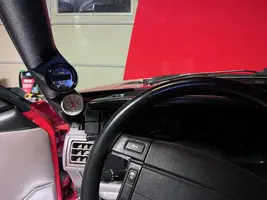
 
About to go and check out his thread as well. Did you install a boost gauge and did you use the plastic tube or the rubber hose? People are saying that I've read don't use that plastic because it will become brittle over time.

Researching now because I read where one guy on the corral said to use a brass fitting/barb to attach the hose on the back of the gauge but I'm wondering if the I.D. of the hose need to be the same size as the plastic tube?
I do have an Autometer Boost Gauge. I used the white-ish plastic hose that came with my gauge. I'm sure it would take a long ass time for it to become brittle. The brass fittings come with the gauge and work perfectly with the plastic hose that comes with it.

Boost gauge below, AEM wideband gauge above:

Fox Gauges.webp
 
I do have an Autometer Boost Gauge. I used the white-ish plastic hose that came with my gauge. I'm sure it would take a long ass time for it to become brittle. The brass fittings come with the gauge and work perfectly with the plastic hose that comes with it.

Boost gauge below, AEM wideband gauge above:

Fox Gauges.webp
Gotcha.

Yeah I guess I just want to do it once and don't have to worry about you know messing with it later on down the road and I don't know if it breaks when you're under boost or something if anything bad will happen.

I got three gauges on a pot already in my '94 and so I will buy the instrument cluster little bezel that holds two and then a steering wheel hard. I just have to decide which one goes on the steering wheel