

How much for the QH and tune? I suspect it would be the cheapest and if you’re running just a basic setup would it would work just fine.
How much for the QH and tune? I suspect it would be the cheapest and if you’re running just a basic setup would it would work just fine.

Yes they can , I run a tial 50mm on my ysiThis is what I was looking for. Thanks.
That's pretty much what I figured. I'm assuming most of the complaints are from those with sketchy installs and just relying on the system to "auto tune".
Excellent. This guy isn't far from me at all. 35 minutes tops. Never even knew he was there. This is exactly what I was hoping for.
Another advantage of the Holley is without the mass air boosted applications could just use a typical blowoff valve i would imagine.
That's pretty much what I'm assuming, and not having anyone local to tune it isn't great. Ideally I'd get either system dialed in by a pro amd then goof around and learn about it as i go.I highly doubt you don’t have the touch the pro m.
I can’t understand how the pro m will run the tfi with a bad module it sort of goes against the principle of how the tfi works but there are people who are much smarter then me out there. So I am curious but suspect on that.

HolyIt was 850 for the tune plus the chip. So around 1000. If I went that route I was going to send my ECU in to be gone over and serviced 150. Plus my MAF recalibrate (guessing) 150. So around 1300.
For the Holley I'd be at 2500 for the basic kit, MAP, A/C harness, various sensors. Tack on another 500 for various sensors and wiring supplies.
 ballz, bud! I took a bit of risk and got a QH with a dongle (licenses) for Binary Editor & Engine Analyzer for $250. Only other thing you *should* get is a $70 J3 chip & something to write to it, like the $85 Jaybird I bought. So, altogether the 'base' cost for me was $405. From this point, it would only cost me a new J3 chip, each time I tuned another fox.
Thanks for all that. I'm just not sure I'll have the time to do a standalone the way I'd want to this winter. I just have to many irons in the fire. Currently doing a MM suspension, full brake system replacement with big discs, and likely some engine mods. Installing and learning a stand alone just feels rushed this winter.All of that said, I'm impressed with your level of research, and I think you have the capacity and passion to figure this out for yourself. In that case, what do you want to spend your time learning?


The Holley can use dual wide bands. They plug directly into the computer. The first one is already wired, the second one has to be wired in. Once wored in, it is then plug and play.Some of the things I've been learning between the Holley and ProM. Feel free to correct any errors.
Wideband operation
Holley uses a single wideband. It operates in a standard arrangement where the sensor plugs directly to the computer.
ProM uses dual widebands in a somewhat odd (at least to me) arrangement where you use an aftermarket wideband kit that includes it's own controller (seperate small computer box). The wideband controller plugs into the ProM computer. They use Innovate widebands kits. Reviews seem mixed.
Yeah, thats an option too.The stand alone is easy to install so call it an early summer project and you can actually tune it while the weather is good.


About to go and check out his thread as well. Did you install a boost gauge and did you use the plastic tube or the rubber hose? People are saying that I've read don't use that plastic because it will become brittle over time.If i'm not mistaken he went with the ProM system? I think he has discussed it in his Progress Thread.
I do have an Autometer Boost Gauge. I used the white-ish plastic hose that came with my gauge. I'm sure it would take a long ass time for it to become brittle. The brass fittings come with the gauge and work perfectly with the plastic hose that comes with it.About to go and check out his thread as well. Did you install a boost gauge and did you use the plastic tube or the rubber hose? People are saying that I've read don't use that plastic because it will become brittle over time.
Researching now because I read where one guy on the corral said to use a brass fitting/barb to attach the hose on the back of the gauge but I'm wondering if the I.D. of the hose need to be the same size as the plastic tube?
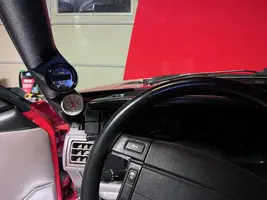
Gotcha.I do have an Autometer Boost Gauge. I used the white-ish plastic hose that came with my gauge. I'm sure it would take a long ass time for it to become brittle. The brass fittings come with the gauge and work perfectly with the plastic hose that comes with it.
Boost gauge below, AEM wideband gauge above:


