Help me create the "Surging Idle Checklist"

Can a leaky header/h-pipe flange cause surging? I got a pretty loud leak from under there and I was wondering if air is getting in there and contaminating the exhaust around the O2 sensors. I've got BBK LT's and h-pipe, and the o2 sensors are only about 3 years old (Bosch). Also is there any way to stick a gasket in the ball flange?
 
vikingpower said:
Can a leaky header/h-pipe flange cause surging? I got a pretty loud leak from under there and I was wondering if air is getting in there and contaminating the exhaust around the O2 sensors. I've got BBK LT's and h-pipe, and the o2 sensors are only about 3 years old (Bosch). Also is there any way to stick a gasket in the ball flange?
No.

There is always pressure inside the exhanust system. There is no way you can suck air into the exhaust on a running engine. The exhaust will be pushing gases out any leaky joint it can find.
 
Well this is my first interaction in these forums. Thank you for this thread I've been fighting with surges for a long time now. I tried all what is mentioned with non or little success and my next move will be to splice once and for all the "Salt/Pepper" connectors to eliminate any loose, wet or corroeded connections.
 
JR - just a suggestion for some clarification on the first post in this ultra cool thread.

Item 13 reads
13.) Mismatched MAF and injector size. The MAF must have a matching flow rating for the injectors. If you have 24 lb in injectors, you need a 24 LB MAF. The Cobra computer is the exception to this rule, since it uses a 19 LB MAF & internal tables to modify the fuel curve. Some aftermarket devices can modify the mismatch, but they are not very common.


This could be somewhat misleading as...
In the 93 Cobra setup the MAF, MAS, fuel injector size, and the actual Calibration File in the Cobra computer were all different than the A9* series computers. The 93 Cobra is its own beast.

Of course running an aftermarket MAF or larger injectors will change things, as you already stated.

Off topic -
I am about to find out how well this applies to an SD N/A 2.3L 87 Mustang.

jason
 
idle woes

ok the iac, or idle air control valve, you said, unplug it, start car, adjust to 600 rpms? well my car wont even idle with it unplugged. so should i turn the iac upside down? it is an aftermarket sensor so maybe thats why since replacing it, my cold idle sucks!
 
ok the iac, or idle air control valve, you said, unplug it, start car, adjust to 600 rpms? well my car wont even idle with it unplugged. so should i turn the iac upside down? it is an aftermarket sensor so maybe thats why since replacing it, my cold idle sucks![/QUOTE]
 
vanwilder692 said:
ok the iac, or idle air control valve, you said, unplug it, start car, adjust to 600 rpms? well my car wont even idle with it unplugged. so should i turn the iac upside down? it is an aftermarket sensor so maybe thats why since replacing it, my cold idle sucks!
[/quote]

You may have to turn the throttle set screw a little to get to where you can idle.
 
vanwilder692 said:
ok the iac, or idle air control valve, you said, unplug it, start car, adjust to 600 rpms? well my car wont even idle with it unplugged. so should i turn the iac upside down? it is an aftermarket sensor so maybe thats why since replacing it, my cold idle sucks!

jrichker said:
This isn't the method Ford uses, but it does work. Do not attempt to set the idle speed until you have fixed all the codes and are sure that there are no vacuum leaks. Warm the engine up to operating temperature, place the transmission in neutral, and set the parking brake. Turn off lights, A/C, all unnecessary electrical loads. Disconnect the IAC electrical connector. Note the engine RPM: use the mechanical adjustment screw under the throttle body to raise or lower the RPM until you get the 600 RPM mark +/- 25 RPM. When you are done, reconnect the IAC electrical connector. Changing the mechanical adjustment changes the TPS, so you will need to set it.

Turning the IAC upside down won't help much if you can't set the mechanical base idle speed.
 
vanwilder692 said:
ok the iac, or idle air control valve, you said, unplug it, start car, adjust to 600 rpms? well my car wont even idle with it unplugged. so should i turn the iac upside down? it is an aftermarket sensor so maybe thats why since replacing it, my cold idle sucks!
You do have a hot motor and all accessories turned off when you try to let it idle with the IAC disconnected, right? I had to ask.

Good luck.
 
My car has the hanging idle and a tiny surge, the idle hangs for like 2 to 5 sec, I notice when i unplug the IAC the idle does not change, so i'm assuming this might be part of the problem, the IAC looks to be from a parts store and looks brandnew. Should i try another local parts store one , Or is the ford one from the dealer really better?, I was looking in cj pony parts catalog and it says they need a code No. from inside the door jamb when ordering one from them, do i really need this code to order one? becuse my car was converted from a 4cyl when i bought it.
 
The first post contains all the updates to the fixes. I continue to update it as more people post fixes or ask questions. Pay special attention to the setting base idle speed section.
 
does anyone know if the ACT sensor will creat surging idle and driving too??? like driving slowly in 1st gear?

I've had limited time with the car because it's been in and out of the tranny shop...so I've lost allot of time to narrow this checklist down...:(
 
A surge/bucking in first gear is not uncommon at just off idle. The engine may try to stall and speed up. Any tendency to surge may be amplified by the load of moving the car with light or no pressure applied to the throttle.
 
I think I found my surge issue:

15.) EGR leaking or partially open. An EGR that doesn’t seal or has vacuum applied when the engine is at idle can cause rough idle. Look for EGR code 34 in this case. Disconnect the EGR vacuum and cap the line and observe if the idle improves.

Carbon between EGR the pintle valve and seat can hold the valve off its seat. Remove the EGR valve and clean it with carbon remover. Prior to re-installing see if you can blow air through the flange side of the EGR by mouth. If it leaks, there is carbon stuck on the pintle valve seat, replace the EGR valve ($85-$95).
If I take the vacume line off and plug the vacume line, then my idle is perfect now. So; can I just replace the EGR Sensor/EGR valve? is there both the sensor and the valve in this assembly?
 
Follow the instructions and see what happens. If you can blow through the EGR after cleaning it, replace it. The EGR vavle is $85-$95 and the sensor is $15-$25.

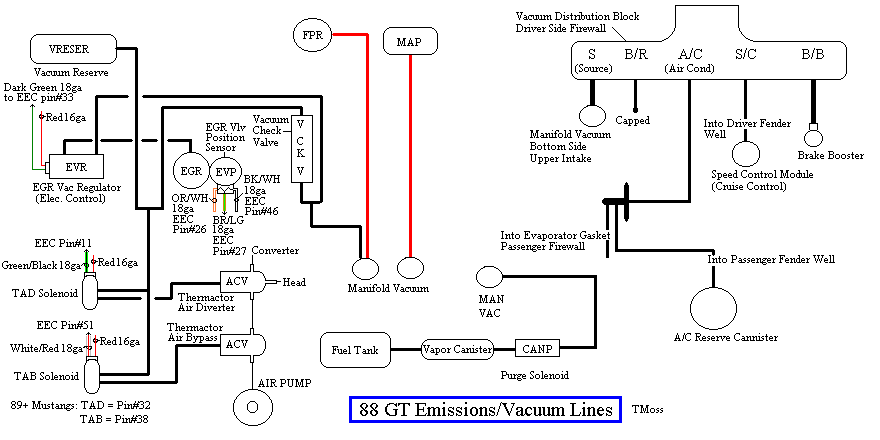
The EGR system has a vacuum source (line from the intake manifold) that goes to the EVR, computer operated electronic vacuum regulator. The EVR is located on the back of the passenger side shock strut tower. The computer uses RPM, Load. and some other factors to tell the EVR to pass vacuum to open the EGR valve. The EGR valve and the passages in the heads and intake manifold route exhaust gas to the EGR spacer (throttle body spacer). The EGR sensor tells the computer how far the EGR valve is open. Then computer adjusts the signal sent to the EVR to hold, increase or decrease the vacuum. The computer adds spark advance to compensate for the recirculated gases and the slower rate they burn at.

There should be no vacuum at the EGR valve when at idle. If there is, the EVR (electronic vacuum regulator) mounted on the backside of the passenger side wheelwell is suspect. Check the vacuum line plumbing to make sure the previous owner didn’t cross the vacuum lines.

Diagram courtesy of Tmoss & Stang&2birds.
88Stang5.0Vacuum.gif
 
I have a vacume line comming form the back of the upper intake going directly to the EGR...so that's wrong then!

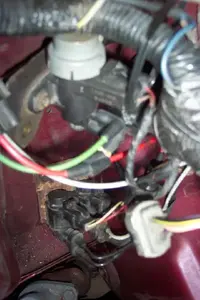
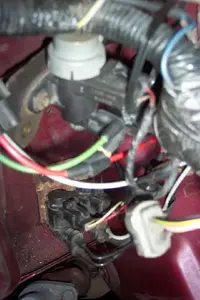
so; I found the EVR and it has a rubber vacume piece w/ one not being used, and two valcume lines going to similar canister like vacume things, and then from there it goes to the in the fender vacume ball, and then to the 3 tier vacume piece, and then to the vacume tree which is then hooked up to the intake.

vacume%20003.webp


so; should there be a vacume line where there's a blank vacume part here not be used, and go to the EGR?

vacume%20001.webp


vacume%20002.webp
 

Attachments

  • vacume%20003.webp
    vacume%20003.webp
    6.7 KB · Views: 209
  • vacume%20001.webp
    vacume%20001.webp
    41.6 KB · Views: 231
  • vacume%20002.webp
    vacume%20002.webp
    20.5 KB · Views: 240
On your picture of the EVR, the red vacuum line should connect to manifold vacuum. The green vacuum line should conncet to the EGR valve.

On my car, there is a 4 way rubber splice connector. The red line connects to a black vacuum line that goes to the manifold vacuum. The green line connects to a white line that goes to the EGR valve. You car is a conversion, so the splice may not be present.

vacume%20002.webp
 

Attachments

  • vacume%20002.webp
    vacume%20002.webp
    20.5 KB · Views: 215